Showing posts with label publishing. Show all posts

Triumph at the End of a Rocky Road


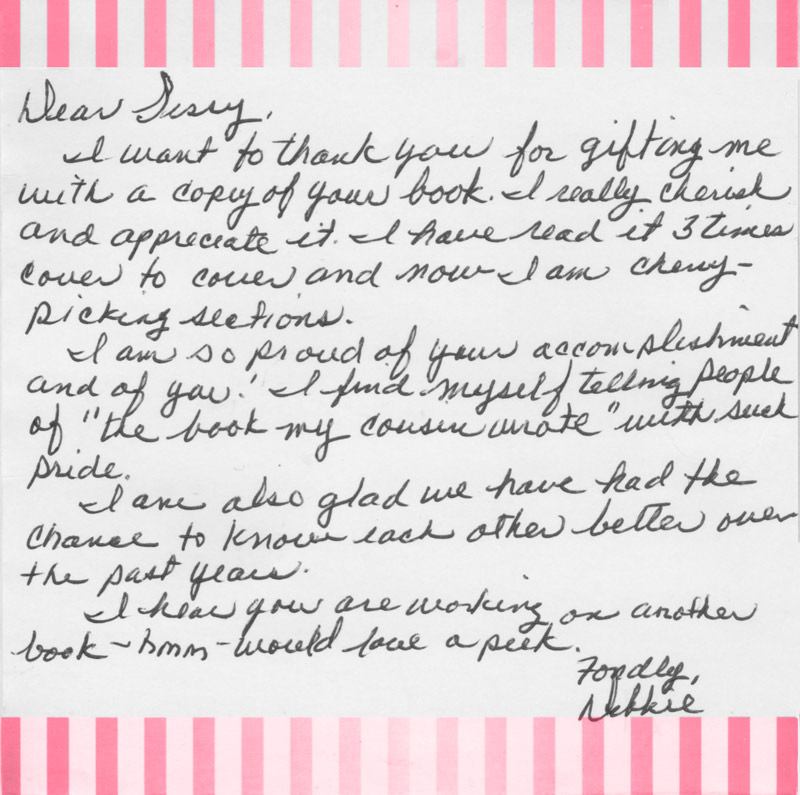
The note above shows one of a rapidly growing list that Carol B has received from family members after privately publishing a volume of family history laced together with relevant aspects of her personal story. She swells with happiness at each one. These notes are more than usually rewarding. The road to this outcome has been rocky. Her stories sizzle with intrigue. That eventually presented a problem.

Carol, her parents, and a family friend (I omit her full name at her request to protect her family’s privacy), spent decades gathering stories and documents from county records and other sources, documenting purchase and sale of property, births, deaths and marriages, police and jail records, newspaper articles and pictures. Piles and piles of pictures. She took careful notes as relatives chewed the fat at family events.  She even sought out help from her local historical society to gather added information.

Eventually she wove memories and facts into stories. Lifestory writing group members pointed out unclear areas, missing material and more. Her strong writing grew polished in both content and structure. Then forces of darkness emerged.

Her family’s history includes mayhem, madness and murder. It’s all a matter of public record, and mostly forgotten, though ripples remain in family attitudes and traits. Still, she was loathe to publish it all without warning the family. She told everyone whose names appeared in the book what she was up to and asked their permission to share stories relevant to their immediate family members. With the exception of one person within her family, she was offered nothing but support and encouragement.  She did not have anyone else read her book, as she was not willing to write a book by committee.  As it turned out, the faith that family members had in her was almost unanimous. Others showed their trust by giving full permission to use their names and their particular family stories.

However, there was one family member who, without even reading the book, objected on principle. “There is no reason to dig all that stuff up again.”  Said Person would not discuss it with Carol and did not respond to numerous requests to be named in the book, then cut off  direct communication.

Carol’s inner critic went nuts. What if I’m sued?  Maybe I’m too critical. Maybe my book is too negative.  Even if I do expose the people in my book to public scrutiny, these are the stories of my family. What should I do?

Her voice had the sound of defeat as she told me, “That person has gobs of money and can afford to sue me on a whim. Maybe that will happen. Maybe I should just drop it. Maybe I should just share the Word file with anyone who wants to read it.”

“You’ve told dozens of people you’re doing this, and they all want to see it finished. What about them? Will you be letting them down? You’ve set aside funds to see it through. How can we work around this?”

Note to readers: don’t try to handle this alone. Get plenty of perspectives. 

“Do you think I’ve been too critical?  Is my book too negative?”

“NO! But I’m not always the best judge of emotional tone. Let’s get one more opinion.” I recommended another writer I know who excels in this area. Her response was supportive. Carol regained her grip.

She decided she would proceed with the project with these caveats:
  • She omitted all references to Said Person beyond a couple of picture captions where she cites the relationship without a name.  She decides to include a vintage photo of Said Person, but includes only a first initial and maiden last name.  To do otherwise would have made her uncomfortable, since she did not want to purposefully leave anyone out of the family history.  She also decided to mail Said Person a copy of the family history book. To date, there has been no acknowledgement of receipt though communication on other subjects has been resumed. 
  • In the Acknowledgments she states: “I have remained faithful to the stories that were passed down through the family and relied on my own memories and those of other family members for additional tales. Throughout the process, I maintained my belief and intention to cause no harm.”
  • The back cover includes a disclaimer of sorts: “… For decades she has collected stories from relatives and public records. She compiles those stories with personal reflections to tell the family’s story with truth and honesty to the best of her understanding.” 

She also firmed up her decision to keep publication as private as possible.

This last step required thinking out of the box. Carol is facing serious health problems and wants to ensure that her extended family will be able to independently order additional copies for years to come.

In line with her decision to keep the book private, she vowed to avoid all promotion and publicity. She is eager, however, for others to know of her experience, even though they won’t be reading the book. Buoyed by the outpouring of gratitude from family members, such as the note above, she has asked me to share that story, hoping to inspire others who battled doubts about sensitive disclosure to persist and find their own way around obstacles.

I’m happy to oblige, emphasizing to readers that publishing privately with limited distribution can be a strong and rewarding option for those who shy away from telling all to the world at large.

As the fan letter notes, Carol is hard at work on a second volume, a personal memoir. Will this one also be kept under wraps? Who knows? If she opts for open publication, you’ll be among the first to know.

Points to Ponder: What tense material might slow down your writing project? What creative workarounds can you come up with? Who can you turn to for support and fresh ideas?

Points to Ponder: What tense material might slow down your writing project? What creative workarounds can you come up with? Who can you turn to for support and fresh ideas?

Chili or Chile? Check It Out

Chile-ristraAdventures of a Chilihead is the title I chose ages ago for what I intended to be a story album or themed collection of short stories about my experiences eating hot chili peppers and other blow-your-head-off food. As usual, getting the book pulled together is an adventure itself as it morphed from loose stories to mini-memoir, and part of that adventure includes resolving a quandary about the proper spelling of the main subject.

More years ago than I can remember, my father sorted me out on the proper spelling of chile. “Chile is a country in South America. We eat chili!” He grew up in New Mexico, staying there until he was a grandfather. He’s a reliable trivia consultant and can always back up his opinions, so as far as I was concerned, that settled it. I consistently used the correct spelling in my manuscript.

Or so I thought. I follow a couple of Facebook groups populated with people who grew up in Los Alamos. On a whim, I posted a request for comments testifying to their love of chili. Results were completely unexpected. A few posted short comments about their love of chili, their favorite varieties and so forth, but far more made sure I know the New Mexican way to spell CHILE!

The word was originally adapted by the Spanish explorers from Mexico’s native Nahuatl term, “xilli” o(alternately spelled “chilli”). The Spaniards adapted it as chile, which was subsequently rendered chili in American English. The Brits, whether by design or fluke, stuck to the Nahuatl spelling, chilli. Although most of the United States accepts chili as the proper spelling, many southwesterners assert that the word is of Spanish origin, hence the Spanish spelling should be retained.

New Mexicans are especially assertive about this, and on November 3, 1983, Senator Pete Domenici, R-NM, had a statement read into the Congressional Record 129 (149) entitled “The correct way to spell chile.” However, I know of no resolution introduced or legislation passed, so the question continues to loom.

Not relying strictly on a well-informed, but possibly biased, sample, or grandstanding Congressional hoopla, I turned to my own definitive resource, a decades old publications from the New Mexico State Agricultural Extension Service. The title says it all: CHILE.

You may wonder why I’m taking such pains to detail all this. Why I don’t just quietly make the change? Because of the cover. I’d like to be true to my roots, but I also want an instantly recognizable title. So, I’m asking you to help me decide. Please look at the two images below and leave a comment to tell me if you see any reason to stick with Chilihead rather than changing to Chilehead.

Chilehead

Chilihead

Stay tuned for more of the writing adventure.

Write now: make a list of colloquial terms specific to the area where you live or grew up. Select a couple of related ones to include in a story, and consider how to make them clear to your readers while remaining true to your roots and voice. Do any necessary research to support your usage. Involve others who share those roots.

Writing Compelling Description

frontcover 600The Heart and Craft family of fine publications has expanded. Today marks the official debut of The Heart and Craft of Writing Compelling Description.

Chapters in this book may sound familiar to some. Each of the forty-eight chapters appeared as a post on this blog. Many may wonder why I published this book when all the content is available online. Here’s the story.

I already had a short anthology of description-related posts that I’ve used in various ways over the past few years. One gray January day, I whimsically decided to transform that document into a $.99 Kindle short. I thought it might take … maybe three hours. That was three months ago!

Many of my favorite posts were missing, so I sorted through nearly six hundred posts. Forty-eight made the cut. Next I shuffled them into some semblance of order, checked for dead links, and double-checked permissions for graphics. Sharing on a blog  the public can read for free is one thing. Using images in a for-profit publication is another. Some had to be changed. The posts needed more editing than I realized. A volunteer team of friends and writing group buddies offered  remarkable suggestions and the quality improved.

As I struggled with the introduction, I had an epiphany about the entire process of writing description:

Description is anything that shapes the reader’s perception of your message or story.

That insight blew out the walls of  my boxed-in concept of description as adjectives, similes and metaphors, opening a universe of creative options I had not previously noticed in those posts as I wrote them.

As the collection grew, friends convinced me this project had outgrown the original $.99 intention. They wanted to have a collection of those posts at their fingertips where they could easily refer to them, so I crafted a print version and turned to Amazon’s free CreateSpace publishing service as my printer and distributor.

During the ensuing weeks, various cheerleaders, with Gutsy Sonia Marsh at the fore, held my feet to the fire to develop a cover everyone was happy with. Writing group friends helped with content edits. Thanks especially to Elizabeth Kim, Carol Broz and Tom Imerito. How I valued their help with the book description! Who thinks about these aspects of publishing?

Hillary Clinton coined the phrase “It takes a village.” That phrase is equally true of publishing. Anyone can write a book, but it takes a village to ensure it’s a solid, well-written, well-crafted book the world can benefit from. I especially appreciate enthusiastic “beta readers” who have (or soon will) post reviews. I can’t begin to describe the sense of elated humility I feel as I read those reviews and personal comments.

The biggest differences between publishing this book and The Heart and Craft of Lifestory Writing (released seven years ago) is that this time I made final decisions on everything, and I control the business end. Even that book was a non-traditional experience. Although the earlier cover was professionally designed, it built on my concept, and I did all layout – an unheard-of arrangement when working with a traditional publisher. I love doing layout!

Controlling graphics for eBook conversion had a steep learning curve. I’ve now tamed that beast, and I can save you a lot of time if you ever need to know the secret.

Thanks again to all who have helped along the way, and I hope everyone else finds as much value in this new volume as you have!

Write now: I invite you to click over to Amazon and use the “Look Inside” feature to read the introduction to The Heart and Craft of Writing Compelling Description, and skim the reviews. Then either buy a copy of this new book and write a review. Or find a book you’ve recently enjoyed and review it. Reviewing is the best way to find hidden insights you missed on the first reading and milk even more goodness from the volume. It builds community with other readers, past and potential, as well as the authors.

Writerly Resolutions for 2013

2013-GoalsWriters benefit from New Year Resolutions as much or more than anyone. I realize we are already four days into the year, and for many, thoughts of resolutions last about as long as ice cubes in New Year’s Eve drinks.

But it's not too late. Durable, productive resolutions take time to craft. Besides, you need to do more than write two or five words about an outcome. You need to use your writerly skills to flesh out that description. Tell yourself or the world what it will look like, taste like, feel like (both tactile feel and emotional), and so forth. Then draft at least a rudimentary plan of getting from here to there, so you can track your progress.

I have two goals I’ll mention here. One is relatively new. In November I featured a guest post by Elizabeth Kim, who wrote about her experience publishing two Kindle Short eBooks, Dancing In the Rain and What My Mother Didn’t Know. Each of her books is what I refer to as a story album. Each is comprised of six or seven poignant and touching short stories that focus on a common theme.

This was not a new idea to me – I include instructions for compiling story albums in The Heart and Craft of Lifestory Writing – but I have not, to date, published one of my own. Now that it’s become easy to do this in eBook format, it’s time to get the show on the road. I already had four stories about my adventures as a chilihead (someone addicted to the endorphin rush that follows hot chili intake and considers a day without chili rather like a day without sunshine). I have resolved to finish three more and publish this eBook story album by … April?

Process: finish drafting one story, then draft the other two on the list. Edit all three. Compile all seven stories into a single document, format, upload to Kindle and Smashwords. Celebrate.

I’d be more specific about dates, but my second goal may nudge this one aside. I have firmly resolved that this is the year I will finally finish the book on sensory description that I began a couple of years ago. Delays have made the content richer, and now it’s time to finish it and send it out to the world.

Surely you’re curious about this second project. I hope so! I’m working on finalizing the content, and will be announcing the title shortly with the advent of a Facebook page for it. You’ll be hearing more about it here, and I’ll be having book-related events. Stay tuned for details and excerpts! Subscribe to the blog if you haven’t already so you won’t  miss a post about it.

Write Now: Set at least one writerly goal you want to accomplish by the end of 2013. This may be a goal to write twelve stories, one a month. It might be to finish the draft of a memoir. It might be to journal at least five times a week through the year, or complete a story album of two dozen stories. Whatever it is, be sure you do believe you can complete it. Then write a description of the completed project, as discussed above, and create a simple outline of steps to get from here to there.

Barbara Tate’s West End Girls

westendgirls_largeGuest post by Harry Bingham gives some prepublication back story from an agent’s perspective showing the need to keep ourselves in our story and prune the extra text to highlight the true story.

When people ask me what I do, I never quite know what to tell them. I’m an author, yes, but I also work part-time running The Writers’ Workshop, an outfit in the UK which offers everything from editorial feedback to running writing courses. Needless to say, many of the manuscripts we receive are still fairly raw, some are good but not exciting – and some, a very few, are simply mind-blowing.

Early in 2009, I got such a manuscript through the letterbox. It was huge. 160,000 words or almost enough material for a 600 page book. And it was a memoir, every word of it true.

The author was an 82-year-old British woman, Barbara Tate, but she hadn’t written the manuscript recently – she’d written the whole thing back in the 1970s. And the story she told tracks back still further, to a two-year period in 1948-49, when the author was a young woman, newly independent in post-war London.

Barbara had had a truly difficult childhood. Her father had been dangerous, her mother neglectful. When Barbara was still very young, she found herself abandoned to the less than tender care of her grandmother. Indeed, although she wasn’t directly abused, her childhood was scarred by lovelessness. She’d never really been loved, never really had a friend.

Her two passions were painting and writing. She painted as often as she could, and signed up to correspondence writing courses when and if she could afford them.

Then, to her joy, she became old enough to leave home. She had a few temporary jobs and was working as a waitress in Soho – one of London’s more exotic areas – when she encountered a woman, the like of whom she’d never previously encountered. That woman was Mae: glamorous, impulsive, charming, spontaneous and warm. She was also a prostitute.

The two woman made friends instantly. Although Barbara was (and would remain) rather conservative in her values, she knew friendship when she saw it. She knew love.

Mae offered Barbara a position as her ‘maid’ – half-companion, half general helper. Barbara accepted.

The manuscript told the story of how that friendship developed: touching, astonishing, moving. The trouble was that the manuscript did lots of other things too. Barbara had felt uncomfortable telling her own story, and kept writing herself out of the picture. The manuscript was amazing, but not quite publishable.

Normally, we’d suggest that such a plainly gifted writer do the necessary editorial work themselves. One of our writing courses teaches self-editing skills that a younger Barbara could have made excellent use of. Or we could just have offered detailed feedback and let her make any corrections herself. But she was in her eighties and simply not physically strong enough to tackle the work involved. So we agreed to do it on her behalf: cutting 70,000 words from that giant manuscript to tease out the amazing story that lay buried within.

The shorter and more focused the manuscript became, the more appealing it grew. It was a delightfully surprising combination of chaste and raunchy, nostalgic and energetic. Most of all though, it told a story. About a friendship between two women. Explaining why that friendship arose in the first place, explaining why the friendship was finally doomed.

We sold that book direct to publishers in a competitive auction. It was published very well, got glowing reviews, and sat for weeks on the British bestseller lists. It deserved all its praise.

Tragically, Barbara died (peacefully) before the book was published, but she had met her publishers, signed a contract, seen a book cover. And before she died, she told me repeatedly, ‘Harry, this book is the crown of my life.’ Considering that, after her time in Soho, Barbara became one of the best known women painters in England, that’s high praise indeed. She used to remind me that while her art teacher had wanted her to become a painter, her English teacher had always urged her to write. It turned out that it wasn’t an either/or choice. She’d done both and done them brilliantly.

Harry Bingham is an author of fiction and non-fiction. He also runs the Writers’ Workshop which offers feedback on writing and a range of writing courses.

Everyone Wins With Memoir

Memoirsofageisha
Last weekend at a panel discussion on various forms of electronic publishing, someone in the audience mentioned that the number of publishers listed as accepting fiction submissions in the current edition of Writer’s Market has shrunk dramatically from previous years. “Only a handful are interested,” she lamented.

This could be a sign of the turmoil currently swirling through the traditional publishing industry. Perhaps more significant is the surging shift of public preference toward memoir. It’s tippy to compare the memoir craze to the glut of reality show programming on television, but both feature presumably real people with the emphasis on real. Few people seriously believe reality shows aren’t scripted, but catch a memoir writer playing fast and loose with the facts, and the blogosphere conflagrates. People want to believe memoir is true. They relate to it.

Maybe the memoir mania springs from a sense of isolation due as people turn increasingly often to Facebook and text messages rather than personal contact. Memoir offers a sense of genuine connection with the author. Reading a memoir can offer hope to those in similar situations and reassurance to those who may see their own lives in a more positive light by comparison. Light or humorous memoir is pure fun to read.

Memoir may both entertain and benefit readers, but it benefits the author even more. I’m currently reading Growing Old, by Swiss psychoanalyst Danielle Quinodoz. The book focuses on the enormous value elderly people derive from reviewing their memories and attaining an integrated overview of their lives, for better or worse. Her observation is that people who are able to view their lives in this meaningful way experience more joy in living, especially in their last years. They tend to approach aging more actively, retaining curiosity and involvement with life and the people around them, and they are more likely to die peacefully and serenely.

As I read, I’m struck by the thought that this benefit of living more joyfully and meaningfully is available at any age, and although her focus is totally on psychoanalysis, the integrated overview she describes fits memoir perfectly.

I’ve written a number of posts here and on Writing for the Health of It about the physical and emotional health benefits of writing. The “raw” writing modes of freewriting and journaling are beneficial for exploration of specific issues. “Processed” writing in the form of stories and essays serve well to focus memories of events, people and reactions. Memoir draws on both raw and processed components to provide an integrated overview of a specific time or aspect of life, lending greater meaning and depth.

Psychoanalysis can lead to profound transformation for those who can afford it. The rest of us can invest in paper, pens, and maybe a few guidebooks (The Heart and Craft of Lifestory Writing is a great place to begin if you’re starting cold, and The Power of Memoir is superb). Taking a class, locally or online can help you hone your skills. You can enhance your results by joining a writing group specializing in life writing – start one if you can’t find one already meeting. Join an online group like the free Life Writers Forum or the National Association of Memoir Writers. Or find a writing coach to work with. You can work with a coach for a long time for a fraction of the cost of psychoanalysis.

However you do it, whether you publish your memoir or not, you’ll gain enormous perspective and insight on your life. You’ll win even if nobody ever reads it. But the time has never been better to publish your story. The publishing industry has never been more approachable, and the self-publishing option is wide open.

However you go about it, both you and your readers win with memoir.

Write Now: sign up for the NAMW Fall Telesummit

Photo credit: Lissalou66

Accessing Intuition

Swhite coverI recently wrote a review of Someone to Talk To,  Samantha M. White’s compelling memoir of her long process of building a life of serenity, love and happiness after falling into a pit despair when her young daughter died in a fatal car crash after a string of traumatic events. Since writing the review, Samantha and I have exchanged a number of emails about writing and memoir, and I’m delighted that she agreed to share the following thoughts as a guest post.

My rule for intuitive writing: While writing, don’t edit. Editing is the job of the brain; writing is the job of the heart. The heart knows no rules. Intuitive writing is what comes from the heart.

I believe the voice of my intuition has always been there, that we are probably all born with it. Parents, teachers, friends, and the media, in the process of “civilizing” us, overlay it with “rules” – lots of “don’ts” (”Don’t waste paper, don’t talk about others, don’t talk about sex,”) “always” (“Always stand up straight, always start a sentence with a noun phrase, always keep your prepositional phrases short,”) “never” (“Never wear white after Labor Day, never use an exclamation point at the end of a complete sentence”) and “shoulds” (A chapter should have a structure, contain action, a lady shouldn’t wear trousers in public,” etc.). I learned when I was still a teen-ager that cocktails were before dinner drinks, cordials were served after the meal. Red wine went with meat, white wines with chicken and fish. Those rules were as important as using the correct fork at the banquet table and sticking to the correct subjects in my speech and my writing. It was all part of the same very long list of Rights and Wrongs.

The rules were good to know, in order to not appear clumsy, gauche, or ignorant. But rules can pile up and eventually become so numerous that they hold the door to our intuition shut by their sheer weight. They become a barrier between us and our intuition, which is the free expression of our inner voice, our heart voice.

So accessing intuition, for me, was about judiciously discarding rules. In violation of what I had been taught, I wrote in incomplete sentences and about forbidden topics, and revealed my true self, weaknesses and strengths alike.

Does that suggest we would have better access to our intuition if we were not conscientiously “civilized” by our elders? Probably. But intuition without thought wouldn’t make for skill. I needed to know the rules AND to give myself permission to break them, first knowing, in every case, the reason why I was doing it, and measuring whether my action would cause anyone harm, and if it supported or violated my ethics and purpose.

So I guess my take on intuition is: know the rules of good writing, and then consciously put them aside and write from the heart. Write the initial drafts with confidence that they will never be seen by the reading public. Journal writing is especially valuable practice for accessing intuition, especially when we finally learn to trust that no one else is going to read it. Then we write as if we were talking to ourselves, telling ourselves only what is true and important, without regard for anyone else’s opinion of it. It helps open the door previously held shut by concerns of what others will think of us.

If writing for publication, go back afterward and check whether the writing conforms to good grammar, etc. Allow violations, but know the reason why. Always have an editor you can trust to both know the rules and respect your heart. The first step in writing a good paper, article, story, or book is to first write a “bad” one. It’s not really bad, of course, just probably in need of lots of good editing. Know the difference between editing and writing. Start with the writing.

Samantha M. WHite, MSW, LICSW, is a psychotherapist and life coach in private practice. She has earned college degrees in Pre-Med, Chemistry, Computer Science, and Social Work, achieving her most recent degree, the MSW, at the age of fifty-five. Her career has spanned the fields of medical research, education, health care administration, business and medical, hospice, and clinical social work, and she is a writer, educator, and public speaker. She lives in New England with her jazz musician husband, plays folk harp and percussion instruments, and enjoys kayaking on quiet rivers and ponds. Visit her website at http://www.samanthawhite.com/

Write Now: make a list of as many “rules” as you can think of that were uploaded into your head to govern your life. Then write a story about one of them, and how it has influenced you. Let intuition be your guide as you write, real and raw.

Gift from the Heart

StorybookGiftAre you among the growing number of people searching for ideas for more personal, low-budget gift ideas for people on your Christmas or Hannukah  list this year? Many are motivated by the sagging economy, others by a desire to cut down on frivolous consumption and a general shift toward sustainability.

One gift you can give, in place of or in addition to others, is the gift of story. If you already have a pile of life stories and you’ve been thinking about pulling them together into a volume, you have plenty of time to pull it together and place your order by Thanksgiving or shortly after to ensure delivery before Christmas.

If you don’t yet have a pile of stories, you still have time to write several. You could write a personal story for each recipient, recalling a favorite memory of that person and why they are special to you. You might write humorous or poignant stories about your own life or perhaps shared ancestors.You can include essays about your beliefs and values. The list is endless.

Many years ago Thelly Rheam, the original Story Lady from California’s Cardiff on the Sea, began writing short vignette stories documenting her life and lessons she learned, planning to distribute stories she’d written through the year to family members each Christmas. The year she began, she gave each child and grandchild a binder with labeled dividers for each decade in her life and an assortment of stories already filed. In subsequent years, they received envelopes with additional stories and instructions on where to file them in the binder. She has set aside funds and made arrangements for the collection to be printed in bound volumes upon her demise.

Writing a memoir, a rewarding though complex undertaking, is one way to organize your stories, and but it’s far from the only way, and no single memoir can encompass all the stories that come to mind.

In The Heart and Craft of Lifestory Writing you’ll find oodles of ideas for organizing collections I refer to as story albums. These can range from a random assemblage of miscellaneous memories to an compilation of family recipes including the story of each, or a composite of photos and the stories surrounding them. This khelpful book covers all the basics from inception of the idea to writing tips and prompts and layout tips for self-publishing.

Publishing options abound. High-end photobook publishers produce gorgeous full-color volumes, but options for accomanying text are limited, and price soars as page count rises. No-setup fee Print-On-Demand services like CreateSpace or Lulu,  are economical alternatives for commercially printed and bound volumes if black-and-white print is adequate. They can also handle color printing, though at a much higher cost. For special projects, you can print pages at home or a copy shop and put them in binders or similar alternatives.

Thinking outside the box, they don’t have to be printed at all. You could make your own eBook in pdf format, using one of  the free pdf “printers” such as PDF24. Smashwords is a free service that coverts print documents to Kindle and other eBook reader formats.  Or you could use the free Audacity software to digitally recording  yourself reading your stories for an audiobook. Going one step further, you could use the free Windows Live Movie Maker to  combine those recordings with photos and turn them into a movie. Similar applications are available for Macs.

Due to limited space in this post, I can’t expand on individual options. If you have questions about specific ones, please leave a comment and I’ll cover them in a future posts.

However you go about it, give your family the gift of story, for  their reading pleasure and to preserve a legacy of your life.

Write Now:  write a story to share with  at least one person as a gift this holiday season.

Digging Deep—Interview With Boyd Lemon, Pt. 1

DiggingDeepCoverBoyd Lemon is the author of the recently published memoir, Digging Deep. His memoir is unusual in many respects: the depth and candor of the material, his organizing structure and his decision to self-publish and promote it like crazy. In this post Boyd answers questions about his general writing process.

SL: Early in the book you mention that you’d been writing short fiction and decided to write about your marriages. What gave you that idea?

BL: My young writing mentor, whom I call Kate in the book, suggested it. I yearned to write a novel, after having written about 15 short stories, and when I mentioned it to her, she told me she thought I wasn’t ready yet to write a novel and suggested that I write a memoir about my three marriages. “There’s gold there,” she said. After thinking about it, I decided she was right.

SL: When did your idea of writing about your marriages evolve into a commitment to publish a memoir?

BL: After I finished the third draft, I thought about publishing it. I sent it to a beta reader who was a best-selling author. He read it and told me I should publish it. That encouraged me, and I hired a professional editor, who came up with the idea of putting the material about my writing the memoir in the present tense to make it less confusing. I did and thought that made a world of difference. At that point, I decided to publish it, although it went through several more drafts after that.

SL: Your editor was inspired. I especially admired the way you alternate present tense reflections and an ongoing account of your writing experience with memory flashbacks. Many readers may find inspiration in this structure. Did you give yourself a deadline for finishing the project?

BL: Not a time deadline, but I gave myself a limit on the number of drafts, because I am the type of person who could go on making revisions forever. My arbitrary limit was 10 drafts, which I never reached, surprisingly. I decided it was finished after seven drafts, except for correcting typographical and grammatical errors.

SL: You’ve mentioned that you are working on a second memoir. Will it be structured the same way as Digging Deep?

BL: I don’t think so, although I haven’t settled on a structure yet. So far I have just been writing whatever comes into my head, and I’m only about half way through the first draft as best I can tell, but don’t think the present tense looking back to the past will fit this one.

SL: What is your uber-agenda as you write your second book?

BL:  It is about retirement, how I planned it, what issues I faced, what went right, what went wrong, what surprised me and how it changed me as a human being. I hope to finish the first draft by the end of October, complete the book by next summer and go on a cross country tour promoting both books next summer. However, if it doesn’t work out, I am not going to rush the second book. I’ll just go on tour with Digging Deep.

SL: What advice do you have for memoir writers?

BL: I think a lot of memoir writers have difficulty finishing their memoirs, probably because many memoirs are emotionally wrenching combined with fear of what others will think. However, I think that most of us who have finished a memoir have found them healing in the end. So I encourage memoir writers to keep at it and finish. Whether you publish it is another issue, but you don’t have to decide that before you finish it. The other advice I have is, above all, be honest. If you try to sugarcoat it, your readers will know.

Part Two of this interview is published on my sister blog, Writing for the Health of It. Click here to read Boyd’s answers to questions about the writing process as it relates to his ex-wives and children.

Readers can order print copies of Digging Deep from Amazon, any form of eBook from Smashwords, or you can order directly from Boyd’s website.

When Are You Ready to Publish?

Untied, coverI recently finished reading Meredith Baxter’s memoir, Untied: A Memoir of Family, Fame, and Floundering. My initial reaction to the book was quite favorable, but upon reflection I realize that was primarily based on the fact that I personally related, though in a different context, to many of the things she was saying about her early life.

I was also pleased to discover that this book is not what I consider a typical celebrity memoir that sounds like it was cranked out by a publicist, full of name-dropping and plastic humility. Behind the glamor of stage life, Meredith’s life was rather ordinary.

The material is blazingly honest. She pulls no punches as she describes experiences with her stepdad, her drug abuse as an early adult, and the physical and emotional abuse heaped upon her and the children by her second husband, actor David Birnie. She berates herself as she reflects on the erratic thinking that led to her third marriage to a prescription drug addict she met at AA.

Finally she gets to the sensational part about the belated discovery of lesbian preferences and how she finally began to break through her own delusions to live a life of freedom, honesty, truth and love.

Basically, the book is about relationships and dysfunctional thinking. There is a lot to think about, and from that point of view, it’s a thought-provoking read for nearly anyone. From another point of view, I wonder if she may have rushed it to publication a bit quickly, or perhaps relied overly much on her editor/ghost-writer for advice. Three factors prompt these questions:

She begins the book by explaining that she has learned some valuable lessons and wants to write about them. She barely touches on those lessons. The primary focus of the book is her general cluelessness. In the final part she writes of glowing happiness with her partner Nancy, but there is almost nothing about her transformational process.

The second factor relates to the first. In the most satisfying memoirs, such as Glass Castle by Jeannett Walls, or Angela’s Ashes  by Frank McCourt, the dark times of abuse are told and concluded in way that demonstrates deep understanding and compassion for those who “caused the problems.” That sense of compassion seems to be lacking in Untied, which may be a sign that she has not fully resolved the underlying anger and hurt.

The lack of compassion may be the source of the hornet’s nest she stirred up. A bit of web research about the book disclosed that even before David Birnie pointed out in an interview that she didn’t appear to remember one single happy moment in all their years together, she told another reporter that she realized her words would cause David and his family great pain. She sounded a bit chagrinned, even apologetic, as if perhaps she hadn’t thought that through.

Many authors I know such as Linda Joy Myers (Don’t Call Me Mother), Heather Summerhayes Carriou (Sixty-five Roses), and Karen Walker (Following the Whispers) wrote five or more drafts and took at least ten years to complete their stories. It doesn’t have to take that long, but those piles of drafts and prolonged time of reflection give plenty of opportunity to consider multiple angles and other points of view as well as developing a full heart of compassion.

Baxter’s book was on bookstore shelves, available for purchase thirteen short months after she “came out” on Good Morning America and less than five years after she began her serious relationship with Nancy and began shedding the layers of secrecy and denial that had kept her locked in previous patterns. Her book, which she says took nine months to write, definitely has value, but if she had let the material age another year or few, her box wine story might have matured into a fine vintage one.

Write now: give deep thought to people you know who can be trusted to evaluate your work’s compassion index. Look for a trusted cluster of friends, preferably writer friends, who can challenge your assumptions and help you refine insights into the pure gold of wise compassion as you write. 

News on Thursday

Secret
Thursday I’ll announce some major news that has been a long time in the making.
You know how sometimes you start reading a book and can’t bear to put it down to go to bed? It’s the tension and mystery or drama that keep you turning those pages. That’s the sort of gripping reader involvement we all strive for as we write memoir and shorter life stories. We want to keep readers hanging, panting for the revelation.
That’s an especially big challenge when people know how the story ends before they begin. So what you can do to add that interest?
  • Tell them something new, some angle on the situation they didn’t know before.

  • Tell them things you’ve never told anyone.

  • Hone your story crafting skills to a fine edge.

  • Tease them with promises of new information if they just keep reading and make it so tantalizing they’ll hang in there with you. These teasers are also known as hooks. If you lack have a strong hook in the first sentence, or at least the first paragraph, you risk having people put the book down and walk away.

I led into this post with a hook about major news. If you’re like me, you started thinking of possible topics I could announce, and your curiosity is piqued. I’m not going to tell you yet what that news is, but I will tell you how you can be one of the first to hear it: Dial in to the March NAMW Public Memoir Writing Roundtable Tele-conversation at 4 pst / 5 mst / 6 cst / 7 est. I will be joining leading literary and media specialist Kim Dower and host Linda Joy Myers to address the topic of How to Publicize Your Memoir. My news is related to that topic.
Quite aside from the opportunity to get in on breaking news, I hope you’ll join the call because after you follow those tips above and write a killer memoir, whether you sell it to a major publisher or do it yourself as an eBook on Smashwords, you’ll want people to know about it, and that involves publicity. It’s best to plan way ahead on this, almost from the time you decide to write the book. So it’s never too soon to start picking up tips.
For more information and to sign up for the call, click here.
Write now: look through half a dozen of your favorite books, books you could hardly bear to put down, and study the first page. Can you find the hook that caught your attention? Where is it located? What was the bait that got you to bite? What else do you notice about it? Consider what you learned, and write a couple of opening paragraphs for stories of your own.

An Ethical Dilemma?

Considering my recent admonition that reading great works of memoir and fiction are the best do-it-yourself writing workshop you can find — at no cost if you have a library card — a recent fiasco involving the Amazon Kindle caught my eye. As a disclaimer, I should begin by stating that in spite of recognizing their convenience factor, I do not own a Kindle, nor have I ever had plans to buy one.

Part of this reluctance stems from the price. Only a small part. A much larger part stems from the fact that I realized I would not own the books I bought. I owned only the right to read them. I could not pass them along to a friend or relative. I could not donate them to the library or sell them at a garage sale. I couldn’t use sticky flags to mark sections I wanted to note for future reference (I respond best to visual cues), and I couldn’t run selected pages through the copier.


A third part relates to the first. I’m a library addict. If my local library doesn’t have a book I want to read, they can get it through Inter Library Loan. This is my personal plan to live within my means, avoid cluttered shelves, and “read green.” Not only do I save dollars and shelf space, but library funding is based on Use It or Lose It. Circulation figures weigh heavily, and not just in Pennsylvania where the Neanderthal governor and state legislature is threatening to cut library funding by 50%, sending us back toward the stone age.

Yep. I’m a geek who loves techno toys, but the Kindle did not make the cut. Neither did the Sony, which is favorably recommended. Nor did any of the other lesser known and even higher priced alternatives.

So where is the dilemma, and what does this have to do with life writing?

The dilemma is that today’s July 17 New York Times carried a
report that “This morning, hundreds of Amazon Kindle owners awoke to discover that books by a certain famous author had mysteriously disappeared from their e-book readers ... “ Amazon stealthily removed copies of George Orwell’s classic novels Animal Farm and 1984. The good news is that they did credit the readers’ accounts.

Within hours, over 200 comments on the New York Times page had registered outrage, with over half expressing a firm determination stick with paper books — especially the library versions
— rather than buying the Kindle they’d been considering. This has lit a highly readable firestorm of debate about Digital Rights Management, ethics, Amazon’s greed factor, and a score of other issues. More debate follows on the official Kindle Forum.
Another aspect of the debate and dilemma is the issue of copyright. These titles are in the public domain in most of the world, but still covered by what many consider to be unreasonably prolonged copyright protection in the USA. Apparently this was part of the reason for the scandal. The matter of copyright protection is one that concerns all writers.

I sense a watershed here involving the world of electronic publishing. Which way will it go? Who will determine the outcome?

The tie to Life Writing and your personal writing opportunity, involves personal essays outlining feelings about this ironically Orwellian issue of eBooks versus paper, copyright, rights of ownership, and related matters. This is your chance to put the stamp of your opinion on the history of publishing.

Write now: write that essay. Tell how you feel about technology in general, and digital books in particular. Do you have a Kindle? How do you feel about that now? Did you realize you wouldn’t own the books you purchase in the traditional way? If you don’t own a Kindle, would you consider buying one? Let it all hang out on paper or screen.

Financial Costs of Publishing a Memoir

Few topics are hotter among aspiring memoir writers than the debate about the value of going public with your story. Most of the debate centers around the issue of upsetting family and friends. That is a valid concern. Far fewer consider the financial cost, and far too many authors end up feeling discouraged and disillusioned as they bathe in red ink. Let’s take a look at the facts.

Publishing costs vary from one individual to another, and depend on a combination of your skills and your publishing strategy. For example, for The Albuquerque Years, I had the skills to do my own editing and layout and create a professional looking cover myself. Then I uploaded the files to Lulu.com and have finished books available without investing a single cent.

In contrast, I know people who have spent $2000 or more on professional editing and layout services, cover design, and press preparation. Some spent another large chunk of cash on a press run of several hundred or a thousand books and promotional aids. One friend invested over $5000 by the time all the prep, printing and publicity was done.

Is it worth it? For me it definitely was. I never planned to make money on The Albuquerque Years and didn’t add any royalty mark-up to the price. I purr like a kitten with a saucer of cream when someone orders a copy, and a gratifying number have done so.

According to a post on “Sales Statistics” in the blog How Publishing Really Works, average sales stats for most individual books, especially self-published one, are plummeting — hardly surprising, considering the glut of new titles. According to this post, in 2004, Publisher’s Weekly reported that only 83 of more than 18,000 iUniverse titles published that year sold more than 500 copies. It goes on to quote iUniverse VP Susan Driscoll’s admission in the New York Times that in 2008 most iUniverse authors sold fewer than 200 books. Author
’s House titles did even worse, with an average of around 54 sales per title.

Let’s do the math. The least expensive package available on iUniverse right now requires the aspiring author to invest $599. Editing, promotion, and other services are available at additional cost. If you sell 200 books, that basic investment works out to $3 per book. It’s not easy to discover the royalty structure on iUniverse, but if you exceed $5-$6 per book, you’ll probably price it out of the market. If you add the cost of professional editing, you are unlikely to break even at the 200 book level.

If you need to pay for editing, layout and cover design help, even with a no-cost Print On Demand (POD) option like Lulu.com or Createspace.com, you’ll have to sell a huge pile of books to break even.

So, where does that leave you? If you feel compelled to write and publish a book about your life, go for it. Go for it with gusto. As you write, keep these factors in mind:

Forget any idea of making a profit. Focus instead on the pleasure of completing a project that will prove satisfying for the rest of your life. If you lose money, consider it an investment in personal education and gratification.

Write primarily for personal satisfaction. Think like a Visa ad: “Editing, $1200. Proof-reading, $300. Layout, $500. Holding your dream in your hands, Priceless!"

Be realistic in your planning. Don’t spend hundreds or thousands of dollars on editing services in the blind hope they will help you sell a book unless you can afford this as a personal indulgence or training. It may pay off occasionally, and it may help you land an agent and commercial publisher, but if you do land an agent and publisher, your per-volume royalty will average around $1 per book, and you are unlikely to get an advance.

Keep hope alive. Even knowing that the chances of having your book hit it big and sell hundreds of thousands of copies is akin to that of winning the lottery, some do. Yours could. Dream big, plan smart, and learn everything you can about marketing books.

There is a back door around these costs. Form a collaborative with other writers, local or on the web. Trade proof-reading services with trusted and discerning friends. Brush up your layout and formatting skills. (The Heart and Craft of Lifestory Writing has a chapter to help with this.) Join a writer’s group or take a class to improve your skills and get feedback on your plot, character development and other story elements. Use the online templates on Lulu or CreateSpace to design an attractive cover.

With these economizing measures, your writing skills will improve and you can have a book you’ll be proud of, your family will cherish, and you can promote as much or as little as you like. However you publish, please let me know you did it, so I can celebrate with you.

Write now: do some research and come up with a balance sheet on what your anticipated publishing cost would be with various alternatives. Then devise a plan for getting your story into print.

Write-It-Yourself Gifts

The holiday season is approaching approaching like a freight train, and legions of people are looking for inexpensive gift ideas this year. Here’s an idea for you: Give the gift of yourself.

If you have already been writing life stories, this may be the perfect year to compile an anthology of your stories, lay them out nicely in a single document, and upload them to Lulu.com or Amazon’s CreateSpace for printing. You can produce a fully professional volume in your choice of hard or soft cover for a fraction of what it used to cost. For example, a 220 page paperback in the standard “trade” size of 6" x 9" lists right now for $6.25 base price on Lulu.com.

I used Lulu.com last year to publish The Albuquerque Years, a memoir of my life as a preschooler. It is 88 pages, full of photos, a slightly larger, wider page size (7.44" x 9.68") to accommodate the pictures and it sells (without any markup) for $6.29 on the Lulu website. You can also download a free eBook version there.

If you are primarily interested in creating books for your own use as gifts, or for order at cost by family members and friends, I recommend that you work with Lulu. They will convert your file to pdf format for you (although you can easily do this yourself with the free, downloadable pdf conversion utility, PrimoPDF), they have on online cover creation utility if you need help with that, and they allow you to list the book in their catalog without adding a markup for royalties if you wish. You can even allow people to download your book as a eBook for free from their website.

CreateSpace also allows you to obtain copies of your book with no set-up fee, and they may be even less expensive than Lulu. I say may be, because quite frankly, I find CreateSpace confusing and a bit intimidating. I set up an account, but did not easily find information on pricing and related matters. Even though it is confusing, I do recommend CreateSpace for projects you want to sell commercially with a royalty. The direct link into Amazon is probably worth the hassle, and I have heard good things about the quality.

There are other Print-On-Demand services, but these are the only two I know enough about to comment on.

If you don’t have a pile of stories ready to be compiled, you may prefer to do a cookbook with favorite family recipes. Write a short story with a quick memory associated with each recipe, and include Cooks Notes about menus using the recipe, special modifications you make, who especially likes it, and that sort of thing. I haven’t checked this on CreateSpace, but on Lulu you can order your book bound with a comb binding, a nice option for cookbooks. The advantage of using Lulu is that you can select page sizes other than letter-size as you’d get at a local copy shop.

Since you can include an unlimited quantity of photos and other artwork in a Print-On-Demand book, you could also create an annotated photo album. Lulu can print in color as well as black-and-white, though the cost per page is significantly higher.

If you need help with layout to get your manuscript ready for conversion to a pdf file, I give step-by-step instructions for everything you need to know in the final chapter of The Heart and Craft of Lifestory Writing.

So, there you have it — ideas for write-it-yourself gifts, and a referral to a production partners to make it happen. Get those fingers flying while there's still time, and delight the people on your list with a one-of-a-kind, write-it-yourself gift.

Write now: an outline of contents for a gift book for one or more people. But don’t stop with the outline. Keep your momentum going and create the file.

Sibling Rivalry and Story Albums

The tale of sibling rivalry, especially among boys, is as old as Cain and Abel. It may be mild and quickly pass, especially in siblings with a wide age difference, or it may be intense and, as in the case of Cain and Abel, even deadly. It can be the source of humor, lasting scars, or even both. It's almost the norm that siblings argue, tattle on each other, plot revenge, and set each other up. They may even slug things out on occasion. This is all frequent fodder for comic strips like Foxtrot, Jump Start, or Baby Blues.

It’s also fodder for blogs. Pete, the author of the blog Your Neighborhood Reverend, posted a piece titled “Memphis - the New City of Brotherly Love” in which he describes torments he suffered at the hands of his older brother. It’s illuminating. Don’t let your children read it! I learned some things about spit from that story that I never would have guessed, and that swinging body — how graphic! Besides telling of tortures, he also assures us that not only did he survive, but that nobody who sees those brothers together today would guess at their past.

This is a great example of a vignette story that works well standing on its own. However, even as a story complete unto itself, it contains many loose ends. I’m left wondering: Does he remember having good times with his brother during that same period? How did he and his brother get from this stage of villain and victim to brotherly love? Aside from terror, how did Pete handle things during this period? Did he ever tattle?

Obviously Pete couldn’t paint a comprehensive picture of life with his brother in the limited space of this post, and this is where the value of a story album or integrated memoir comes into play. You can write about the various angles I mentioned above in separate pieces to tuck in those loose ends.

You don’t have to weave all your stories artfully into a commercially viable memoir to leave a valuable legacy for your heirs. Few people are that motivated. Pete has given his descendants at least a glimpse of his boyhood. If that’s the only story he ever writes, they’ll be glad to have that. But if you read Pete’s blog, you’ll see that this mystery man has more stories than you can shake a stick at, and they don’t generally relate to each other in any specific way. What would Pete do to pull those stories together for publication?

The simplest thing for Pete to do is to put together what I refer to in The Heart and Craft of Lifestory Writing as a Story Album, or collection of short stories. Arrange them in any order that makes sense, which may be topical, chronological by your age in the story or when your wrote the story, totally random, or whatever. You’ll find further guidelines for assembling them in my book, and you can look at any book of short stories for further inspiration.

Now that’s a long circle, all the way from sibling rivalry to book layout, but this post was inspired by Your Neighborhood Reverend, and he’s also given to such rambles, so ... be alerted that what you read influences your writing.

Write now: about sibling rivalry in your family. How did your brothers and/or sisters torture you? If you were an older sibling, how did you cause grief for your younger ones? What is the other side of the coin? What good times and joy did you share together? If you were an only child, write about your longing for a sibling. Share your stories with your siblings, if you are really brave. I almost guarantee they’ll have quite a different version of the same story. Just remember, this is your story. They can write it their way if they wise.

Memory Triggers

In a post on June 11, 2006, I discussed the pros and cons of using autobiography kits. My personal distaste for the idea of filling in someone else’s blanks and facing the likelihood of leaving many pages empty because the questions are meaningless for your specific life has not abated.

However, I’ve always acknowledged the value of “memory triggers” and include over two hundred of them in The Heart and Craft of Lifestory Writing. As time goes by, I’m becoming more keenly aware of the value an organized set of questions can have for helping people organize their memories.

Just a few days ago I discovered GreatLifestories.com, an amazing website that offers a couple of valuable services. It provides a set of thoughtfully organized questions divided into twelve topical chapters to help you work sift through your memories and get the stories written. The questions are general enough to apply to anyone, so you won’t be boxed in with questions (for example, about military service) that may be irrelevant to you. You can write as much or as little as you like about each question without concern about making things fit in a prescribed space. You can skip questions or whole chapters, and add material that isn’t covered. You can also upload one picture per chapter.

You write your stories on the site, editing them and saving them there. When you are happy with your results, you can download the finished story, neatly laid out, in pdf format for printing in your choice of four page sizes. Two of these sizes are suitable for uploading to Lulu for printing as a book.

Working online has several advantages. You don’t have to worry about losing your work if your hard drive crashes and you hadn’t backed things up. You can work on your story on any computer that’s connected to the Internet. You choose on a section-by-section basis whether to keep your work entirely private or share stories with family and friends (people you tell where to find them). You can also share them with the public. It’s your choice.

You may be wondering, like I did, what the catch is. What are they trying to sell? I wondered. The amazing thing is, there is nothing for sale! Right now, this is a free service. Will it always remain so? Who knows? Right now it’s a great deal. Right now it’s still in its infancy, and you may find a few glitches. The pdf may not export perfectly — it may repeat your story several times, and not have proper paragraph breaks. But these things will surely be fixed. In any event, you can always copy the contents of your story pages and paste them into a word processing program to format as you wish. You can also write by hand, or off-line, and paste stories into the web editor page.

It’s worth looking around this site, if only to see the questions. You’ll find a few on the story writing pages, and many more are located on the Inspirational Quotes, Helpful Questions and Practical Tips link on the Get Started tab on the top of each page. You’ll also find hundreds of stories that others have chosen to share. They’ll give you lots more ideas for stories of your own and ways to write them.

Write now: a story based on a question from GreatLifestories.com.

Write on,

Sharon Lippincott, aka Ritergal

The Project That's Finally Done


TA-DAH! The Albuquerque Years is finished!


This is the last in a series of posts about my experience with Lulu.com as I published The Albuquerque Years, a memoir of my life as a preschooler. The saga began with The Project That Just Won't Quit on August 30, and continued with Part 2 on September 2. In my Lulu Project Update on September 22, I reported on the result of my initial order.

Today, I posted the link to the book's own Lulu page. It will remain in the left column, just under the link to The Heart and Craft of Lifestory Writing. I have chosen to list The Albuquerque Years with no price mark-up, so anyone who wishes to order a copy as an example of Lulu's product quality can do so at nothing more than the cost of printing and postage. Anyone curious to see an example of a project brought to completion by the process I outline in The Heart and Craft, can do likewise. I include a short afterward with an overview of the Lulu Experience.

Finishing this project has been a thrill on at least two levels. It's always rewarding to see something through to completion, but when it's the story of your own life, it's especially rewarding. I have a much stronger sense of the depth of my life's roots, and where the story began.

Beyond that, having found my way through the Lulu labyrinth, which you know from earlier posts wasn't all smooth, I'm in a much better position to give reliable advice to any who ask. And I hope you will. Here's a summary of what I learned:
  • Use styles to keep your headers and other content consistent. (See Appendix 3 in The Heart and Craft of Lifestory Writing for detailed instructions on using styles in whatever word processing program you use.)

  • Once you decide on a page size for your finished book, set the page size in your word processing program to those measurements, and adjust margins. (See Appendix 3 as above.)

  • Use a photo editing program to resize any photos or other graphics you use to the exact size you need in your manuscript. Save them in jpg format (not tiff) at 300 dpi in RGB color mode, not grayscale. Use the grayscale mode even for black and white pictures. It's also advisable to convert your color pictures to grayscale and adjust accordingly before you switch them back to color mode. They will look like grayscale and be printed in grayscale on the Lulu presses, but experience showed me that the pictures set in color mode printed better than the grayscale one. Ditto with jpg/tiff.

  • Do not, under any circumstances, attempt to resize a graphic inside your word processing program. I guarantee you will not be happy with the results.

  • Unless you are a real whiz with PDF programs, upload your finished manuscript to Lulu for conversion to PDF. This will assure that the process goes smoothly. Download the finished PDF and preview it carefully to make sure there were no formatting glitches in the process.

  • Unless you are a real whiz with a graphics program and PDF conversion, use Lulu's cover templates.
If anyone gets snarled up in this process, please contact me with questions. I learn from your challenges right along with you! Likewise, I'd love to hear of your successes!

Finally, for a short time I'm making the ebook version available at no cost to those who request it. Just click that link above and send me an e-mail.

I hope legions of lifestory writers will soon join the ranks of proudly published authors. (No, this is not a paid testimonial for Lulu! Right now they are the only reliable operation I know of with no setup fee.)

Write on,

Sharon Lippincott, aka Ritergal

Lulu Project Update

I arrived home yesterday from my great adventure in Austin to find The Albuquerque Years awaiting inspection. I’m pleased to report that it passes with flying colors.

The cover looks exactly as I expected — except — I got the title wrong on the spine! Can you believe it? This is why you should always order a preview copy of anything you do. I might not ever have noticed this fluke, and probably nobody else would either. I only noticed it when I inspected the spine to make sure it was exactly centered. I
’m pleased to report that it is. The error is easy enough to fix, and I’ll simply upload the file again, so it will be correct for future volumes. I’ll also extract the stray comma from the middle of a sentence on the author bio page. Of course that's the first thing I noticed in there ... .

(Taking such pains to get the finished product as close to perfect as I can make it is a personal preference. We each set our own standard. You'd have to know the story of how my mother taught me to sew to fully understand what some may rightfully consider my nitpicky anality in this matter. I would not sneer at others who might choose to let them slide.)

At my urgent request, my husband opened the package to report on it while I was still gone. He was surprised at the size of the pages, which are larger than The Heart and Craft of Lifestory Writing, a standard trade paperback (6 x 9 in.). This one is Lulu’s Crown Quarto page size (7.44 x 9.68 in).

“Why did you make the pages so big and such an odd size?” he wondered. “Why didn’t you make it the same as your other one?”

“Two reasons. Mainly, I wanted the extra width to give me more flexibility for flowing text around pictures. But I also wanted to keep the printing cost down. The smaller size would have added at least sixteen more pages, and at 2¢ per page, that adds up.”

He garumphed a few times and I reminded him that if he looks on my bookshelf, he’ll find lots of odd-sized books. I quite like this page size. I think it looks distinguished.

Looking inside the book, I’m pleased with my choice of header font. I looked long and hard through several free font sites to find one that approximates the handwriting of a beginning writer. Several “kiddie” fonts were available, but most were smeary, ugly, and hard to read. I finally settled on one called
I Did This!.

There is one thing I’m not delighted with. The photographs are dim looking, and rather grainy, some more so than others. Fortunately I did store the specific version of the photo files in a dedicated folder. I purposely used three different file formats, jpg, tif, and eps. According to Lulu, jpg is best. According to the printer for The Heart and Craft of Lifestory Writing, eps (encapsulated postscript) is best, and that’s the format that produced the exceptionally fine photo and graphics results in that book. In a few days I’ll go through and analyze each photo to see if I can identify a correlation, and let you know what I learn.

Even with this minor disappointment, I’m delighted with the book, and if this is as good as I can get the photos right now, they will do. Lulu receives 4.5 stars for product quality (I
’m withholding half a star because of the photo quality), and about 2 stars for user-friendliness (I have no doubt this rating would be higher if you use their online pdf conversion and cover templates).

Write on,

Sharon Lippincott, aka Ritergal