Showing posts with label Agents. Show all posts

Like Santa’s Bag of Presents

Santa's Choice“True, I’ve written a few stories, but I’m not a writer!” Such is the mindset of most beginning writers. In January of this year I posted an interview with author Nancy Pogue LaTurner based on her experience writing her memoir, Voluntary Nomads: A Mother's Memories of Foreign Service Life. I’m happy to welcome her back with this guest post building on the metaphor of Santa Claus as she outlines her writing path from novice to “real writer.”

Before beginning my memoir, Voluntary Nomads, I carried a weight around with me. Like Santa's bag of presents, I hefted my sack of stories. It was full to bursting and I needed to lighten the load by giving these gifts away.

Unlike Santa, with his centuries of expertise and magic delivery system, I worried that I was ill equipped to carry out my plan. When I began the memoir-writing journey, I didn't consider myself a writer. I could have, given my early experience as editor of my elementary and high school newspapers, columnist for my hometown weekly, and jobs throughout my working years that required writing grants, proposals, procedure manuals, and public relations material.

I didn't yet see myself as a "real" writer. Then I took a writing class, the first since college half a century ago. The teacher told us to introduce ourselves by saying, "Hello, my name is So-and-so and I'm a writer." It was embarrassing at first, and I felt like an imposter, but as the class continued over several weeks, I grew to fit the writer's costume and learned more skills to perform the author's role.

Faced with the instructor's scathing critique of my final short story in that class, I almost surrendered my name-tag along with any hopes I had of deserving the title "Writer." However, I surprised myself by having the courage to return to my story with a commitment to make it better. My persistence paid off. That story won a cash prize in an international contest sponsored by SouthWest Writers  and received Honorable Mention in the Writers Digest Magazine annual contest of the same year.

Even though more of my writing won other prizes and earned publication in two volumes of the Albuquerque Almanac and an anthology Wisdom Has a Voice, I still didn't see a real writer when I looked in the mirror. Like a department store Santa's promises, my sleigh full of gifts offered potential rather than actual achievement.

Even so, prizes and publication served as validation and infused me with energy to pursue my desire to make a book of my Foreign Service stories. I took more classes and joined critique groups. In 2009, NaNoWriMo (National Novel Writing Month) fever ignited the urge to write 50,000 words during the month of November. When I recognized the power of daily writing practice, I made January my own personal writing month and finished my memoir manuscript.
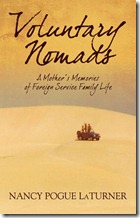
Voluntary Nomads, coverWith the first draft completed, I began a new adventure. On this journey, I learned what it takes to publish a book, and I discovered plenty about myself too. At the beginning of the trip, I couldn't have guessed that I would be able to handle the critical input of an editor, find a publisher, format a manuscript for both print and digital editions, turn color photos into black and white as well as crop and size them for both print and digital reproduction, or carry out the marketing of my final product.

I should have worn a Santa suit to launch my book. On that day, as I signed and distributed my gift of stories, I finally felt like the real thing. I recognized myself as a real writer at last and changed my identity forever.

Nancy Pogue LaTurner plays Santa to three grandsons when they visit her home in Albuquerque where she enjoys retirement with her husband, Fred. Nancy's current writing project is a suspense novel set in New Mexico. Learn more about her on her website and read my review of Voluntary Nomads on Amazon.

Write now: Write a story about your writing journey. If you’ve been writing for years, include some of the blocks you’ve faced and how you overcame them. If you are just beginning, write about your hopes and dreams, and how you will know you are a real writer. Explore elements underlying your belief that you are not yet a real writer. Regardless of your state of maturity as a writer, include your dreams for what you’d like to achieve with your writing.

Writing Around Obstacles

SheepBlockAs anyone who has written more than a dozen life stories or begun a memoir knows, some stories flow onto the page more smoothly and easily than others. What do you do when a story jams up? What do you do when you start writing and realize you aren’t going where you thought you wanted to go?

Let me use this blog post as an example: I originally intended to write it to highlight Andrea Hurst’s AUTHORNOMICS Interview Series, which features weekly interviews with literary agents, editors, authors, marketing experts and more talking about their opinions on the publishing industry, writing, and what a writer needs to know. I wanted to tell you how valuable it can be to learn from experts in other genres as well as your own, and I wanted to alert you that I’m featured in an interview this week.

But that’s not enough to fill an entire blog post, so I decided to add a few more resources, for example a link to Kathy Pooler’s blog, Memoir Writer’s Journey. Kathy is a walking Wikipedia for life writers, with more resource links per post than anyone I know.

Jerry Waxler’s blog, Memory Writer’s Network, is crammed with wisdom and writing lessons gleaned from his deep study of over a hundred memoirs. He includes dozens of author interviews.

I could fill many pages with links to rich blog sites like Shirley Showalter’s Discover the Power of Writing Your Story, or SuziCate’s Water Witch’s Daughter, one of the finest and most consistent examples of scintillating description I’ve found. Linda Joy Myers’ Memories and Memoirs is full of great tips, along with the Women’s Memoirs site.

I save one of the best for last: the National Association of Memoir Writers. I saved this one for last because I hope you’ll click over to learn more about the 3-week NAMW short course I’m offering, beginning next week: Soaring High and Digging Deep: Tools for Refining Your Memoir, which I mention in the AUTHORNOMICS Interview.

That last link brings me back around to my original intent of discussing what to do when your story doesn’t go where you intended: Let it take a detour. Write around the log jam – or through it. If you encounter a flock of sheep on a New Zealand road, unless you plan to sit there for an hour, you must keep moving, very slowly, until you work your way through. You might later edit out extraneous material after you write to the other side, or perhaps you’ll find it has value after all, and leave it in. Today I cut a lot, but left in links I have been meaning to feature, “when the time is right.”

A second alternative is to set aside your keyboard and linear writing in favor of more visual ways of exploring and organizing memories and meaning. I’ve written a number of posts on some of these tools in the past, but reading about them and using them are two different matters. In the Soaring High and Digging Deep class, you’ll have the opportunity to discover their power by using them yourself and share your experience with others to learn even more.

To find out more about the class and memories in general, join me on February 9 on the free NAMW February Roundtable: Memories are Made of This … or Are They? Click here to sign up.

Write Now: Pull out a story you’re jammed up on and write aroudn your logjam. Just freewrite about it and see where you go. Surprise yourself. You can throw it away later, or you may find a gem. Try a tool like inner dialogue,  mind-mapping, or asking yourself questions. Sign up for the class and get help as you practice using new tools.

Photo credit: Susan Mack

Barbara Tate’s West End Girls

westendgirls_largeGuest post by Harry Bingham gives some prepublication back story from an agent’s perspective showing the need to keep ourselves in our story and prune the extra text to highlight the true story.

When people ask me what I do, I never quite know what to tell them. I’m an author, yes, but I also work part-time running The Writers’ Workshop, an outfit in the UK which offers everything from editorial feedback to running writing courses. Needless to say, many of the manuscripts we receive are still fairly raw, some are good but not exciting – and some, a very few, are simply mind-blowing.

Early in 2009, I got such a manuscript through the letterbox. It was huge. 160,000 words or almost enough material for a 600 page book. And it was a memoir, every word of it true.

The author was an 82-year-old British woman, Barbara Tate, but she hadn’t written the manuscript recently – she’d written the whole thing back in the 1970s. And the story she told tracks back still further, to a two-year period in 1948-49, when the author was a young woman, newly independent in post-war London.

Barbara had had a truly difficult childhood. Her father had been dangerous, her mother neglectful. When Barbara was still very young, she found herself abandoned to the less than tender care of her grandmother. Indeed, although she wasn’t directly abused, her childhood was scarred by lovelessness. She’d never really been loved, never really had a friend.

Her two passions were painting and writing. She painted as often as she could, and signed up to correspondence writing courses when and if she could afford them.

Then, to her joy, she became old enough to leave home. She had a few temporary jobs and was working as a waitress in Soho – one of London’s more exotic areas – when she encountered a woman, the like of whom she’d never previously encountered. That woman was Mae: glamorous, impulsive, charming, spontaneous and warm. She was also a prostitute.

The two woman made friends instantly. Although Barbara was (and would remain) rather conservative in her values, she knew friendship when she saw it. She knew love.

Mae offered Barbara a position as her ‘maid’ – half-companion, half general helper. Barbara accepted.

The manuscript told the story of how that friendship developed: touching, astonishing, moving. The trouble was that the manuscript did lots of other things too. Barbara had felt uncomfortable telling her own story, and kept writing herself out of the picture. The manuscript was amazing, but not quite publishable.

Normally, we’d suggest that such a plainly gifted writer do the necessary editorial work themselves. One of our writing courses teaches self-editing skills that a younger Barbara could have made excellent use of. Or we could just have offered detailed feedback and let her make any corrections herself. But she was in her eighties and simply not physically strong enough to tackle the work involved. So we agreed to do it on her behalf: cutting 70,000 words from that giant manuscript to tease out the amazing story that lay buried within.

The shorter and more focused the manuscript became, the more appealing it grew. It was a delightfully surprising combination of chaste and raunchy, nostalgic and energetic. Most of all though, it told a story. About a friendship between two women. Explaining why that friendship arose in the first place, explaining why the friendship was finally doomed.

We sold that book direct to publishers in a competitive auction. It was published very well, got glowing reviews, and sat for weeks on the British bestseller lists. It deserved all its praise.

Tragically, Barbara died (peacefully) before the book was published, but she had met her publishers, signed a contract, seen a book cover. And before she died, she told me repeatedly, ‘Harry, this book is the crown of my life.’ Considering that, after her time in Soho, Barbara became one of the best known women painters in England, that’s high praise indeed. She used to remind me that while her art teacher had wanted her to become a painter, her English teacher had always urged her to write. It turned out that it wasn’t an either/or choice. She’d done both and done them brilliantly.

Harry Bingham is an author of fiction and non-fiction. He also runs the Writers’ Workshop which offers feedback on writing and a range of writing courses.

How to Write the Killer Query

Query-letterDoes the thought of finding an agent or publisher give you vapors? If so, you are in good company. Query letters are among the most important documents an author writes. Whether you are a full-time freelancer or a wannabe one-time writer hoping for publication of a memoir, your future hangs on that one page. It can make or break your chances of seeing your words between commercially printed covers.

Writing great query letters is a special art form, and not one that we learn in any classes in school. Some people complete their MFA in writing without learning this crucial skill. So what’s a person to do?

The traditional way to learn is to find a good book. You may find something in your library, but this is an important topic, and it’s worth having something on hand to refer to whenever you need it.

I must include a disclaimer here. Since I had any clue at all about how to write, I’ve only written one query letter and received an acceptance within half an hour of sending the email. That was to a local newspaper and I included the story cold, so it wasn’t a true query letter. Both my traditionally published books were pitched in a face-to-face meeting, without so much as a proposal. Remember the old saying, “It’s not what you know, it’s who you know”? That does help. Because I’m always as busy as I want to be without tracking down additional writing assignments, I don’t write query letters, so I can only offer suggestions.

What I suggest, besides scanning the titles on Amazon, is to surf over to  visit Query Shark. That site has an amazing collection of query letters that have been critiqued by Janet Reid, an agent with the FinePrint Literary Management Agency.

Janet suggests that you read all the posts and learn from them. Now that there are more than 200, perhaps the most recent hundred will do. Then, if you wish, you may submit your query letter in hopes of having it anonymously critiqued. There are explicit instructions on how to accomplish this and increase the (slim) odds yours will be chosen. She focuses on fiction, but her Q&A page says she occasionally runs examples from other genres (like memoir).

A couple of paragraphs way down one page on the AgentQuery site advises you that memoirs are marketed like fiction, so Janet’s models should give you terrific guidance.

Miss Snark, the literary agent seconds AgentQuery’s advice that the memoir must be finished and polished before querying. She adds further that “You get one shot on this. Don't **** it up by querying before your ms is ready.” Check out other topics on her site. She retired after two years, but her helpful posts remain, and her blog writing format differs from QueryShark’s.

On her PubAgent blog, Agent Kristin advises that “Writing a memoir is not therapy.” Focus on the artistic merits of your work, not the fact that writing it changed your life. Art sells, therapy doesn’t.

Lynn Griffin has uplifting news in her “Easy-Peasy Query Letter” post on The Writers’ Group blog. “Writing a query letter for fiction or memoir should take no more than 15-20 minutes tops. Assuming, of course, you've been researching agents while writing your book.”

Research. Aw, yes. All agents want to read queries they way they ask for them to be written.  Read and study their sites. Know what they handle, how they want to be approached, and anything else they tell you. Then write away. Your odds will be much higher if you study this subject before you start collecting those infamous rejection slips. Perhaps you’ll win the submissions lottery on your first submission.

Write now: read a couple of AgentQuery’s columns, then practice writing a query letter for your story or memoir. Who knows? You might find someone to send it to, now or later.