Showing posts with label Conflict. Show all posts

How to Write About a Change of Perspective

Celebrate-not-celibate

The meme you see above has prompted millions of laughs, but can you imagine a more life-changing moment than a priest, monk or nun hearing this revelation after decades of devotion?

Misperceptions like this do happen, and they can shape lives. This meme came to mind recently when a woman told me how she spent her child and early adulthood terrified of burning in hell. She knew in the core of her being that ministers thundered messages of hellfire and brimstone “all the time.”

Eventually she discovered that her particular church believed that yes, the wicked did perish in “The lake of fire,” but they did not burn forever. The perishing was mercifully quick and permanent. The wicked were punished only by being deprived  of the multitude of blessings the righteous are due to receive. She did hear about a lake of fire. That was true. But the burning forever part must have leaked in from outside, according to her informant. “I assure you, that was never part of our teaching.”

By the time she heard this, she had moved away from that church. But learning this still angered her: I didn’t have to spend all those years so scared!

Now she’s wondering how to write about this: “I really did believe that. That is how I heard it. If I was wrong, and I only have that one person’s explanation to go on, I still totally believed it. But now things have changed. And I’d definitely never go back to that church. How do I tell this story?”

“That was your truth back then, and nothing has changed that,” I said. “Not even finding out you were, or might have been, wrong.” My advice to her was simple and four-pronged.

1) Write about what life was like back then. Explain what you heard and how that affected you.

2) Write about the whiplash you experienced when you heard the other point of view. Who told  you? How did you know to believe it? How did that affect you? How did you and do you feel about all this? What has changed?

3) Write with compassion. True, you may feel angry and betrayed. Own that and write it. Then consider the angles. Did any one purposely deceive you? Did you ever ask for help or tell anyone you were scared?

4) Sum it all up. By the time you’ve written through steps one, two and three, you will probably be feeling some closure, if you weren’t already there. Stories demand it, whether they’re still at the stage of self-talk or written down. Readers crave it.

Conflict or tension, especially the internal sort, is the meat of this and any story. Jump into the middle of the mud with both feet and let it all rip. Be brave. Write it real. Polish it to flow smoothly, but leave those emotions in place. They are the lifeblood of your tale. They add the juice and the glue that bonds reader to story and helps them gain their own insight from your message.

Write Away Election Stress

FingerPointAs much as we’d like to forget it all, it’s hard. Who can forget the finger pointing, the name calling, the conversations you tried not to have before November 8? We hoped it would end the next day, but we knew, most of us knew anyway, that it wouldn’t.

Here we are now, stressed, burned out and perhaps more divided than ever. Half the country is rejoicing that they managed to Trump the so-called self-righteous, socialistic feminists represented by That Woman. “Change is finally possible,” they crow. “We can get back to true values, to democracy as it was intended to be.” And on it goes.

On the flip side are those who were Hillary’s True Believers as well as many who may not have preferred That Woman, but they claim a trained seal would be better than that devious, inexperienced, misogynistic bully. The sudden triumph of Trump seemed unimaginable and that half of the country is in deep mourning, highly traumatized.

“How can they believe all that stuff?”

“How can they just throw out all the progress we’ve made?”

And on it goes.

We’ll see how things unfold in the future, but for the present, our collective national life stress index is off the map.

The medical community has been warning us about the negative health effects of stress for over fifty years. We know it leads to cardiovascular problems, lowered immunity, depression, and a host of other ills. So what's a person to do? Lists of stress management techniques abound. A search for "stress management" turned up 16 million links. WebMD has two pages of tips, and many more of links and articles.

Fortunately, one of the simplest ways to offset the stressful effects of trauma is to pick up pen and paper and write about your thoughts, feelings, fears and perceptions. Original research showed that writing for as little as twenty minutes about troubling topics may boost your immune system and lead to numerous health benefits reversing the ravages of stress. Research has repeatedly shown enhanced cardio-vascular function, lower blood pressure, reduced asthma and arthritis symptoms, decreased need for pain medication in many instances, and more. Emotional health benefits such as relief from depression, better sleep, and enhanced sense of well-being are also common.

More recent studies have shown measurable results from writing for five or ten minutes a day, or even writing once for a few minutes. It’s undeniably clear that expressive writing is good for your health! Expressive writing is not a panacea intended to replace medical care, but it often serves as an effective adjunct, enhancing effects of any treatment you may undergo. It's affordable for anyone, and can be done anywhere.

In our current situation, you can make it even more effective by expanding your writing to include attempts to understand the perspective of those on the other side of the electoral divide. Think and write as deeply about their fears, hopes and concerns as you do your own. You may find you have more in common than you imagined. You may discover deeper compassion for others as well as your self and begin to rebuild community that may have suffered over the last several months.

Please leave a comment about ways you are using writing to recover from election stress, along with any other tips you may have.

Start Your Story with a Hook

HookIf you spend time worrying about the best way to start a story, you may never write it. Your first challenge is to get it on the page in any form at all. But before you release it to readers, give your opening some thought so you sink a hook firmly into readers’ brains and guts.

I offer these Before and After opening excerpts of a story titled Missing Neighbor that’s based on a personal experience.

Before

You would not believe the adventure I had with my friend Ellie. We were scheduled to take her to the airport at ten. I texted her around nine-thirty, and she didn't reply. I tried calling a few minutes later. She didn't answer, but I assumed she was on the phone with her daughter. Her voice mail was full. Hmm. Shall I go over there now just to check? No ... she's a big girl ... I muted my ESP.

After

Something is dreadfully wrong! This thought roils through my head after I punch the doorbell five more times and pound on the door and get no response. I see no light behind the frosted door glass. She has to be up. Her plane leaves in two hours. What am I going to do?

~ ~ ~

You may not be surprised to learn that the Before version began life as an email, which is a great way to discover and develop a story draft. In fact, it’s just fine to send it as an email. Whether you send it or not, you may want to copy it out and develop it further. I decided to hold onto mine before sending it off and exercise a little creativity.

I realized that the creepy, horrified feeling I had as I crept through her house was the perfect beginning for a compelling mystery novel. Taking all the advice I’ve read from both fiction authors and experts like Lisa Cron in Wired for Story, I cut right to the emotion-filled point where my stomach began churning and let it build from there, looping briefly back to tell who Ellie is.

Are you curious about what I found? Was Ellie hurt or … dead? Mission accomplished.

Writing tip: write a new story or pull out an old one and find the juicy part. Rewrite the story starting with that.

Memoir Writing Lesson from Fiction

Fiction can offer powerful insights for memoir writers. I just began reading a classic historical novel, Divine Average, first published in 1952 by Elith Hamilton Kirkland. Like many novels, it’s written in memoir format, in this case an end-of-life memoir. It’s set in 1838-1858 in “that period of Texas history when ‘cow boy’ was a phrase with a controversial meaning and ‘Texians’ a nationality.

The second paragraph stopped me in my tracks:
I feel compelled at this time by the Spirit of the Holy Mother and the force of God to leave an account of the things that have happened to me and mine. It all lies on my heart like a confession that must be made before I can die in peace . . . a confession not only for myself, but for my husband, Range Templeton, who despises me now after loving me for twenty years, for my daughter Laska, lost to us and to herself, a companion to outlaws in the wilds of Mexico, and for my son, Luke Templeton, so bold of mind and pure in heart.
I know right away that Luvisa Templeton, “a consumptive, soon to die,” is confessing all for peaceful death, which she’s looking forward to “as deliverance.” This compelling reason to write creates a compelling reason to read. What juicy secrets is she about to divulge? What better way to hook my attention?

She immediately goes on to explain her time frame – the twenty years of her marriage to Rage Templeton – and her frustration at never being able to understand him. That sounds like a rich topic.

She then explains that she’s not penning this tome herself. She’s dictating it all to Mr. Bryson, a “very close friend to every member of the Templeton family,” which relationship she’ll explain in due course. Bryson is literate, articulate, better able than she to find the right words for her thoughts and feelings. Bryson has promised to place the completed manuscript “in the proper hands with instructions that it be preserved until such time as it might seem fitting to give it out for reading, in a book perhaps.” She continues:
Is it too much to hope that in some future generation these events may stir the minds and warm the hearts of men and women destined to know more and see further than those of us here now? Perhaps I attach too much importance to the life I have lived and the lives of which my living has played a part. But I yield completely to the compulsion that I must leave such a documentation. 
Like Luvisa, many of us write because we’re compelled to do so. In heeding that compulsion, we’ll do well to follow her fictitious example on several counts:

  • Be clear about why you are writing and
  • Who you are writing for.
  • Be clear about the frame for your story, in her case a twenty year marriage and
  • The story focus or theme, in her case what happened to her and hers. 
  • Have a strong, compelling opening. 
  • Get the tension/conflict going right away, in her case her husband who loved her for twenty years despises her now. Why? How did her daughter come to be in Mexico with outlaws?
  • Seek help when you need it. Luvisa used Mr. Bryson, a sort of ghost writer. You may choose to use an editor, beta readers, reading groups, friends, even family to help you on your way. 
  • Have a strong, compelling opening. 
  • Postpone distribution if you feel it unwise to disclose it all now. 

Points to Ponder: Do you have a story you’re compelled to tell? Can you identify the frame and focus? What help might you need to get it written? 

Shifting Rhythms

Music blue
It’s too soon to draft a  memoir about our move, but it’s not too soon to begin reflecting on my sense of things. As I sat in a glorious state of almost forgotten peace and relaxation earlier today, I realized that (speaking only for myself) we’ve entered a new phase, and not a minute too soon.

That corner was actually turned the day we were told that the photographer who would make our house look amazing on the web needed to arrive three days early. Before that I’d been in a total panicked frenzy, wondering how on earth we would ever possibly meet our self-imposed deadline for listing. But right on schedule, birds sang, bells rang, and angels descended. Only one room remained out of bounds for the photographer.

Tension drained.

Then, a few hours before we were scheduled to fly to Austin to find a house, that last room clicked into alignment, ready for showing. We flew off to Austin a few hours later. For three days we looked, well-prepared with seven months of web research. We did find a home, holding our breath until a previous negotiation fell through at exactly the right time. We never needed our backup choices.
 
Once that contract was signed, life became large, calm and amazing. Pondering the shift, I noticed some similarity to a symphony. Each movement has a different rhythm and tone. So it has been with us. Our transition symphony seems to have :

Deciding to do it. This was the beginning. We’ve talked for years about relocating. Our three children are widely scattered. We can only be near one. Which one? Or maybe suit ourselves and go somewhere else? We lived in a state of paralysis by analysis for a few years. Slowly, a decision emerged from the fog.

Public announcement. We “came out” in Austin last winter at a huge party at our daughter's home. Through the course of the evening, “We’re thinking about moving here” morphed into “We’re planning to move here.” We called a real estate agent and began our search.

Big shift!

Delaying phase. We both had commitments in Pittsburgh that had to be completed. Although listing around the first of April would have been ideal, it did not work out that way. I stayed mellow and loose through this time. 

Big shift!

Pressure phase. When not much had happened around the first of May, I got nervous. I got tense, fretful, even bitchy. I lived in a state of chronic fear and anxiety, dreading the thought of yet another winter here, and even more, the loss of time to dig in down there. As much as I’ve loved the time we’ve spent here and all our friends, it’s time to go! My clock is ticking louder every day. Productive years could possibly be counted on fingers. No time to waste! Committing to a listing date amplified that pressure several fold. Then, Ta Dah! We were done.

Big shift.

Transition. From the time that final room was vacuumed through the time when we signed our offer, was an intense transition, packed into a very few days. As I said earlier, signing the contract was an enormous relief. Time to kick back for a day or two. Intense or not, it was different from the previous phase.

Packing up. That’s where we are right now. Things may not stay mellow. Pressure is sure to increase.

Projected big shift.

Moving. Driving two cars from here to there and getting all the loose ends in place at our new house is bound to be intense.

Projected big shift.

Settling in. I’m hoping that after the first few days,  settling in will be a relaxed affair. No need to rush. This will be the end of this story.

I can’t tell the story yet, but I can see the plot. I see tension arcs within each of these phases, or movements. I think I see the thread holding it all together, but that’s another post for another day.

Write now: Think of a period of time when you went through a transition. Jot down some thoughts about turning points or Big Shifts as the transition evolved. Can you map out a story along that path? It may be a large story or a shorter one. Give it a try.

Six Things I Learned Going from Memoir to Fiction

CB-covers

Invited guest post by Carol Bodensteiner

Long time readers may be surprised to find a post about writing fiction on this blog about life writing. While it’s true that my focus is on memoir, lifestory, journaling and other forms that draw upon actual experience to express personal truth, sometimes the freedom of fiction is more effective in conveying truth. Carol Bodensteiner found this to be true. She has successfully written in both genres and her experience moving from memoir to fiction has lessons for all.


I’d been a business writer all my life, so I was used to working with facts. Memoir was a logical first writing step. Growing Up Country: Memories of an Iowa Girl, tells the stories of my childhood growing up on a family farm in the middle of the United States, in the middle of the 20th Century.

When I finally raised my head from writing, publishing, and marketing the memoir, I looked around for what I’d write next. I turned to family-inspired fiction, which I’d never written before.  My novel, Go Away Home, which I indie published in 2014 and was acquired by Lake Union Publishing (an imprint of Amazon Publishing) later that year, is the result of that effort.

The road from memoir to fiction brought many adventures and a lot of learning. Here are six things I learned along the way.

1) A family story can be a great launching pad to fiction.

Go Away Home was inspired by my maternal grandparents. My grandfather died of the Spanish Flu in 1918. Throughout my life, I’ve been intrigued by my connection to this major world event. As someone used to writing from facts, a family story gave me a starting point: A story I cared to write and people and places that were familiar.

Writing the story as fiction was necessary for many reasons. One was that I didn’t have enough facts to write it any other way. Of course I never knew my grandfather and even though my grandmother lived until I was well into my 20s, I never asked her a single question about him or their lives together. And she was not the type to share. So though the story began with family, it is fiction.

2) Don’t get stuck on the facts

Once I got into writing the story, one of the biggest challenges was letting go of the facts. Since the genesis of this story rose from people in my family, and I knew a bit about the people, places, and events, my inclination was to use those facts. But I quickly found that the facts didn’t work for the story I was ultimately telling. They didn’t create a good story arc. There was no drama. On his website, Write the Truth, Robert McKee said, “The weakest possible excuse to include anything in a story is: ‘But it actually happened.’”  Having gone this route, I believe him.

3) Do get stuck on the facts

Since Go Away Home is historical fiction, research was critical to creating the time period accurately. Clothes, transportation, hairstyles, technology, colloquialisms. The list of topics I researched and fact checked was long. Readers of historical fiction really care about the details. Writers must, too.

Research also helped shape the story. One example: Family lore was that my grandmother went to a sewing school. Research revealed that the town in question didn’t have a sewing school, rather that young girls apprenticed with seamstresses as a way to learn an important life skill and to meet a man to marry.  The idea that seamstresses were invited to their clients’ house parties had terrific dramatic potential, so I ran with that.

Another bit of fact to fiction. My grandmother took pictures, but the whole part in the book about the main character’s work for a photographer and her relationship with him is entirely fiction.  Most of the book is that way. Tiny fact. Huge fiction.

4) Planner vs. Pantser

Writers fall into two general camps: Planners and Pantsers. I wrote my way into Go Away Home, discovering the story through countless re-writes – by the seat of my pants. I always knew the end of the story; I didn’t know how we got there. In the first draft, the story started in 1900 and my main character Liddie was 10. In the second draft, the story started in 1915 and Liddie was 19. In the published draft, the story starts in 1913 and Liddie is 16. Believe me – those changes create seismic waves throughout the story.

Having used this highly inefficient “pantser” approach once, I’m reasonably certain that I’m a “plotter” at heart and will be more plan-ful in future writing.

5) Fiction is freeing

While I thought it would be easier to start with some facts because that was what I was used to, the reality was there was great freedom in starting with nothing. As the story developed (pantser), it became clear that connections were missing. I needed a scene to show my main character’s inexperience with men. No problem. I made up a guy. I found it was great fun to let my imagination run. Over and over, I filled holes with scenes that met a plot need.

6) New craft to learn

I learned a lot about creative writing as I crafted my memoir, much of which was also applicable to fiction. Dialogue, scene development, visual characterization – all come into play in both genres. Plotting was a new challenge in fiction writing, as I noted earlier. Developing multi-dimensional fictional characters was another challenge.

I used a number of techniques that contributed to creating the real, individual people living in my novel. I visualized people I know who were somewhat like the characters I had in mind. Writing exercises helped to identify key traits and to express them in fresh ways. I used Enneagram research to flesh out the positive and negative traits of various personality types.

From memoir to fiction, from craft to research, I will always be able to learn something new about writing, and for me, that’s great fun.

Go Away Home is available on Amazon in paperback and ebook formats.

Growing Up Country is available on Amazon in paperback, ebook, and audio book formats.

Carol Bodensteiner – Bio

Carol Bodensteiner is a writer who finds inspiration in the places, people, culture and history of the Midwest. After a successful career in public relations consulting, she turned to creative writing. She blogs about writing, her prairie, gardening, and whatever in life interests her at the moment. She published her memoir Growing Up Country in 2008. Her WWI-era, debut novel Go Away Home was acquired by Lake Union Publishing, an imprint of Amazon Publishing. It launches July 7, 2015.

Carol’s online links
Website/blog 
Twitter
LinkedIn
Facebook

Write now: think of an interesting ancestor or other person who has influenced your life that you know relatively little about. Drawing on Carol’s experience, write a short story about how you imagine this person’s life might have been. Don’t worry about facts. Just let that story rip. Have fun with this!

Lessons Learned

Mr-ChileThat curve ball I reported in the previous post about my book title has been tossed all over the field. I appreciate the comments many left there. An update is in order about  principles validated, lessons learned, and conclusions reached.

Principle 1: Do your research.

When controversy arose over the spelling of chile or chilehead, I did do lots of research, and I learned many fascinating facts about chile/chili quite apart from the spelling lessons and history.

Principle 2: Check your references

When I called my father to double check my memory of what he told me, I was in for yet another surprise. Without knowing why I was asking, he turned my memory inside out. In his considered opinion, replacing the “e” at the end of chile with an “I” is an affectation that became fashionable about the time people began naming baby girls Christie rather than Christy. I never did understand how he could be at such odds with local custom, so although chagrinned at this outcome, I’m relieved to find him in character after all.

Lesson 1: Involve lots of others

I was beginning to wish I’d never mentioned this project to the Facebook group, considering in retrospect that asking forgiveness would have been easier. I had no intention of stirring up such a flap. But … I was using what I remembered as my father’s guidance in the first place, and his opinion trumps the rest. Had I not stirred up that Facebook pot, a permanent cloud would have hung over that book when I learned of my flub. This way I can still fix it. Community matters. Crowdsourcing helps.

Lesson 2: Double check your sources.

Memory is a tricky thing. We all know that. My memory error was legitimate and defensible. And I could have asked that question sooner. I just never thought of doing that. So, learn from my example and think about it. Root out and check out your assumptions to keep that egg off your face.

Conclusion 1: I need a new title!

It’s time for creativity. I’m considering options and open to suggestion.

Conclusion 2: It’s chile, not chili.

Case closed on that.

The story of compiling this collection from loose stories to memoir goes far beyond the title. I’ll continue the tale in the next post.

Write now: Think back through your old stories, or perhaps one you are currently writing and look for underlying assumptions. In my case, this was an assumption about spelling and remembered advice. Yours may be quite different. When you find an assumption, check it out. This is especially important when your assumption is based on things other people said or did. Mine was resolvable. Yours may not be. But it’s always worth a try.

Photo credit: Clotee Allochuku

Above All, Cause No Harm

toad warts“You can’t write the truth of someone without mentioning their warts and wrinkles as well as their angelic smile. And how can  you write about the warts and wrinkles without causing them distress?”

This question comes up in one form or another in every memoir and lifestory class I teach. Everyone hopes for stone tablet truth to guide them, but alas, there are no hard and fast rules. But take hope and use these tips to guide your decisions:

1) Write privately first.

It’s therapeutic to get angry feelings on the page, out in the open where you can see them. Sometimes simply writing the reasons for your rage focuses it, and the reasons may look ridiculous or blown out of proportion. Perhaps that’s enough and you can burn, shred or delete the words and all will be well.

If it isn’t well, think care-fully before sharing your thoughts lest you cause greater damage to self or others, or paint yourself into an unforeseen corner or difficult situation. I speak here of rage, but other emotions can be equally volatile. You can’t always know how others will hear or understand.

2) Go to the balcony.

The idea in this concept borrowed from negotiation texts is to rise above the situation and consider the points of view of all concerned in any conflict, misunderstanding, or emotional events. There is always another side to any story. Simply making the effort to look at other points of view may change the way you see things. 

3) Write from compassion rather than revenge.

Nobody wants to read whining stories, and those simply point fingers and write from a victim’s point of view are likely to be set aside rather soon. You may not understand why a person committed an evil or hurtful act, but whether it’s an “external” event such as failure to repay a loan, or an “internal” one like betrayal of trust, physical or emotional abuse, or other forms of pain, simply state what happened and how it affected you. Skip the name calling and judging. That will not gain you sympathy or credibility with readers, nor will it improve your state of mind and mental health. Give them the benefit of the doubt if you can and express empathy.

4) Get guidance from others.

Ask a trusted friend or writing group if your story is too judgmental or likely to cause pain to someone you care about – or worse yet, provoke legal complications. Ultimately it has to be your decision, but these advisers can help you tone things down or make decisions about certain story elements you may do well to omit.

5) Ask permission.

Many memoir writers mention somewhere in their books that they showed their draft to parents or others who might be offended or hurt by the material. They encountered surprisingly few objections. Requests for changes were often about things the author never would have expected.

However, few realize that their consent is no guarantee that no feelings will be hurt. For a variety of reasons, people may agree to allow you to publish something that actually is hurtful. To minimize this possibility, go back up the list to the point about compassion. Hopefully if your relationship is healthy enough that you were able to ask, you have come to the point of understanding and forgiveness, and expressing that that will surely blunt the pain for the offenders as well as gaining you points with readers.

6) Change names and details.

People who know you will probably know who you are writing about, but far fewer than if you use real names.

7) Write fiction.

You may have heard the adage, “All stories are true, some stories happened.” Some truth is best and most safely expressed in fiction.

Write now: write a personal essay on your feelings about showing other people’s warts and wrinkles in published stories. You may have someone specific in mind, or you may write more generally about people you once knew who are unlikely to ever read your story, but if they learned about it could be embarrassed.

Photo credit: Quinn Dombrowsky

Entering the Next Age

Broken-CalendarA few hours ago the Mayan calendar reset. We are officially in a new “age”, at least according to the Mayans.

Nobody I know was surprised to wake up this morning to find the world unchanged in any discernible way. I heard reports that some were stockpiling Doomsday kits of food and survival gear, just as they did for Y2K thirteen years ago, but this event has had far less hoopla in the media or public attention.

I’ve been contemplating its possible significance for at least four years, never expecting anything dramatic to happen, but watching trends and listening to thought leaders who point out that change has become dramatic and global since about the end of World War II. They also point out, for whatever it may be worth, that the Women’s Movement has occurred in waves of about forty years from the first Suffragette efforts, to the Consciousness Raising of the 60s and 70s to now.

These gurus opine that the trends they discuss have brought us to a tipping point where change must and will occur. They express no doubt that this change will be positive, escalating mankind to new levels of awareness and collaboration, but they don’t promise it will come about smoothly, without a certain degree of pain and suffering in the interim.

Their intriguing theories boil down to one thing: Stories are changing. Stories shape collective awareness, collective perceptions and judgments. On one level, our individual stories have become so fragmented that at least in the USA, even those who claim strong allegiance to ethnic, religious, professional or other groups tend to feel isolated within those groups.

On the other hand, collective stories about things like political correctness, individual rights, and such things abound. The challenge is that we have numerous collective stories at work that compete with each other. Which is right, my story or yours?

Anyone writing life stories and memoir is well aware of perceptual and conceptual differences on a small scale, for example within families. It’s only a matter of degree to see it on the level of an entire society, even globally.

How does collective Story change? Just as personal stories are an accumulation of memories and scenes that may change as we explore, question and examine them, scenes that may be linked together in an infinite variety of ways, collective Story is a compilation of individual stories. Thus collective Story evolves as personal ones do.

My part in bringing about the change I hope to see in global Story is to continue writing and revising my own story, seeking ever increasing transformation from fear, resentment and worry to one of loving acceptance, peace, and gratitude.

While this may seem a small, perhaps insignificant contribution, reports continue to pour from the media indicating that “writing peace” into our lives is a skyrocketing trend. I’m part of this trend, part of what Jerry Waxler calls “The Memoir Revolution.” Watch for his forthcoming book on this topic.

In prophesies about the turn of this age, the ancient Mayans never predicted Doomsday. They pointed to this pivotal point as a time of decision for mankind. Depending on our decisions, we may plunge into chaos and possible annihilation, or we may shift into that promised age of universal peace and prosperity.

That decision rests on the stories underlying decisions at every level. My story and yours can help spread healing and peace or perpetuate violence. My hope is that you will join me and keep working on your contribution as we transform to a new Story of love and peace, worldwide.

Write now: write a story about change in your life. For example, has your thinking changed over time about volatile topics like same sex marriage or gun control? How has your understanding of your own relationships changed? Be brave. Be brutally honest with yourself and burn your writing if you don’t want anyone to read it. And be open to new ways of looking at what you find.

Like Santa’s Bag of Presents

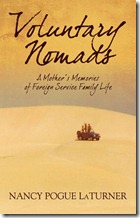
Santa's Choice“True, I’ve written a few stories, but I’m not a writer!” Such is the mindset of most beginning writers. In January of this year I posted an interview with author Nancy Pogue LaTurner based on her experience writing her memoir, Voluntary Nomads: A Mother's Memories of Foreign Service Life. I’m happy to welcome her back with this guest post building on the metaphor of Santa Claus as she outlines her writing path from novice to “real writer.”

Before beginning my memoir, Voluntary Nomads, I carried a weight around with me. Like Santa's bag of presents, I hefted my sack of stories. It was full to bursting and I needed to lighten the load by giving these gifts away.

Unlike Santa, with his centuries of expertise and magic delivery system, I worried that I was ill equipped to carry out my plan. When I began the memoir-writing journey, I didn't consider myself a writer. I could have, given my early experience as editor of my elementary and high school newspapers, columnist for my hometown weekly, and jobs throughout my working years that required writing grants, proposals, procedure manuals, and public relations material.

I didn't yet see myself as a "real" writer. Then I took a writing class, the first since college half a century ago. The teacher told us to introduce ourselves by saying, "Hello, my name is So-and-so and I'm a writer." It was embarrassing at first, and I felt like an imposter, but as the class continued over several weeks, I grew to fit the writer's costume and learned more skills to perform the author's role.

Faced with the instructor's scathing critique of my final short story in that class, I almost surrendered my name-tag along with any hopes I had of deserving the title "Writer." However, I surprised myself by having the courage to return to my story with a commitment to make it better. My persistence paid off. That story won a cash prize in an international contest sponsored by SouthWest Writers  and received Honorable Mention in the Writers Digest Magazine annual contest of the same year.

Even though more of my writing won other prizes and earned publication in two volumes of the Albuquerque Almanac and an anthology Wisdom Has a Voice, I still didn't see a real writer when I looked in the mirror. Like a department store Santa's promises, my sleigh full of gifts offered potential rather than actual achievement.

Even so, prizes and publication served as validation and infused me with energy to pursue my desire to make a book of my Foreign Service stories. I took more classes and joined critique groups. In 2009, NaNoWriMo (National Novel Writing Month) fever ignited the urge to write 50,000 words during the month of November. When I recognized the power of daily writing practice, I made January my own personal writing month and finished my memoir manuscript.

Voluntary Nomads, coverWith the first draft completed, I began a new adventure. On this journey, I learned what it takes to publish a book, and I discovered plenty about myself too. At the beginning of the trip, I couldn't have guessed that I would be able to handle the critical input of an editor, find a publisher, format a manuscript for both print and digital editions, turn color photos into black and white as well as crop and size them for both print and digital reproduction, or carry out the marketing of my final product.

I should have worn a Santa suit to launch my book. On that day, as I signed and distributed my gift of stories, I finally felt like the real thing. I recognized myself as a real writer at last and changed my identity forever.

Nancy Pogue LaTurner plays Santa to three grandsons when they visit her home in Albuquerque where she enjoys retirement with her husband, Fred. Nancy's current writing project is a suspense novel set in New Mexico. Learn more about her on her website and read my review of Voluntary Nomads on Amazon.

Write now: Write a story about your writing journey. If you’ve been writing for years, include some of the blocks you’ve faced and how you overcame them. If you are just beginning, write about your hopes and dreams, and how you will know you are a real writer. Explore elements underlying your belief that you are not yet a real writer. Regardless of your state of maturity as a writer, include your dreams for what you’d like to achieve with your writing.

Writing Out the Tough Times

Voluntary Nomads, coverNancy Pogue LaTurner is that author of Voluntary Nomads, a book I reviewed a couple of months ago. Read the review for general information about the book. For now I’ll simply say that I was mesmerized by the grace and compassion with which she wrote an account of a time when her husband became involved with Another Woman. After some brief correspondence, I asked Nancy if she would consent to an interview about the experience of writing that account. She did. Here it is:

SL: You made a brave decision to write about an affair your husband became involved in for a time. Many wives who remained married afterward may prefer to simply forget about that difficult time and avoid reliving the trauma. What was your purpose in including this material? How did you make this decision?

NPL: Before writing my stories, I took several writing classes and read as much as I could about the memoir genre. Absorbing great advice from William Zinsser, Natalie Goldberg, Judith Barrington, and others, I realized that the essential element in any memoir is the author's own truth. Then I made a conscious decision to write as honestly and openly as I could about what I believed to be my truth -- both the good and the not-so-good experiences and the lessons learned. "The whole truth and nothing but the truth" became my motto. My nemesis, That Woman, taught me an important lesson: in her words, "Life is a series of tradeoffs." I believe we are able to make better choices when we are fully aware that any of our choices can, and usually do, rule out other options.

SL: Did writing about it reopen the wound and/or heal it?

NPL: It is important to note that the events took place more than twenty-five years ago. But, even though I approached the writing of this issue with resolve, I still suffered pangs of the long ago pain and anger. In fact, in the beginning I couldn't write it in first person. So I methodically outlined scenes and created character profiles for a fiction short story. About midway through my preparations, a bright light bulb lit and my story took its own direction toward an ending that turned out to be the complete opposite of what transpired in real life. The process was like picking a scab -- it drew a few drops of blood without completely opening the old wound -- and it took me right down to a basic level of healing. Experiencing an alternative choice (that is, to leave my husband) within the fictional account empowered me to let go of any residual anger I still harbored.

SL: How did you handle the matter of letting your husband know you planned to write (or had written) about this and include it in the finished manuscript? How did he react?

NPL: After I finished and polished the short story, I gave it to my husband. His comments revealed that the fictional account provided him new insights into my feelings. It also resurrected some of his old guilt and shame. We had a few valuable discussions on the subject, but he still seemed reluctant about "going public." He did, however, leave the final decision up to me.

SL: How did your children respond?

NPL: Our daughter, also a writer, gave me her complete support, both on the infidelity issue and also on the revelations about her own teenage problems. Our son gave no feedback. He explained that he couldn't bear to read the manuscript and thus verify that the best years of his life were in his childhood. Now, three months after publication, he says that he is reading the book and finds it "interesting to view those years through his mother's adult eyes." I hope to create an opportunity to hear more from him when he finishes reading.

SL: What sort of response have you gotten to that revelation from friends and relatives?

NPL: I also gave the manuscript before publication to my husband's younger sister and her husband. My sister-in-law urged me to examine my motives for telling about our marital woes. She wanted me to be sure I wasn't doing it to punish my husband or get revenge. That prompted another round of soul-searching for me.

One of the first copies of the published book went to a dear friend who gave excellent feedback on all aspects of the memoir. His heartfelt comments on our near-divorce had the most impact, especially when he revealed that what we thought was our "shameful secret" was actually known to many through the grapevine of our community. My husband and I both felt unburdened -- he no longer had to bear the weight of secrecy and I felt my courage had been vindicated.

SL: Would you do it again?

NPL: Absolutely.

SL: Thank you Nancy. Hopefully your answers will give hope, courage and guidance to others who face challenging situations and want to use writing to heal residual pain and anger.

Visit Nancy’s blog to read excerpts from the book and more.

Write Now: think of a challenging situation in your life and write about it as fiction. Give it a new ending. See how that shifts your point of view about the situation.

Fear of Exposure

Secrets7I’ve done things in my life that I’m not proud of, and I’ve never told anyone about them. Do I have to write about those things in my lifestory?

I just read a memoir that left me with my mouth hanging open. I almost quit reading because of all the talk about sex, drugs and other stuff. Even if I’d lived through anything like that, I could never write about it. Is that what it takes to write a memoir?

This are typical questions about self-disclosure that I’m asked as a lifewriting coach and teacher. The simple answer is NO. If a subject gives you pause, respect that feeling. Don’t leave your comfort zone without good reason. The healthy thing to do is to write those stories in full detail. Spill your guts on the page, but keep it private at first. This will give you the health benefits of writing without the counter-acting stress of confrontations.

Once those stories are written, you have many options. You can burn the pages, or decide to delay sharing them. Depending on your relative ages, you may wait until those key players die to publish your work. But if you’re young and they aren’t old, another solution may be better. Here are a few considerations:

Look at the situation from other perspectives. You’ve probably only been thinking of this experience from your own point of view. Perhaps it looks quite different from the other person’s or the reader’s. Try experimenting by writing what you think the other person would say about it. You may find that it looks quite different, and your story may change as a result. This experiment may have additional value. In a recent IAJW member teleseminar James Pennebaker again emphasized that subjects in his research who adopted the most diverse points of view in their writing demonstrated the strongest health benefits.

Question your assumptions. Perhaps you overestimate the power of other people’s reactions. Perhaps some of your assumptions about what actually happened are a bit off-base. The techniques Byron Katie developed in The Work provide a simple process for challenging assumptions and beliefs.

Consider the value for readers. After reading several memoirs that were candid about the pain of feeling different during childhood, I’ve come to realize this is a much more common situation than I’d ever imagined, and I would not know that if those authors had not been brave enough to share their experience. As a result, I feel more comfortable openly joining their “club.”

Realize that reader attitudes are changing. Who doesn’t know that a vast sea of change has taken place over the course of a generation. My daughter’s generation could shock the socks off my mother’s with ordinary conversations among friends. They are more candid about nearly everything, and write accordingly. Even among those who are old enough to remember living conditions during World War II, many are disclosing things they would not have dreamed of telling fifty years ago.

Be compassionate with yourself. If you decide to admit to shortcomings or transgressions of various sorts, don’t just toss them out there and duck for cover. Include enough reflection to let the reader know what lessons you learned. Extend the same compassion and understanding to yourself that you would to a grandchild or any younger person who was feeling fears, pressures to conform, or general lack of insight similar to you experienced.

Never include anything simply for shock value. If, for example, your story involves sexual experiences, it’s okay to close the doors for privacy after the reader knows what’s going on behind them. Include only those details necessary to serve the purpose and move the story along.

These considerations barely brush the surface of this deep topic. For what promises to be a thought-provoking discussion about the issue of self-disclosure, sign up for the free NAMW telesummit on Friday, October 21 and dial in for the fourth session: Young Memoirists Talk about Truth, featuring Elisabeth Eaves, Nicole Johns, and Anna Mitchael. Everyone who signs up will receive an email link to listen to replays if you can’t dial in live.

Write now: think of a story you are afraid to share and work through the considerations above. You may still not want to share it, but I guarantee you’ll see the situation somewhat differently as a result.

Photo Credit: Wesley Oostvogels

To Tell the Truth

Guest Post by Wayne E. Groner

WayneGronerA common oath for courtroom witnesses is: “Do you swear to tell the truth, the whole truth and nothing but the truth, so help you God?” While witnesses may still raise their right hands, the use of a Bible in taking the oath has mostly gone out of favor in deference to a variety of non-Christian religious beliefs. The word God is deleted for Atheists and Muslims.

Rotary International encourages members to use its Four-Way Test in all personal and business matters: Is it the truth? Is it fair to all concerned? Will it build goodwill and better friendships? Will it be beneficial to all concerned?

Which brings me to memoirs; to what extent are writers of memoirs required to tell the truth? After all, a memoir is a collection of remembrances, not an exercise in journalism. The best memoirs tell good stories with conflicts, lessons learned, issues resolved or not, and changes that bring growth. Can a memoirist accurately and fairly remember all that stuff, especially the dialogue? And do readers really care?

Storytelling has its extremes. Local and regional liars’ clubs encourage the telling of tall tales for fun. Mary Karr, in The Liars' Club: A Memoir, tells of “a terrific family of liars and drunks” with tidbits and chunks of redeeming truths. Some critics claimed to be unable to tell whether, in some cases, Karr is retelling a fabrication or creating one. James Frey was embarrassed by the national media when it revealed much of his bestseller, A Million Little Pieces, was made up; Oprah Winfrey publicly rebuked him for lying after she initially praised him. A lot of movies are declared to be based on true stories. Based on are the operative words; many of the opening credits should include, “Some of the following is true.” Does memoir qualify as creative nonfiction, that ambiguous and relatively new term for using fiction writing techniques to tell true stories? Lee Gutkind posits creative nonfiction encourages personal viewpoint and conjecture.

Ben Yagoda and Dan DeLorenzo, writing for the Nieman Storyboard project at Harvard University, declared there are no simple answers for the complex questions surrounding truth in memoirs. That said, they tried to take on the problems of memoir inaccuracies by constructing a scoring system, a system they admit is half-facetious and half-serious. They rate inaccuracies according to their negative reflections on people, living or dead; corroboration of facts; questionable dialogue; clichés and flat writing; and self-deprecation. A passing score is 65 out of 100. They applied their scoring to nine memoirs from the year 397 to 2009. Ernest Hemingway’s A Movable Feast received a 69, James Frey’s A Million Little Pieces got 29, and Sarah Palin’s Going Rogue: An American Life got 69. Read the full scoring report and download a printable worksheet to evaluate your memoir. It is a subjective process, since we are all biased about our own work, but it could prove insightful.

What does all this mean for today’s writers of memoirs? If you want to be accepted and respected then you must be as accurate and truthful as possible. What does it mean for today’s readers of memoirs, who are the final judges because they approve or reject memoirs based on what they buy? As Yagoda and DeLorenzo said, “. . . an informed reader has to make the call.”

___________________

Wayne E. Groner is a personal historian and memoir writing coach who blogs at www.waynegroner.blogspot.com