Showing posts with label Free Writing. Show all posts

Who Owns Which Memory?

Cousins

I know three sisters who remember life differently, and sometimes things I hear from them drop my jaw, at least mentally. For simplicity here, I’ll call them Annie, Betsy and Connie, in order of age. All are in their mid-eighties.

One day I got an email from Connie with a scanned letter attached. The letter was from her aunt, confirming that this aunt had indeed taken Connie as an infant to her house to care for while Connie’s mother was sick.

“I can’t wait to show this to Annie! She has sworn for years that Aunt Laura never took me home with her, she just took me to a motel!”

Apparently, when Annie saw the letter, she humphed and changed the subject. Obviously this development did not square with her memory of things, and as the older sister, she was supposed to be the authority. 

During a recent visit with Annie and Connie, we got to talking about their grandfather. He let me drive his old car all over the place when I was only eleven. He even lied to the Department of Motor Vehicles so I could get my driver’s license when I was twelve. He told them I was fourteen,” said Annie.

“That’s interesting. He did the same thing for Connie,” I said.

“What?”

“She told me the same story about him taking her to get a license when she was twelve and letting her drive thirty miles to Turkey Town by herself to get something he needed.”

Annie looked at Betsy. “That’s not possible. He didn’t live near us when she was that age.”

Betsy shrugged. She didn’t seem eager to get involved. I changed the subject.

Which sister owns that memory? Did Connie hear Annie tell the story often enough that she started thinking it had been her? Stranger things have happened.

As it turns out, I may be the one with the creative memory. Connie affirmed that it was Annie’s story. “I hardly ever spent time with him when I was young.” Well … whatever. In the overall scheme of things, who cares?

This all goes to show that much of family history is myth, and a changing one at that. One key thing we collectively agree to is that the old man was a scoundrel who bent rules when it suited him and ignored them much of the time.

From the larger perspective, that matters more than which granddaughter got to drive when or where. I’m semi-sorry I sought to clarify the source.

Writing tip: Do some freewriting or journaling about conflicting stories within your family. (This may be best left unshared.)

Memoir Writing Lesson from Fiction

Fiction can offer powerful insights for memoir writers. I just began reading a classic historical novel, Divine Average, first published in 1952 by Elith Hamilton Kirkland. Like many novels, it’s written in memoir format, in this case an end-of-life memoir. It’s set in 1838-1858 in “that period of Texas history when ‘cow boy’ was a phrase with a controversial meaning and ‘Texians’ a nationality.

The second paragraph stopped me in my tracks:
I feel compelled at this time by the Spirit of the Holy Mother and the force of God to leave an account of the things that have happened to me and mine. It all lies on my heart like a confession that must be made before I can die in peace . . . a confession not only for myself, but for my husband, Range Templeton, who despises me now after loving me for twenty years, for my daughter Laska, lost to us and to herself, a companion to outlaws in the wilds of Mexico, and for my son, Luke Templeton, so bold of mind and pure in heart.
I know right away that Luvisa Templeton, “a consumptive, soon to die,” is confessing all for peaceful death, which she’s looking forward to “as deliverance.” This compelling reason to write creates a compelling reason to read. What juicy secrets is she about to divulge? What better way to hook my attention?

She immediately goes on to explain her time frame – the twenty years of her marriage to Rage Templeton – and her frustration at never being able to understand him. That sounds like a rich topic.

She then explains that she’s not penning this tome herself. She’s dictating it all to Mr. Bryson, a “very close friend to every member of the Templeton family,” which relationship she’ll explain in due course. Bryson is literate, articulate, better able than she to find the right words for her thoughts and feelings. Bryson has promised to place the completed manuscript “in the proper hands with instructions that it be preserved until such time as it might seem fitting to give it out for reading, in a book perhaps.” She continues:
Is it too much to hope that in some future generation these events may stir the minds and warm the hearts of men and women destined to know more and see further than those of us here now? Perhaps I attach too much importance to the life I have lived and the lives of which my living has played a part. But I yield completely to the compulsion that I must leave such a documentation. 
Like Luvisa, many of us write because we’re compelled to do so. In heeding that compulsion, we’ll do well to follow her fictitious example on several counts:

  • Be clear about why you are writing and
  • Who you are writing for.
  • Be clear about the frame for your story, in her case a twenty year marriage and
  • The story focus or theme, in her case what happened to her and hers. 
  • Have a strong, compelling opening. 
  • Get the tension/conflict going right away, in her case her husband who loved her for twenty years despises her now. Why? How did her daughter come to be in Mexico with outlaws?
  • Seek help when you need it. Luvisa used Mr. Bryson, a sort of ghost writer. You may choose to use an editor, beta readers, reading groups, friends, even family to help you on your way. 
  • Have a strong, compelling opening. 
  • Postpone distribution if you feel it unwise to disclose it all now. 

Points to Ponder: Do you have a story you’re compelled to tell? Can you identify the frame and focus? What help might you need to get it written? 

Mystery Solved

SmokeI couldn’t put words to the vision, perhaps because the vision itself wasn’t clear. Looking across the Godfrey’s living room while  babysitting, I vaguely sensed a phantom group of sophisticated people gathered in a dimly lit, smoke-filled living room much like this one. People lounged on sofa and chairs, some sitting on the floor. They sipped martinis or gin and tonic, discussed philosophy, and ascended to levels of vision inaccessible to mere mortals. These beings were in touch with another realm, larger than life. In touch with the gods? This vision stirred a nameless yearning for something mysterious and transcendent.

Though I seldom thought of it until several years ago when I began writing about those years, that vision has stuck with me for many decades, remaining clear and compelling, an enduring enigma. Over a few years, I’ve written about it from at least a dozen different slants, chipping away, bit by bit, seeking to discern what I was yearning for. Words like transcendence, intellectual and vision came to mind. Those people seemed privy to wisdom and cosmic truths that I yearned to learn.

I came to see this quest for understanding as my metaphor of what may well be mankind’s eternal quest, the force driving most religions. But the mystery remained locked. I continued to hold it gently in the back of my mind.

Last week I found a fascinating thought in Paul Watzlawick’s classic, How Real Is Real? Mankind craves universal unity. I felt a buzz of recognition when I read that thought, and I reread it several times over the next few days, seeking to fully understand its appeal. This seemed deeper than casual allusions to world peace or fear-mongering talk about sinister cabals.

Finally the dots connected: I was imagining phantom people who were at one with Source.

As I realized this, several related pieces fell into place. They saw order. Of course! I’ve mentioned before that Story is the operating system of the human brain. We crave unity. We also crave order, logic, understanding. We want to make sense of life.

But wait. I discovered another channel in this scene, one I’d been unaware of. At least to my young mind, these people had broken through the shackles of convention and societal expectations. They were free. They were bold. They were unafraid. They were happy with who they were, and for at least that moment, that was enough.

Bottom line, they were immersed in universal LOVE. (I remind myself and readers that I had no basis in fact or experience for this totally fictitious fantasy.)

Well, what do you know – universal love is something I know a bit about, and it doesn’t take a cocktail party to find. After all the books, the rituals, the prayers, the seeking, it’s just … there. My mystery is solved, and through the magic of story and the magic of words – my words, Watzlawick’s words, and many others – the yearning has come full circle. How delightfully ironic that once I saw, I already knew.

Perhaps my life would be equally rich if I’d never unlocked this nagging mystery, but the fact that it stayed freshly in mind for well over fifty years, begging to be solved, says something. I’m convinced I would never have unraveled it if I had not discovered various forms of life writing. I’ve journaled about it, scribbled random thoughts,  written essays and stories. My writing process chipped away at the shell, thinning it to the point that Watzlawick’s words could rupture that final protective membrane.

What will I do with this insight now? Maybe nothing. Or maybe I’ll include it in another memoir or work it into a novel. For now it’s on my scrap pile awaiting further disposition. Or not. Perhaps solving it is enough.

Write now: write in whatever form you choose about a compelling vision, memory or thought that’s puzzled you for years. Keep writing about it off and on until its message becomes clear.

Busting Buttons

We-Feed-Each-OtherIf there’s anything as satisfying as laying eyes and hands on the first print copy of a book I’ve written, it’s having the same experience with a friend’s book. Especially when I know how hard that friend struggled to make the book happen. Thus I whooped with joy last week when Ellen Dehouske handed me a copy of We Feed Each Other: Nourishment through Friendships, her “memoir of sorts.”

Joyful tears filled my heart as I beheld this substantial volume with the strikingly gorgeous cover and lovely layout. I had witnessed many of the labor pains preceding the birth of this book.

I first met Ellen about three years ago when she took an Osher Life Long Learning class I taught at the University of Pittsburgh on writing description. Subsequently she began attending the Life Writers group that meets at the Monroeville Public Library twice a month.

I’ve known for a couple of years that Ellen had resolved to write this book, but I did not fully comprehend what she had in mind. I only knew it was a tribute to the vast network of loyal friends who have stood by her through trials and triumphs. She brought dozens of component stories to the writing group, seeking and receiving input on how to make them better. I’d seen her writing transform from awkward to amazing in the process.

I’d also known that food was a theme and she was asking each friend to contribute a favorite recipe. To my astonished delight, she asked me for a picture and a recipe.

What I didn’t realized was how those isolated snippets would weave together to give such a comprehensive view of Ellen. This volume is a tightly focused memoir with dual threads of food and friendship highlighting her personal transcendence.

Gratitude for friendship shines through bright and clear, framed within roles friends played in her life. She grew up without a typical family. Her father died before her memory kicked in, and when Ellen was three, her mother began a thirteen year stay in a mental hospital. Ellen and her younger sister were raised by a succession of emotionally distant relatives.

Thanks to a scholarship, she graduated from Duquesne University in Pittsburgh, later earning a PhD in early childhood development. She retired as Professor Emerita from Carlow University. That was not a smooth path. Ellen was hospitalized four times with mental disorders. With the support of friends, she found legal counsel and retained her job when Carlow laid her off after she was hospitalized.

A combination of talk therapy and psychotropic drugs have kept her stable and productive for decades now, and she shares her story as witness that mental illness is just that – illness, much like heart disease or diabetes. It isn’t contagious or scary, nor is it a reason for avoiding contact with the afflicted. Her story is a beacon of hope to mental health patients and their families. Hopefully Ellen’s testimony will build bridges of understanding.

Her story is not a sermon. It’s a carefully crafted journey beginning with a bleak girlhood that nevertheless had rays of happiness penetrating its pallor. It continues through turbulent seas of four melt-downs, ending with profound professional and personal success.

Ellen did not accomplish the miracle of this book on her own. She honed writing skills in classes and groups. She learned to streamline sentences, substituting precision words for rambling phrasing and rearranging awkward sequencing to make them flow. She streamlined stories and used an ingenious menu content to shape her story arc.

She paid for editing and layout help and commissioned an artist to do that brilliant cover. Not only is it gorgeous and eye-grabbing, it’s powerfully symbolic. The significance of the spoon seems obvious at a glance, next to the title of the book: We Feed Each Other. The overlay of tiny icon photos makes sense: this is a book about a friendships. As soon as you begin reading, in the second paragraph of the preface (which you can find in the Amazon preview), she tells of a Jewish allegory of Heaven and Hell, using spoons as the determining element.

One of the most poignant features is that even with all the editors and feedback, Ellen’s unique voice shines through, ringing loud and authentically true.

Write now: click this link to Amazon and read the allegory in the Preface to Ellen’s book. Then ponder myths, legends and tales that might crystalize the essence of an element of your life in a similar way. Free write or journal to get clear on what that element is. Find a writing group, take a class, do something to firm up your resolve to write YOUR story.

Winter Wonderland–It’s All in How You Look At It

Sunburst in snowy woods SL (Custom)This photo is my favorite of all the snow pictures I’ve ever seen or taken. I was standing on our sun porch the morning of December 10, 2003 (I know the date because it’s embedded in the original digital photo file), rejoicing in the return of sunshine after the first serious snow of the winter. I had my camera in hand, already framing the shot, when a branch in the background suddenly relieved itself of its burden. Diamond mist filled the air just as I snapped the shutter.

I lowered the camera and watched this enchanted scene play out. I was bursting with gratitude that I’d been there to see it. This picture reminds me that even during the dreeriest, darkest, coldest times (like the past several weeks in the northeast), flashes of beauty and gratitude appear to lift our spirits.

It reminds me that beauty is all around us, if we learn to look. I was indeed fortunate to be there that day and see a scene nobody could ignore. But I can find beauty anywhere. I look around the room where I sit and admire the tapestry fabric on a chair. I see Chinese embroidery, fine as spider’s web, preserved on a tiny tray that serves as a coaster for my coffee mug. Even when it’s snowing (again!), the flakes and new fallen blanket are beautiful. Slush? I’m working on that.

These are physical objects I can see with my eyes. Finding the beauty may be harder in situations. How do you find beauty and gratitude in pain, anger, loss and grief?

My method is to write. I scribble on piles of paper, I vent in volumes of journals. I bang out stories, real and imagined. Once I have a draft on paper (sometimes in pixels), I start asking questions to crack open assumptions and beliefs:

  • How else could I see this?
  • How might (whoever) see this?
  • Could (that person) have actually meant (this)?
  • What would (advisor of my choice, real or imagined) tell me about this?
  • What if … (fill in the blank)?

One question, from The Work of Byron Katie is so powerful it’s in a class of its own:

  • Is this true?

Three other questions support that one. You can download more information on Byron Katie’s site: The Work.com. Whatever questions I use, I write the answers. I may write them several times.

I don’t always find answers and beauty right away. It may take years, but I know it’s there, and pictures like the one above help me remember that one day, in a blinding flash of the obvious, I’ll see what was always there, but hidden by the darkness of a storm. I’ll find my old story flipping upside down or turning inside out to form a new one. I’ll feel relieved and enormously grateful.

Write now: look around you and find some beauty that inspires gratitude. Write about this. Then think of a situation that’s harder to parse. Use tools like the ones above to write your way through to what may be a jolting conclusion and new way of looking at life.

Full size image link: http://t.co/JeokuYdSp6

Discover by Doing

Medusa“I don’t really know how things will turn out until I start making them. They don’t always look like I thought they would, so sometimes I’m surprised.”

My eight-year-old granddaughter Sarah was talking about the clothespin doll she was wrapping in a scrap of cloth when she told me this, but she could have been talking about writing. She is also a budding writer, though most of her story-making remains in her head at this point.

I covered her doll making process in my previous post and explained how observing her expanded my creativity. Here are a few tips I gleaned that apply to any creative endeavor, especially writing.

Remain open to possibility. The doll pictured above became an Evil Queen, eventually  named Medusa. Sarah didn’t know who the doll would be when she began. Its identity emerged from the choice of spikey silver hair and black fabric and grew with the addition of lace and lamé.

Stories often work that way for me. Sometimes fanciful stories emerge from freewriting and their significance and meaning for my personal or life story become apparent only later. Other times I may know the bones and drift of a life story, but  my reflections often refract in new directions, adding unexpected elements. Based on my observations of Sarah, I’m ready for lots more freewriting!

Bounce back from mistakes. Sarah discarded several scraps that didn’t look “right”, didn’t quite fit, or didn’t please her. “Sometimes I have to try lots of things before I find what works.” Doesn’t this sound just like the editing process for writers?

Take a break when you need it. These dolls joined several she brought from home to become characters in a sequel she began writing to a book she dearly loves. I saw in silent awe as she made notes on a clipboard to set up the story , then began acting it out. “I’ll work on it more later,” she decided when she hit a snag.

Accept dead ends. “Or maybe I’ll just start over.” Sarah does finish projects, but she has no qualms about abandoning the ones that don’t please her, at least if they aren’t assigned projects for school. Aside from homework and chores, her equivalent of adult work tasks, everything she does is play. What a liberating way to view self-assigned writing projects.

Use organization tools. Sarah didn’t need tools to plan her dolls, but she is using them for writing projects. Her school begins teaching story organization tools in kindergarten, and I wish I’d had time to learn more about them. Her abbreviated notes looked like an outline of sorts, a cryptic sketch of plot. It reminds me of story idea lists, outlines, mind maps, and other planning tools covered in previous posts.

Play with your work. In my opinion, this is the key. Sarah asked various forms of the question, “I wonder what if …” constantly. “What if she had a silver cape? …” “What if” is said to be the most powerful tool a writer can use. It pushes us into the Land of Make Believe, perhaps better understood as the Land of Unlimited Possibility.

You can use “what if?” to explore writing techniques, and you can also use it as a way of examining alternate views of past experiences: “What if she really meant … ?” or “What if something else was going on that affected that situation?”

Realize that imperfections add character. This is a touchy tip, a tw0-edged sword. Sarah’s dolls are quirky and rough cut, exuding the power of primitive art. They are perfect for her purpose, capturing the heart of her vision, but they are imprecise, with blobs of glue peeking beyond hairlines, ragged edges, and more. Would they work as they are in the marketplace? Hard to say. Perhaps our biggest challenge as writers is retaining the freshness of a draft while editing out major flaws. Over-editing can sanitize the life out of a story or interject additional sparkle. Keeping the right balance between Heart and Craft is an ongoing challenge.

Another side to this tip is that imperfections in the people you write about (yourself included) add character to the people and the story.

My time with Sarah as we made these dolls and I watched her begin developing a story was a powerful reminder that life can be an ongoing writing workshop. It’s all a matter of perspective.

Write now: take a play break with your writing and indulge in fifteen or more minutes of freewriting. Explore the results and look for material you can polish into a memorable story.

Mr. Muse Cranks Up Creative Juices


HermI met Herchel Newman, aka Herm, about a dozen years ago in the original Lifestory Group on Yahoo when we were both new to the genre. I’m always blown away by his richly authentic stories. Whatever the topic, gentle humor or compelling drama, I’m mesmerized from the first word. We’ve stayed in touch after that YahooGroup went poof, meeting in person one time, and we’ve both continued to write.

Not long ago he emailed me some thoughts about his muse, the source of inspiration for his writing, both memoir and make-believe. He  graciously agreed to share those thoughts here on this blog. Hopefully Mr. Muse will guide you to tap more deeply into your creative forces.

There’s a guy who lives inside my head. I call him Mr. Muse. Besides God and myself, I’m pretty sure he knows me better than anyone else. He is the contemplative as well as the whimsical part of me. He comes and goes as he pleases. It doesn’t matter if I’m asleep or awake. Sometimes he gives me rhyme and reason for things I’m having a hard time understanding. Other times he’ll show me something that makes me laugh out loud. That causes my wife to wonder about me sometimes. I admit to being quite fond of him even though at times he’ll begin a story or piece of poetry and decide to take a nap before he gets to the end. And sometimes–like now–I call for him and he’s no where to be found.

Mr. Muse, for the most part, is a class act. For instance, recently he showed up while I was doing some free writing–you know, just to see some words going on my computer screen. He started telling a story, I would say from the inside out. Kind of like starting a novel in Chapter 4. Here’s the kicker. He was talking–get this–in character just as if he was Bogart.

Listen to Humphrey Bogart’s voice: “She took a table caddy-corner to the left and front of mine. Her red dress fit as well as the name Coke-A-Cola on a tall bottle. I didn’t mean to stare. It’s just there wasn’t anything else that could compete for my attention. She crossed her legs at the ankles like it was a romantic dance move. I never understood how shoes could be considered sexy until I noticed hers at the end of those cinnamon brown legs. Her brown hair cascaded just past her shoulders with silken waves the Mississip would envy. Her perfume invaded my space and deliberately sat like an invited guest. My wedding band began to vibrate like it was my cell phone. (Of course Bogart never had one) I joked to myself, ‘She needs to be ugly or I need another table.’

“She turned her head to the side, granting me a profile view. No, she wasn’t ugly. A diamond held a ruby dangling from the lobe of her ear. The corner of her mouth and that of her eye were gracefully lined to perfection. I’d no sooner formulated the questions in my mind: Who is this lovely lady and why is she dining alone on a Friday in a place like this? when I noticed a tear forming at the corner of her eye. Perhaps my answers were in that salty drop. She moved as if she might look my way. I turned my attention to the window view.”

I don’t know who or what Muse is to you, but here’s one other thing I’ll share with you about my Mr. Muse. He is a companion of my conscience. If I attempt to turn away from my conscience, he’s resourceful enough to get my attention.

Excuse me. Here he comes now.

Notice how Herm’s muse is fickle. What he didn’t mention here, but I know he knows, just as I know it with my muse Sarabelle, is that when a muse speaks, you’d better not only listen but write down what you hear! You probably won’t get a second chance. Notice also how Mr. Muse guided him to magnificent description details and the “voice” of Bogart. That’s hard to do when writing “cold.”  Mr. Muse puts Herm in a state of flow.

Write now: Try some free writing, as Herm did. That’s the best way to get in touch with your muse, however you may define this source of inspiration. See where s/he leads you. And don’t forget to write down any ideas your muse whispers in your ear at odd times and places.

Herchel Newman A.K.A. Herm, has been a seasoned storyteller all his adult life. He added photography to his skill and operated a successful wedding photography business for many years. He has stories published in three titles of Chicken Soup for the Soul – one a cover highlight. He loves family and romancing Sweet Lonnie, his wife of forty-four years. Also a motorcycle enthusiast, he says every day has an adventure to write about. Click here to read his spellbinding story, Escape from Hell, excerpted from Chicken Soup for the Soul: 101 Miracles. He is a valued member of the Life Writers Forum.

Living to Write the Tale

dreamlife

A novel concept came across my radar lately in the form of a guest post request – the idea of planning to live a life worth writing about. Although I saluted the basic idea, my initial reaction was that such a post belongs in inspirational blogs, and does not fit the focus of this life writing blog. At first glance, it seems to contradict what I’ve said many times, that any life is worth writing about. I also failed to see the connection between establishing visions and goals and writing about life.

The second time I received a proposal about this, something clicked. The idea of taking charge of your life, however many days or years you have left is nothing new. I recognized that people like Elizabeth Gilbert did just that in her best-selling memoir, Eat Pray Love. She planned the sort of adventures she wanted to experience and write about and negotiated a book contract before she bought her plane ticket. A few purists felt that was contrived and perhaps a tad beyond the pale for memoir. But the vast majority applauded her spunk.

What was new this second time was realizing that life writing has powerful tools for making that planning effective, and they’ll work for any age.

These tools work because writing makes thinking visible. Once you see something on the page, whatever form it’s in, it’s easier to understand and manage. Use these tools to explore your hopes and dreams and develop ways to bring them about.

1) Journal: Use your journal to write about hopes and dreams.

  • Make a bucket list of 100 things you want to do, visit, see, or experience before you die.
  • Journal or freewrite about possible ways of doing these things.
  • Explore reasons why you believe you can or cannot do any given one
  • Dig into your beliefs and values.
  • Record your dreams and explore desires hidden in them.

2) Write stories about things you’ve already done that felt especially fulfilling. Dig more deeply into these stories to explore what elements made them exciting or fulfilling and journal about ways to add more of this element to your life.

3) Write stories about things you dream of doing. Include yourself as the main character and give yourself all sorts of exciting challenges you’d live to have. Live your dreams on the page. Even if you never set foot out of your house, you’ll have much the same sense of fulfillment that you would gain from actually doing whatever it was.

Although it seems a bit eerie, visionaries have known for ages that vividly imagining something tricks the brain into believing it is real or really happened. If you write vividly about doing something, your brain will respond as if you have, and make it easier to “do it again.”

So whatever your age, finances or other perceived limitations, write yourself a life worth writing about, then live it to the fullest and go on to to write the tale.

Write now: pull out paper and pen and write yourself into an adventure you'd love to have in real time. Make it vivid, with full detail and emotion. Write a lot about how you feel as you “live in the story.”. Be exotic and daring. Write it in present or past tense, not future, and avoid any form or thought of “if.” Write this real. Polish the story and cherish it. Then put it away and see what happens.

Image credit: Coolcal2011

Seven Tips for Relaxing into the Story

Kicking-back-4We all know the feeling: sitting at the computer, arm wrestling words, hammering away at drafts that aren’t working, feeling stuck, threatening to throw our computers off the nearest bridge.

This is the stuff of WRITER’S BLOCK.

Two metaphors come to mind when I think of writer’s block. One is the legend of Michelangelo, chipping away at a block of marble, removing all the marble that isn’t part of the image he perceives to be hiding within the larger block.

The other is of pregnancy. Stories are initially conceived within the womb of memory and mind. The initial draft of a story is akin to a newborn babe, requiring lots of tending and shaping before the child emerges as a self-sufficient individual.

Here’s some good news. While as with chipping away marble or birthing a child, a certain amount of energy and toil is required, you can keep it to a minimum. How?

RELAX INTO THE STORY.

You may have heard of the concept of writing in a state of flow, where your creative powers are at peak potential. Relaxing into the story is one way to achieve a flow state. The decision is yours, and with practice, it gets easier. Use the following tips to thaw the line when your creative flow freezes up.

Take a relaxation break. It doesn’t have to be long. Get up and stretch. Move around the room, or better yet, go for a walk. Take several slow, deep breaths, focusing and your breathing and feeling your body relax as you release them. Relaxing your body and distracting your mind, even for a few minutes, can loosen the flow of new ideas.

Take a shower. Dozens of writers confirm that the flow of warm water over bare skin turns on a fire hose of creative insights and solutions.

Switch writing modes. Take a section that baffles you and draft three or more questions about it, for example

  • What am I trying to say here?
  • What really matters in this section?
  • Why am I feeling so stuck about this?

Write the question at the top of a sheet of blank paper or journal page, and write the first thing that comes to mind. You may be surprised at the answers that pour out of your fingers.

Switch to free writing about your draft. Before you begin, take five or ten minutes to sit quietly with a simple meditation exercise of your choice to clear your mind. If you don’t have a favorite, try focusing on your breathing. Then start writing with your story in mind but no agenda and see where the story goes.

Take Anne Lamott’s advice and “write a shitty first draft.” This is a great way to start, because you’ll know it can only get better.

Play with the story. Revert to childhood and play “Pretend I’m a writer.” Since you are “only pretending”, you aren’t accountable for results, so you can really let ‘er rip. Write wild and crazy, even if your story is real, and even if it’s as serious as a funeral. You may end up tossing it all out, but more likely, you’ll find most of the material is good. You may toss of a great fiction story as a by-product.

Put your feet up. Take a tip from the picture above. If you don’t have a laptop to work on with your feet up, try writing by hand on a clipboard.

You may have observed from the tips above that relaxation is a key component in each. If stressing isn’t working for you, just quit stressing. If you can’t quit stressing, maybe you need to quit writing for the moment. When you feel more relaxed, have another go at it.

Write now: find a draft you’ve abandoned because you got stuck. Pull it out and use the tips above to get it out of the mud pit. Or start a new story about a challenging topic and use the tips to get it rolling.

Writing Prompts Aren’t Just for Beginners

Little-ShaverNo matter how long we’ve been writing, free writing, writing practice, and writing prompts remain a powerful source of inspiration. Some prompts come from books, some from websites, some from writing groups or friends, but some of the most important come from our thoughts. I was reminded of this when I found the following email snippet from my writing buddy, JS:

I was thinking last night about shaving and decided I’d write a little bit about it. I thought maybe I’d write about ten sentences. As soon as I started writing, I remembered all sorts of things I hadn’t thought about for years. I remembered how my father used to use his shaving brush to stir up some lather in his mug of shaving soap. He’d lather me and let me pretend to shave with a bladeless razor. I remembered starting to shave for real, lots of different kinds of razors, blades and electric, and barbers I’ve gone to, and how they nearly shaved my head in the Army, and all that stuff. I wrote for nearly and hour and really had fun with it. There’ some great story starts in that mess. 

This email snippet also reminded me that listening to those tiny whispers when we start thinking about “the olden days” can yield fascinating stories. It’s also great sport, like having a family reunion with memories and you get to tell al the stories. It can also lead to fame, if not fortune. JS lives in a retirement community that publishes an occasional anthology of poems, pictures and pieces of work written by residents. He submitted an essay based on the ramblings in that memory dump. He’s become a local celebrity there and heard lots of shaving jokes and stories for some time after his essay appeared.

Snippets like his are rewarding for several reasons:

  • Without his essay, his great-grandchildren may never know about shaving mugs and brushes and blades that were sharpened for reuse.
  • Writing about memories like these helps focus on them and renews a sense of connection with the past.
  • Collecting a number of related memories can help you see patterns and connections you never noticed, sometimes solving several minor mysteries of life.
  • Sharing memory stories builds community.
  • It’s fun!

We all have little daily things that bring back memories. My kitchen is haunted with memories. Two of my three cast iron skillets were wedding gifts from my grandmother. I’ve used them nearly every day for over fifty years now and thought of her nearly every time I pull one out. I have pie plates, tea strainers and other gizmos of my mothers. Peeling potatoes or carrots, making meatloaf or enchiladas, even filling the sink with soapy water brings back memories. Some of them go back to childhood, some are more recent.

I’ve written about some. After reading that email from JS, I’m motivated to write more about daily life, probably contrasting then and now.

In fact, I just stopped and filled a long Evernote with prompts that sprang to mind that I can use some morning soon when I sit down to journal and inspiration has run dry. That happens.

Write now: Call up a recent memory of times past and things you used to do. Jot down a few key concepts, then spend ten minutes (more if you get into the swing of things and don’t want to stop) and write about one of them. Start paying attention to those mental riffs and capture some writing prompts. Go back over your free-writing material and find some juicy material to develop into an essay or story.  

Photo adapted from work published by Phyllis Buchanan under a Creative Commons license.

When You Are Not Writing

Not-Writing“What are we both doing right now?” asked a friend during a Skype session the other day.

“Holding a conversation…”

“We are talking about writing. We are NOT WRITING!”

Oh! Yeah. I got the message. In our defense, the logistics we were discussing were important, but indeed, we were not writing. We continued to talk a few more minutes about all the things we do that aren’t writing, such as:

  • Run to the grocery store to buy last-minute items for the dinner we just decided to fix.
  • Finally remember to put in (or take out or fold) that load of laundry.
  • Finally remember to call and make a dentist appointment.
  • Send out publicity for an event.
  • Vacuum the floor.
  • Clean the car windshield – inside and out – and then vacuum the car interior.
  • Meet a friend for coffee.
  • Check Facebook.
  • Scan the news.
  • Work a Sudoku, play “one game!” of FreeCell, etc.

That’s a very short list. Then we logged off of Skype with the promise that we’d touch bases in two hours with reports of how much writing we had gotten done.

That’s a glance at my life, and I claim that I write all the time. Usually I’d rather be writing than doing laundry, fixing dinner or any of those things on the list. But sometimes things just jam up.

So what’s a person to do when things jam up?

In a word, JUST DO IT. Sit down and write! Here are a few other ideas, in no particular order, to help you power through when you jam up:

  • Make a list. Maybe it’s a To Do list that you can go back to after you write. The list will set your mind at rest, knowing you won’t forget anything. Maybe it’s a Story Idea List, or a list of topics or concepts you want to cover as you write.
  • Set a timer. Some of my best writing has happened when I know I only have ten or fifteen minutes. It’s easier to stay focused when you know the duration is short.
  • Switch modes. If you usually write on a keyboard, pick up a pen or pencil and a piece of paper. Writing with one hand on paper involves more areas of your brain. Each mode has advantages. Draw on them both.
  • Check your Story Idea List for inspiration.
  • Join a writing group. I actively participate in one group and mentor many more. Nearly all members agree that the group gives them a deadline that keeps them on track.
  • Start a writing group. This isn’t as hard as it seems. Send me an email if you want a how-to kit.
  • Take a writing class. This may seem like another delaying technique, but most classes encourage your to write and new ideas from class can jump-start motivation.
  • Find a writing partner. Online partners work equally as well as local ones. Make a contract with each other agreeing to hold each other accountable and cheer each other on. This doesn’t mean you have to write five hours a day. Even once a week can be enough.
  • Sit down and write. Sit in your chair. Open a new document or find a fresh sheet of paper. Start moving your fingers and do some free writing or writing practice.
  • Start a new story. If the story, chapter or scene you’ve been working on has stalled you out, put it in the stable to rest and ride forth on a fresh horse. You can come back and tend the tired one later, after you’ve both rested.
  • Make a mind-map. Use online software if you like, but I still like paper.

You can learn more about all of these and other tips in The Heart and Craft of Lifestory Writing.

Now, with all of these tips at your disposal, you have no excuse. Get those fingers moving.

Write now: sit down and WRITE! Add to a current story, start a new one, edit an old one, do writing practice. It doesn’t matter what you do or how long you spend, for ten times, ten hours or ten days, just WRITE!

Red Ink: Threat or Transfusion?

RedInkRed ink bled any possible love of writing from millions of students. You may be one of them. The mere thought of voluntarily exposing your words to censure may fill you with trepidation and turn fingers and brain to stone. Yet you have this story you ache to tell and you want to do it well. What’s a person to do?

Roots of the problem. English teachers back in the dark ages of our school years (whenever those were) were trained to believe in the power of correction. Only occasionally did they whisper words of encouragement and praise to the favored few. This approach did little to foster a love of writing, and deterred untold millions from even trying.

For students with a certain mindset, this approach worked. For example, although we paid little attention to our children’s homework, when he was a high school junior my younger son began asking me to edit his English papers. I gave it my best, flooding early pages with red ink. By then we had a computer, so after I explained what I’d done, he quickly fixed them and floored his teacher with his flawless work. By the end of the year, I seldom found anything to correct. Learning had happened, perhaps in spite of me. I had not yet learned the power of appreciation and positive feedback.

Red ink as symbol. Not long ago I overheard a heart-rending remark in a campus eatery: “Every time I see red ink, I feel like blood is draining out of me. This paper is a total hemorrhage, and I’m dying!”  Wow, this was not exactly a new idea – I have instinctively used green or blue ink when critiquing other people’s writing. An expanded metaphor came to mind:

When blood gushes out of a body, life is threatened. Blood can be returned to that failing body with a life-saving transfusion.

When you think of red ink that way, corrections can become gifts, lessons to help you grow and improve, not violent slashes to fend off an incoherent dolt.

Personal experience bears this out. Let me back up. I learned to sew at my mother’s knee, and at her insistence I spent hundreds of hours ripping and restitching until every seam lay smoothly. At first she ripped for me. Then she demanded to see each seam before I went on to the next, approving or prescribing correction. Ultimately I fixed things on my own initiative, demanding perfection of myself. This trait spilled over into everything, including writing.

Perhaps I’m fortunate to have no memories of red ink from school, although I’m sure there were some. But neither do I have memories of encouragement. I did love outlining sentences, and somehow I did pick up reasonably strong skills that eventually gave me some confidence that I knew how to write.

That confidence hit a brick wall in 1993 when I began working with a publisher on my first book, Meetings: Do’s, Don’ts and Donuts. Barrels of red ink flowed onto the pages. I don’t think a single sentence emerged intact. I reacted with horror, paralyzed by red-faced humiliation. After I scuttled home and entered the edits, words flowed more smoothly. Gabbiness had morphed to an authoritative, professional tone. That was Round One. We probably went through an entire bout, but the book was solid and good and went into a Second Edition.

The situation was rather different with The Heart and Craft of Lifestory Writing a dozen years later. Yes, there was still red ink, but not nearly so much. The gift of red ink allowed learning to happen.

I have a new manuscript working its way through the CreateSpace labyrinth right now. I hope to tell you about it and post links in a week or so. This time I eagerly sought that red ink. I want that volume to be the best it can be. Over half a dozen people provided input, finding “egregious errors” that I would never have noticed and suggesting tweaks to smooth the flow. They found comma problems along with duplicate and missing words Grammar Check missed.

Red ink is my delight, a gift to myself. I view it as a transfusion, and hope you can come to that view also. We help each other grow as writers and learn to give our stories the polish that connects with readers to change lives.

Write now: do some freewriting on the topic of red ink and critique. Do you become defensive? Do you feel humiliated when others find errors, rough spots or holes in your stories? Do you shy away from sharing for that reason? Jot some thoughts about how you might change your perspective to reverse the image of gibes into recognition of gifts.

Back to Basics, Part 1

ABCsAfter whizzing past this blog’s seven year mark three weeks ago, I’ve realized how much ground we’ve covered. It’s time to review of some basics, and terminology is a great place to start.

I’m often asked to define and explain the  differences among six terms in common usage for describing written accounts of personal history. This overview should answer any questions.

Autobiography — a chronological account documenting events of your life from birth through the present. Given the amount of material that is generally covered, these works tend to emphasize basic facts with relatively little reflection and insight.

Memoir — a narrative account of a specific, bounded aspect of your life. You can write many memoirs to emphasize different facets. Typical examples of memoir content include military service, career experience, surviving a hurricane, illness or various sorts of abuse, or perhaps your experiences with quilting, cooking or a favorite sport. Formal memoir is an integrated story using fiction techniques such as an ongoing plot (story line, story arc), scenes, dialog and more. Like autobiography, memoirs are typically book length and divided into chapters. Unlike autobiography, they incorporate insights, emotions, and other elements to emphasize a message in the included material and bring it to life for readers.

Life Story (lifestory) — short, self-contained stories about specific events and experiences. These stories focus on things you did or things that happened to you. They may be combined into anthologies or “story albums” for sharing with others, and they may be incorporated as scenes in memoir or autobiography. Language and structure of life stories may be more or less formal and polished, depending on your levels of interest and skill. These stories are a great way to ease into life writing.

Personal Essay — stories about your beliefs, values and opinions. In their purest form, personal essays focus on thoughts and feelings, life stories on actions and experiences. In reality, the line between them blurs, and the most compelling stories have elements of both. Distinctions between them are meaningless.

Journaling — spontaneous accounts of anything that comes to mind: events, thoughts, hopes, fears, the weather, rants and more. Journal writing is helpful for sorting things out and making sense of life, and purely spontaneous journaling has documented health benefits. You can write journals like letters to the future, intended as a legacy, but may lose some health benefits in the process.

Freewriting — similar to journaling, but usually destined for the wastebasket or fireplace. During sessions of freewriting, you write spontaneously, without thought of form, spelling, or other elements of shared writing. It’s useful for getting ideas onto paper where you can see them and further refine them for sharing with others or just making sense of them for yourself.

Based on levels of complexity, freewriting and journaling are the simplest forms, intended only for personal review, not sharing with others. They serve well to gather your thoughts before writing more material for others to read. Life stories and personal essays are the next rung on the ladder, presenting your thoughts and ideas in and orderly, logical flow. Autobiography and memoir are the most involved, drawing on elements of both lifestories and memoir.

Please understand you need not make a choice. Each form is a tool, and you can use all of them. Many people begin with life stories, then integrate those into an anthology and/or autobiography. After writing the overview, they may drill down to explore certain areas more deeply in a series of memoirs. But if all you do is write a few simple stories, that is a noble accomplishment.

Write now: Ponder these various forms of writing and explore ways each may help you achieve your life writing project goals.

Unimaginable Story

Grief“A gunman went into an elementary school and killed 18 children and 9 adults!” My husband’s voice cracked as he told me this, and I looked up to see his face contorting.

It took a minute or two for the full implication of what he had told me to sink in. I immediately grabbed my laptop – I wanted to know the story, right that minute! It took only two clicks to find it. The more I read, the more stricken I felt.

“Students were told to close their eyes by police as they were led from the building.” I read. The story went on to say that children were led out in a line, with each child placing a hand on the shoulder of the one ahead.

I had to stop and catch my breath. How can we possibly fathom or make sense of such unimaginable horror? That someone could be so deranged, so tormented, that he could gun down children at their desks?

I want to know the story. All of it. Why did this person do this? How did he come to this state? What were the children thinking as this occurred, and how will their families handle the situation to keep it from scarring these kids for life? How will the community cope and heal?

Some of the back story, especially about the perpetrator, will fill the pages of papers and the web for some time to come. Much of the story I want to know is written on the pages of the future just now, but I hunger to know.

What more powerful example that Story is the operating system of the human brain? Story is the way we make sense of life and all that transpires. I’m writing my thoughts and reaction to this event in my journal, and writing this post about it as part of my attempt to come to grips with it. Will this click it into perspective right away? Probably not, but I feel better for trying, and my awareness of the ubiquity of Story is sharpened to a finer edge.

Right now this story stands on its own, but as time passes and I think about it more, I fully expect that it will link with other stories I remember, stories about school, about guns and violence, grief, tragedy and loss. Seeking more about this story helps me feel connection with that community and the people involved. Hopefully the story will ignite compassion in hearts all around the world, not just for the victims’ families, and those traumatized by today’s event’s, but also for the tormented soul who was driven to this abominable act. Story explains. Story sows seeds of healing.

Write now: pull out paper and pen – or use a keyboard – and do some freewriting about this incident and your thoughts about it. How does it affect you? How do you feel about it? What does it mean to you? How does it change your point of view about anything? Does it remind you of anything? If it does, write a story about that.

Image: “Maternal Grief”, sculpture by Carl Johan Eldh. Exhibit in the Ny Carlsberg Glyptotek, Dantes Plads 7, Copenhagen, Denmark

Red Ink, Green Ink: Stop or Grow?

RedInkRed is the color of danger, a universal signal to stop. The mere thought of red ink splattered on pages triggers fear, maybe a slightly sick feeling. Fingers freeze, brains block. Creativity comes to a halt.

Stop right there!

Rather than launch into a lecture on the Inner Critic you know so well, let’s look at a fun work-around for times when you are in a red-ink frame of mind.

Write with green ink.

GreenInkGreen is the symbol for “Go” and “Grow.” It’s a safe, nurturing color of fertility and creation. As odd as it may sound, whether you write on paper or the computer, changing your ink color can make a difference in how your words flow, but you must try it yourself to experience the power. Use a green ink pen, or set the font on your computer screen to green. While you’re at it, try a new paper color, on-screen or under your hand. You can find more information and instructions for doing this in an old post, Write It Your Way.

For yet another variation, with or without color change, try a new handwriting style or font. If you usually use script, try printing, or use a different slant, or different type of pen. On the computer, try a new font.

Playing with  color and fonts is easy to do, and you can quickly change back to something more traditional by editing the Normal style (or Text Body – whatever your default is) that word processing programs use to make sure everything looks the same. When you change it, you only change it for that document, so have no fear. (Check for YouTube videos to teach you everything about styles.)

It’s easy to find fun fonts for free on the web, but it’s also easy to get totally lost in a web of spam sites as you search, or you could click the wrong button and inadvertently install malware along with your free selection.

One site I like, that at the time of this writing is still immediately accessible and safe, is 1001 Free Fonts. I suggest clicking the Handwriting category found in a block near the top. That link will access eight pages of alphabetically arranged “handwriting” fonts.

The site has reliable links at the bottom to find yet  more options. Just pay extra attention to any download links. Sometimes it’s hard to find the actual file you want rather than some “downloader” program you neither need nor want.

As a general note of caution, when downloading anything, double-check each and every screen to be certain what you are authorizing before clicking “Next.” If it isn’t exactly what you expected, stop the process. There is usually some way to skip or cancel the “suggested” toolbar, download helper or other app that generates revenue for the provider of the free software at the expense of your privacy and system integrity.  If not, you really don’t want that free download – it isn’t free!

If you need help figuring out how to use the fonts you download, this site tells you everything you need to know about installing and using new fonts on any operating systems.

Even if you aren’t feeling stuck, try a new color and a new font to match your mood and add zest to your story.

 Write now: Have some fun. Download a handwriting font or two and install them on your system. Look around your page formatting options and find the spot to change your page color. Find a color you like, or maybe a texture instead, and set your font color to a nice strong green. Now you are ready to tackle a tough story. You can change it back to standard color and layout later if you want, but for now, try the green.

You Grow into Your Story

Graduate1“You grow into your story.” I was surprised to hear these words come from my mouth the other day as I met with a new group of lifestory writing students. I’d never thought of things quite this way, and their truth was a bolt of psychic lightening.

The sentence emerged during a discussion about the need for every story to have a “moral.” Moral is a word with a lot of baggage.  We came to an agreement that strong stories include some element of change or growth as a result of events and experiences included in the story.

As mentioned in the previous post, it isn’t always apparent what that insight is. I pondered for a couple of days as I reflected on the lesson learned in “Grabbing Grannie’s Dishes.” Only as I adapted this previously written story for the Gutsy Story contest, did I realize that the initial version, written a dozen years ago, was an extended vignette, lacking the insightful closure that adds impact and meaning to a full story.

As I explained to the class, I was not ready to discover these lessons a dozen years ago. I had to spend hundreds of hours writing hundreds of draft stories – I know now that they were drafts – at the time I thought most of them were polished and perfect. But most are merely vignettes, lacking the full closure of a complete story. They do a good job of documenting experiences, so they remain a valuable contribution to family history. Far more than enhancing the message for others, the primary value in taking them the next step is the personal insight I’ll derive in the process. 

For many years I had to write simple stories, to practice putting memories on the page. Only recently, much later, have I begun to see the structure of stories and be able to analyze what I wrote earlier to see the gaps and voids, to recognize what’s missing to make them complete on a literary level as well as a personal one. As I see this, uncover the missing parts, my life perspective is coming more sharply into focus, with deeper meaning.

It’s become more clear than ever that writing your lifestory will always be a work in progress. No matter how thorough you are or how “mature” your story becomes, there will always be another angle, another way to tell your story, perhaps better, perhaps with specific application to a new purpose.

If you are just starting to write, please, don’t worry about digging deeply for meaning. Write your stories. Write one hundred stories. Write five hundred. This is a case where more is better.

When you do feel ready to dig more deeply into a story, use some or all of these questions to shed new light on the situation and add impact to your story:

  • What does this story mean to me?
  • What did I learn from this situation?
  • How did it change or affect my life?
  • What would I do differently today in light of what I learned?
  • How might (that other person) view this situation?
  • What other situations does this remind me of or apply to?
  • Where is the tension in this story?
  • What is the most true part of this story?
  • Is any part of it not true?  

Ultimately, the only way you can grow into a story is to start writing.

Write now: look through your collection of “finished” stories and find one you’d like to revisit. Use the list of questions above to explore other ways of looking at it. Explore your thoughts with freewriting. Rewrite the story to incorporate new insights.

If you are new to lifestory ory writing, draft a pile of stories, setting each aside to polish and probe later.

Image credit:  Brian Lane Winfield Moore;

Finding Starts in Personal Essay Writing, Part 3

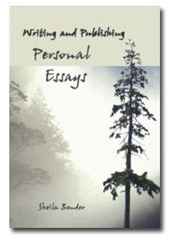
SheilaBenderIn two Part 1, and Part 2 of this series, noted essay expert Sheila Bender, author of the highly acclaimed  Writing and Publishing Personal Essays,  introduced the concept of essay writing as an adventure of personal discovery and described three freewrite exercises to start this process. In this final post, she explains how to harvest the riches of these exercises to open further possibilities for your writing.

Mining the Three Freewrites:

Whether you have done these freewrites in the course of one writing session or over several days, to find out what the freewrites have to tell you about an essay you might write, comb through them and jot down images and phrases that interest you.

When I look over what I have written, I am grabbed by:  “overwhelmed,” “dangerously close to the white line,” “shoulder to shoulder,” “heavenly bamboo,” “thorned bougainvillea,” “the plants survive” and “like me.”  I don’t know why exactly, but these words and phrases jump out. 

Next, I’ll challenge myself to write a paragraph that involves them all:

I live in Los Angeles shoulder-to-shoulder with millions, never far from others in our cars and apartments, on the busy beaches and walking and biking paths along them.  I was overwhelmed the first year I lived here with the sheer numbers of people, power poles strung with cable that buzzed audibly night and day, billboards and clogged freeway lanes.  Slowly I came to see what was planted, first the heavenly bamboo shrubs and of course the palm trees, draping bougainvillea along the banks up from the roads and the ficus trees lining the sidewalks.  I began to see the Morton Bay Figs, trumpet vines, stag horn ferns and exotic fruit trees, the kumquats and pomegranate trees.

It is perhaps not a surprise that distinguishing the plants coincided with making good friends and finding good work, that lonely, I saw only roads and cars and masses of people, and now more connected, I see flowers and trees, the way the people of LA cultivate what grows in this watered desert.  I struggle with my own container garden.  Against pests and fog, my diverse plants survive.  As I water them and watch people of diverse ethnic groups and cultural backgrounds drive and walk by my balcony, I realize I have come once again to value the American melting pot spirit that is alive and thriving in this city of angels and progress.  I have let the American Dream touch me once again.

From here, I could shape an essay that evokes the newly awakened American dream inside me.  I see that I might be talking about a process of growing numb to the dream for awhile before it reawakens in me.  I could talk about becoming jaded while coming of age in the 60’s when the country was engaged in an unpopular war and then again when raising children in the seventies and eighties and trying to teach environmentalism during a time of abundance and spoils. Now, watching and listening to people from all over the world raising families and seeking education, I am revived.  I believe that I could write this view of Los Angeles and of myself at this point in my life.

* * * * *

The way of writing that I am suggesting is aimed at opening writers to a state of not knowing exactly what will happen on their pages.  When we are i n this not-knowing state of being, words come through, and we start to figure out the terms of our explorations.  Teasing topics to the page in this way reminds us that every essay is written in response to the question, “What do I really know?” Finding out how we can put experience together into new knowing, we are on a treasure hunt; we search our way out of the not knowing.  This is the spirit that makes our writing come alive.

Sheila Bender is the author of over a dozen books, including her newest Behind Us the Way Grows Wider: New and Collected Poems, A New Theology: Turning to Poetry in a Time of Grief, Creative Writing Demystified and Writing and Publishing Personal Essays. To learn more about her books and her online classes and instruction, visit http://www.writingitreal.com.

Finding Starts in Personal Essay Writing, Part 2

writing-essaysIn the previous post, noted essay expert Sheila Bender introduced the concept of essay writing as an adventure of personal discovery. In this second of three parts, she continues with two more freewrite prompts.

A Second Freewrite

After writing from where you are, imagine yourself inside a place you can’t really write from, the pantry in your kitchen, a drawer, or perhaps a window box:

If I were sitting in the window box under the leaves of the trailing geraniums, I would look down at the impossible height and draw in my legs under my chin.  Would I feel cramped under scalloped leaves, next to the segmented stems?  Would a pink petal form a little rug at my feet or blanket my knees?  Nothing could protect me from the onrush of the watering hose, the torrents, the floods.  Would I sink into the spongy earth to arise like a swamp monster or get washed overboard to a new destiny, landing perhaps upon the heavenly bamboo or the thorny bougainvillea?

A Third Freewrite

Now open something in print and let your eye fall somewhere on the page. Use the words your eye falls upon as an opening for your writing. When I did this exercise last, I randomly opened William Kittredge’s collection of essays, Who Owns the West? to page 67 and pointed to these words:

Tess had worn a little path around the grave. She went down there and talked to him, she said. "I tell him the news," she said.  "Like all of us, Ray was given to a love of gossip and scandal.”

Knowing this passage was about mourning short story writer Raymond Carver, whose stories I had recently taught to an intro to fiction class, I wrote:

Like all of us, author Raymond Carver was given to a love of gossip and scandal. Although I never knew him, I’ve read and enjoyed his short stories, even taught one in particular, “The Cathedral.”  In this story, a narrator tells about the overnight visit of his wife’s former boss, a blind man from Seattle.  The narrator is a narrow-minded man with little real connection to others, and in the course of the evening, he does enjoy a moment of pure human (and therefore cosmic) connection with the blind man as they draw a cathedral together.  And gossip does seem to be a way of thinking in this story—the narrator uses all he has heard from his wife about this man to build notions about blindness that keep him from entering the moment.  I can certainly identify since I keep myself from living in the moment by leaning on structures in my mind.  One of those is the to-do list I seem to carry perpetually:

There are clothes at the cleaners waiting to be picked up, food to be found at the market, a resume to update and send out, and evening plans that require I bring a dish for the meal.  I have a set of papers to grade and more email than I want to answer at the moment waiting on the spool.  The cats are out of food and I have forgotten to cut their nails this month so they are sharp and leave scratches when they launch from my lap after a moth or a fly.  The outdoor plants need watering, on all three levels of my home.  The jasmine is in bloom.  I should fertilize.  Measure, mix, fill the jug, lift the heavy thing and hear the water rush into the pots.  Too much overflow in the dishes beneath the plants. Must empty that. They don’t like to get their feet wet, my horticultural friend reminded me.  No blooms on the bougainvillea, perhaps over watering.  Container gardening—there are rewards but the plants suffer if I am not attentive—cold roots, wet roots, underfed, overfed.  White fly, aphids. Bites out of leaves from something else I haven’t seen.  Somehow, the plants survive.  Like me!

Next post: In “Mining the Three Freewrites”, Sheila will conclude with instructions on how to tap the power of these freewrites to find a “new way of knowing” on the page.

Sheila Bender is the author of over a dozen books, including her newest Behind Us the Way Grows Wider: New and Collected Poems, A New Theology: Turning to Poetry in a Time of Grief, Creative Writing Demystified and Writing and Publishing Personal Essays. To learn more about her books and her online classes and instruction, visit http://www.writingitreal.com.

.

Everyday Editing

ThinkerWhat to tell and what to hide is one of the most puzzling questions we all face when writing life stories and memoir. Although few may have realized this, this sort of decision isn’t limited to writing. We make them on a regular basis, perhaps daily, maybe hourly.

My epiphany on this matter came as I wrote a recent email. The email included statements such as “Ordinarily I would not have mentioned this, but …” and “knowing the other side of this story may help you understand … more clearly.”

Rereading that email, I realized that even when I’m not writing, I constantly edit what I say for some or all of these reasons:

To avoid coloring person A’s view of person B.  I realize that my perceptions and beliefs about any given individual reflect my experiences and values which may not pertain to others. Of course that’s most true of less favorable impressions. Favorable ones I share quite freely. When I was young, I often heard the aphorism, “If you can’t say something nice, don’t say anything at all.

To help others avoid a pitfall or make sense of a puzzling situation. As an adult, I realize there are times when exposing the dark side of a situation or person may serve a valuable purpose in helping others avoid similar pain and pitfalls or to help them make sense of an otherwise baffling situation. But my personal code of ethics requires a compelling reason to do so.

To avoid embarrassing others. Children are taught (for better or worse) not to blurt out questions like “Why is that man all hunched over?” or observations like “Aunt Agatha sure is fat!” when that man or Aunt Agatha is within earshot. I could write an entire post about situations like this, but you get the drift.

To present myself in a favorable light. I admit it. I want to be liked and admired. I’m not eager to expose my many Achilles’ heels, though reluctance is crumbling with age and experience.

To express my thoughts in a way that makes sense to others. This requires a certain degree of awareness about the background and thought patterns of others and the ability to adapt to alternate points of view.

To keep others interested. How many times have you silently wished someone would get to the point? Excessive detail bogs down your story and causes glazed eyes and wandering attention in both readers and listeners.

Time limitations. I think at warp speed, about 16/7/365. There will never be enough time to report all my jumbled, overlapping, contradictory thoughts.

Filters and editing are an inherent part of effective communication in any mode. Most of us intuitively recognize the strategic importance of suiting both content and mode of expression to the purpose at hand as we go through our days. It’s no different with writing. Consider your reason for writing, what you hope to achieve, and the reaction you hope for from readers. Pair that with your best understanding of where they are coming from, and make you best call about what information will be most effective and helpful for them.

If you have brazen, inflammatory disclosures to make, you may feel safer doing so from behind the shield of print, but the issues involved in making that decision are almost identical to smaller ones you face each day.

Write and live honestly and boldly, with courage and compassion.

Write now: Think back over the last few days and identify situations where you chose to reveal or hide information. Use free writing to explore these decisions and the beliefs, attitudes and values that led you to make them. Then extend this reasoning to puzzling situations you face about disclosures in stories.

Memoir: Breaking Through to the Next Level

Breaktrhough3Over the last few days I’ve read two memoirs back-to-back, Margaret Overton’s Good in a Crisis and Jonna Ivin’s Will Love For Crumbs. Both stories revolve around disastrous relationships with men. I was struck by the fact that although these two women had very different backgrounds and their stories are quite different, each had to piece together the puzzle of her mother’s life to break free and follow a different path. I was reminded of computer games where you must find all the hidden tools to advance to the next level. 

As I thought about this similarity, I realized how universal this theme is. I did study Freud once, along with a tower of other psychology books, and dimly recall some psychobabble about “differentiation.” Obviously there is nothing new under the sun here, other than airing this process in public. That public sharing angle is the aspect that most fascinates me.

Thinking beyond the stories themselves, I realized that as I read each one, it stimulated me to think more deeply about my own life and relationships. I realized once again that although I’ve certainly faced my share of puzzling and tense times,  for the most part I’ve led a charmed life, spared most of the traumas they disclose. In spite of the odds against it, I’ve remained happily married for nearly fifty years, and my mother’s shortcomings are hardly worth mentioning. Still, although comparing my life challenges to theirs may be like placing the Blue Ridge mountains next to the Himalayas, reading how these women “broke through to the next level” and became more peaceful and comfortable in their skin settled me more securely in my own. 

As I pondered the powerful effect these books had on me, a light went on. Each woman explained at the end of her book that she initially began journaling or writing random notes in an attempt to make sense of her experience. Transforming those notes into a coherent narrative was a profoundly healing experience. That healing process rippled out to me as a reader, and presumably to a multitude. Perhaps, just maybe, those of us who are “called” to write and share our stories are gifted with the opportunity to help others find hidden clues and find their own next levels of peace and freedom. As we heal ourselves, the effect spreads through our words into the world at large. 

I’m reminded of thoughts I’ve heard, perhaps from Christina Baldwin, and probably also from others, about “restorying” the world. I’ve written a pile of blog posts scattered around the web about my own experience with revis(ion)ing my memories and discovering far more light in them than I ever imagined. I know the process works, and some memory visualization tools I’ve found are magic cursors pointing to hidden tools and maps.

Not everyone wants or needs to write and fewer still want to share their work. For many or most, it’s enough to read or privately journal. To whatever extent you are called to write for peace and healing, whether it be a letter of reconciliation and forgiveness, a single short story, or several volumes of memoir, write with boldly honest passion and flood the world with light. I’m beginning to find tangible evidence that as we heal the past, we also heal the future. Let’s get on with that!
As an aside, there is still time to register for my 3-week NAMW short course, Soaring High and Digging Deep: Tools for Refining Your Memoir. It begins this week. Find more details and sign up for the class and this month’s related free Roundtable here

Write now: start a collection of random notes about a person or situation that puzzles you. Add to this collection over time as further thoughts occur to you. When you run out of new thoughts, read through what you’ve written and transform that to narrative. As you work on that story, your understanding is almost guaranteed to shift.