Showing posts with label Food. Show all posts

Memoir Writing Lesson from Fiction

Fiction can offer powerful insights for memoir writers. I just began reading a classic historical novel, Divine Average, first published in 1952 by Elith Hamilton Kirkland. Like many novels, it’s written in memoir format, in this case an end-of-life memoir. It’s set in 1838-1858 in “that period of Texas history when ‘cow boy’ was a phrase with a controversial meaning and ‘Texians’ a nationality.

The second paragraph stopped me in my tracks:
I feel compelled at this time by the Spirit of the Holy Mother and the force of God to leave an account of the things that have happened to me and mine. It all lies on my heart like a confession that must be made before I can die in peace . . . a confession not only for myself, but for my husband, Range Templeton, who despises me now after loving me for twenty years, for my daughter Laska, lost to us and to herself, a companion to outlaws in the wilds of Mexico, and for my son, Luke Templeton, so bold of mind and pure in heart.
I know right away that Luvisa Templeton, “a consumptive, soon to die,” is confessing all for peaceful death, which she’s looking forward to “as deliverance.” This compelling reason to write creates a compelling reason to read. What juicy secrets is she about to divulge? What better way to hook my attention?

She immediately goes on to explain her time frame – the twenty years of her marriage to Rage Templeton – and her frustration at never being able to understand him. That sounds like a rich topic.

She then explains that she’s not penning this tome herself. She’s dictating it all to Mr. Bryson, a “very close friend to every member of the Templeton family,” which relationship she’ll explain in due course. Bryson is literate, articulate, better able than she to find the right words for her thoughts and feelings. Bryson has promised to place the completed manuscript “in the proper hands with instructions that it be preserved until such time as it might seem fitting to give it out for reading, in a book perhaps.” She continues:
Is it too much to hope that in some future generation these events may stir the minds and warm the hearts of men and women destined to know more and see further than those of us here now? Perhaps I attach too much importance to the life I have lived and the lives of which my living has played a part. But I yield completely to the compulsion that I must leave such a documentation. 
Like Luvisa, many of us write because we’re compelled to do so. In heeding that compulsion, we’ll do well to follow her fictitious example on several counts:

  • Be clear about why you are writing and
  • Who you are writing for.
  • Be clear about the frame for your story, in her case a twenty year marriage and
  • The story focus or theme, in her case what happened to her and hers. 
  • Have a strong, compelling opening. 
  • Get the tension/conflict going right away, in her case her husband who loved her for twenty years despises her now. Why? How did her daughter come to be in Mexico with outlaws?
  • Seek help when you need it. Luvisa used Mr. Bryson, a sort of ghost writer. You may choose to use an editor, beta readers, reading groups, friends, even family to help you on your way. 
  • Have a strong, compelling opening. 
  • Postpone distribution if you feel it unwise to disclose it all now. 

Points to Ponder: Do you have a story you’re compelled to tell? Can you identify the frame and focus? What help might you need to get it written? 

Memoir with Recipes

Although few things bond people like food and sharing recipes, I didn’t intend to include recipes in my mini-memoir, Adventures of a Chilehead, for several reasons:

1) Some of the stories are set in restaurants and I couldn’t include recipes for those.
2) Recipes for things like frijoles, chile con carne and enchiladas are easily found on the web.
3) When I cook, I use recipes as mere suggestions and cook by the seat of my pants based mostly on what’s in the kitchen at any given time. How do you write recipes for that?
4) Some ingredients, like chile powder, are unreliable in strength.

The finished book bears the subtitle “A Mini-Memoir with Recipes.” Obviously I changed my mind, primarily because most people who read early versions of the manuscript told me they wanted recipes. Since I value their input, I accepted their inspiration and set about writing creative recipes for food the way I make it. The way I make it varies from one time to the next so in addition to the standard list of ingredients and preparation steps, I had to include variations.

That resulted in long, involved instructions that explain a process rather than serving as a formula, but once I got started, thinking through all the factors involved turned out to be fun. In fact, it gave me a reason to make those dishes a time or two to be sure I had not missed anything, so we had lots of yummy dinners.

I explained things like where to buy good chile powder (perhaps online). Chile quality and potency is fickle, so I had to explain how to test the heat level of a new batch, and how to adjust recipes to individual tolerance levels. The recipe for homemade corn tortillas is over three pages long and gives guidelines for when it’s not worth making them as well as what brand of masa you’ll do well to avoid, and how to use grocery bags to simplify rolling or pressing them flat.

Most memoirs that include recipes put a single recipe at the end of each chapter. For example, Ruth Reichl’s Tender at the Bone and Judith Newton’s Tasting Home follow this pattern. Since some of my stories take place in restaurants or feature hot pepper sauce, and some stories spin off three or four recipes, it didn’t make sense to put them with the chapters. Besides, the length of the recipes would interrupt the flow of the stories.

Once I got rolling with the first few, I was having so much fun that I added many more favorites. Over half the recipes in the final list are not mentioned in the memoir section.

I’ve received a pile of emails from happy readers who have tried recipes with good success, and my family is delighted to have those recipes they grew up with documented for all time.

You don’t have to write an entire memoir, mini or full-length, to write about recipes. Next time you share a recipe, take the time to tell the history of the recipe, including some favorite memories, to go with it. Sharing its story builds the sort of bond I write about in the last chapter of Chilehead when I tell of feeling a link with centuries of women who have prepared chile for their families.

Write now: select one of your favorite recipes, perhaps one that has been handed down in your family, and write a story about how you came to have the recipe and memorable occasions when it has been served by you or others.

Guest Post: Recipes for Living

In this post Guest Blogger Judith Newton shares the back story about the food theme that serves to weave together numerous subthemes in her newly released memoir.

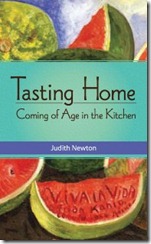
Newton headshot thumbMy memoir, Tasting Home, is about the healing and connecting powers of cooking and eating with others, a theme that came to me early in my life. Since as a child I’d found my mother’s meals to be the most secure form of nurturing I’d received, for me, as an adult, cooking became the only sure way I knew to create a sense of home. Tasting Home deals with some painful episodes in my life, but I wanted readers to experience the ways in which cooking helped me to establish emotional connections and a sustaining sense of joy. It is for this reason that the memoir is loaded with scenes in which I invite readers to the table, by recreating what the food tasted like, what surroundings it was eaten in, and the ways in which it bound me to others.

Tasting front cover thumbFood memoirs were popular by 2009 when I began Tasting Home. Some came with recipes and others did not. I decided to include recipes as a way of inviting readers to enter a communal space. Although I could share food experiences with my readers through telling my story, I wanted to give them a more lasting way of creating pleasurable moments in their lives. I think of recipes as gifts. I wanted my readers to feel what I often experience when I read magazines like Woman’s World — that I have entered a place in which women share stories, give advice, provide comfort, and hand on recipes.

Recipes also captured the changing cuisines and the spirit of the many decades I wrote about. Mastering the Art of French Cooking, for example, struck me as very much a product of the 1960s in the wild optimism and ambition it demanded of those who used it. (Julia Child’s recipe for Veal Prince Orloff went on for three pages when my mother’s recipe for spareribs in the 1950s took only one side of a 3 by 5 card.)

Recipes for the fifth section of the memoir, which covers the 1990s and 2000s when I was hosting buffets to build a cross-racial community on my campus, are often dishes that combine cuisines and that are easy to serve to a large crowd —goat cheese tamales, oven baked polenta with tomato fondue, Sonoma Jack cheese, and chiles en nogada, stuffed chiles in walnut sauce.

I also baked a lot from Martha Stewart’s Entertaining — lemon curd tart made with sweet Meyer lemons and tons of butter, pear frangipane with glazed pears on a bed of almond paste, a chocolate cake surprisingly flavored with whiskey-soaked raisins. Recipes helped the memoir become a book that invited readers to give parties, to bring exuberance to living, and to feel that , despite the suffering one might endure, life could be joyful, intense, and thoughtfully led. As one of my readers wrote about an early scene “you were in a moment of grace and you took us there with you.”

Huffington Post Food blogger Judith Newton is Professor Emerita at UC Davis and lives in the San Francisco Bay Area. On March 1, She Writes Press released her culinary autobiography, Tasting Home: Coming of Age in the Kitchen. The next stop on her blog tour is Eat, Drink & Be Merry Magazine.

Write now: pick out one of your favorite recipes that brings back memories and write the stories behind it.

Alpacas Are Mom Enough

NursingAlpaca

On a recent trip to Bolivia and Peru, our tour group stopped at the mysterious Sillustani burial towers near Puno, Peru. As we hiked up to the site, I was amazed to see a young alpaca nearly as big as the mother root for swigs of milk between mouthfuls of succulent grass. I was equally amazed that Mom didn’t seem to notice. Female  Alapacas are obviously mom enough, I thought, zooming in for a closer look at a picture I took.

My thought harks back to the May 21 Time Magazine cover. Its provocative picture of Jamie Lynn Grumet breastfeeding her three-year-old son as he stands on a stool created a predictable storm of controversy. The caption, “Are You Mom Enough?” added fuel to the fire, seeming to throw down a gauntlet to advocates of early weaning.

A quick search led me to an article showing that the proper age and process for weaning alpaca crias is as controversial among ranchers as the human topic.

You know where this is all going: story time! I became a mother just as Lamaze classes and La Leche League were picking up steam in Boston. Fellow grad student wives introduced me to these cutting edge trends that defied the tradition of the anesthetized birth experiences our  mothers had undergone and the hassle and hazards of bottle feeding. I inadvertently ended up with an “old school” Harvard Med professor obstetrician about my grandfather’s age, and their pep talks prepared me to stand my ground.

My dignified doctor was aghast at my plans to breastfeed. “We don’t raise our young women to be cows!” he said. “We’ll be traveling across the country when the baby is four weeks old …” I shot back. He gruffly conceded the point, but obviously clung to his belief.

Over the ensuing years, conversations with women friends have often ventured onto experiences and memories of breastfeeding. Some did, some didn’t. Some tried and soon switched to bottles for various reasons. 

We talk about it freely, but of all the hundreds of student stories I’ve read over the years, I do not recall a single one addressing the topic of breastfeeding— not even peripherally.

What a shame! What better topic to share with future generations than your experience in this regard, whether it be good, bad, or indifferent. These are the stories that bind generations, and may also serve as encouragement.

Before you write, consider your feelings about the topic. Does it embarrass you? Do you still feel the need to keep a blanket over the topic as you once hid your suckling infant from view? Does the topic of breasts seem too prurient to write about publicly? Where did your attitudes originate?

While you’re on the topic of feelings, think about the physical sensations and emotions involved – the feel of the child in your arms, the chair you generally used, satisfaction, pain, dismay – anything that comes to mind. If you chose to or had to bottle feed, how did you feel about that? Did you feel like a failure for not breastfeeding? Were you relieved? Follow your intuition to the bottom of this feelings barrel. What smells do you recall? How about sounds?

Do you have childhood memories of feeding babies? Did you help bottle feed siblings or babysitting charges? Did your other breastfeed you or your siblings? Did you hear her talk about it?

These questions have no right or wrong answers, but they are important. Weaving insights into a story or essay on the topic will give it life and meaning beyond anything a factual account could possibly achieve. Your thoughts and memories are an important part of the history of child reading and nutrition.

Write now: a story or essay about your experiences with breast or bottle feeding. If you never had children and/or you’re a man, your views still matter. You may not have had the same experience, but everyone has had experiences with this important subject. Please leave a comment about your feelings on writing about this topic.

Write a Birthday Story

My Grandmother Clara was known far and wide for her fabulous white cakes. During a visit one summer while I was in my mid-teens, she showed me her secrets. One of them was to sift the flour not once, but seven times. She always used Pillsbury’s Best flour — though she may have switched to Swans Down Cake Flour in her later years. She always slathered Seven Minute Frosting on it, and my very favorite was when she covered the frosting with coconut.

Although I know she baked this cake practically every time we visited, most have slid into a composite memory of Grandmother Clara’s White Cake. But one in particular stands out in memory. The year I was five, she baked her cake for my birthday, fixing it my favorite way, with coconut on the frosting. She wrapped it carefully in waxed paper (plastic wrap was decades away), set it in a box, and filled the empty space in the box with popcorn. Then she took it down to the Greyhound station in Clovis, New Mexico and put it on  a bus to Albuquerque. My mother met the bus in Albuquerque and brought the cake home. Nothing ever tasted so wonderful.

Other memorable birthday cakes include one my mom made for me with a Story Book doll stuck in the center of an angel food cake. She frosted the cake with whipped cream, smoothing it up to form a bodice for the doll, thus turning the cake into the doll’s huge big skirt. Another year she surprised me with an ice cream cake from Baskin-Robbins. I’d never heard of such and thing, and was it ever yummy!

Maybe because I grew up eating “real” cake, mixes and bake shop cake have never appealed to me. Their texture is off, and they taste like chemicals. To me, the act of making a  “real” birthday cake is a gift in itself, an act of love. I’ve always made cakes from scratch for family members and special friends. Preferences have shifted to chocolate, with a chocolate-chip mint ice cream-filled chocolate log cake at the top of the request list.

Cakes are only one aspect of birthdays. When I remember birthdays, I also remember gifts, though these memories are few. Unlike most of my friends then and now, our family never has been big on gifts and parties for birthdays. Then there are special events that have coincided with birthdays, and various joys and sorrows that accompanied the turning of the calendar.

Birthdays are a splendid time for personal rituals. I usually take a few minutes on mine to update my timeline. Many other people begin a new journal on their birthday, write a special entry in an on-going journal, or treat themselves to something special

All of this is rich fodder for stories as a feature element or elaboration in a larger story. Think back over your birthdays, and look for memories that belong on your story idea list.

Write now:
a story about a significant birthday you recall. What made it special? Tell about all the trimmings, whatever they were: cake, gifts, party, (or the lack of any or all of these.) Who did you celebrate with? What did you do?

Write-It-Yourself Gifts

The holiday season is approaching approaching like a freight train, and legions of people are looking for inexpensive gift ideas this year. Here’s an idea for you: Give the gift of yourself.

If you have already been writing life stories, this may be the perfect year to compile an anthology of your stories, lay them out nicely in a single document, and upload them to Lulu.com or Amazon’s CreateSpace for printing. You can produce a fully professional volume in your choice of hard or soft cover for a fraction of what it used to cost. For example, a 220 page paperback in the standard “trade” size of 6" x 9" lists right now for $6.25 base price on Lulu.com.

I used Lulu.com last year to publish The Albuquerque Years, a memoir of my life as a preschooler. It is 88 pages, full of photos, a slightly larger, wider page size (7.44" x 9.68") to accommodate the pictures and it sells (without any markup) for $6.29 on the Lulu website. You can also download a free eBook version there.

If you are primarily interested in creating books for your own use as gifts, or for order at cost by family members and friends, I recommend that you work with Lulu. They will convert your file to pdf format for you (although you can easily do this yourself with the free, downloadable pdf conversion utility, PrimoPDF), they have on online cover creation utility if you need help with that, and they allow you to list the book in their catalog without adding a markup for royalties if you wish. You can even allow people to download your book as a eBook for free from their website.

CreateSpace also allows you to obtain copies of your book with no set-up fee, and they may be even less expensive than Lulu. I say may be, because quite frankly, I find CreateSpace confusing and a bit intimidating. I set up an account, but did not easily find information on pricing and related matters. Even though it is confusing, I do recommend CreateSpace for projects you want to sell commercially with a royalty. The direct link into Amazon is probably worth the hassle, and I have heard good things about the quality.

There are other Print-On-Demand services, but these are the only two I know enough about to comment on.

If you don’t have a pile of stories ready to be compiled, you may prefer to do a cookbook with favorite family recipes. Write a short story with a quick memory associated with each recipe, and include Cooks Notes about menus using the recipe, special modifications you make, who especially likes it, and that sort of thing. I haven’t checked this on CreateSpace, but on Lulu you can order your book bound with a comb binding, a nice option for cookbooks. The advantage of using Lulu is that you can select page sizes other than letter-size as you’d get at a local copy shop.

Since you can include an unlimited quantity of photos and other artwork in a Print-On-Demand book, you could also create an annotated photo album. Lulu can print in color as well as black-and-white, though the cost per page is significantly higher.

If you need help with layout to get your manuscript ready for conversion to a pdf file, I give step-by-step instructions for everything you need to know in the final chapter of The Heart and Craft of Lifestory Writing.

So, there you have it — ideas for write-it-yourself gifts, and a referral to a production partners to make it happen. Get those fingers flying while there's still time, and delight the people on your list with a one-of-a-kind, write-it-yourself gift.

Write now: an outline of contents for a gift book for one or more people. But don’t stop with the outline. Keep your momentum going and create the file.

I'd Rather Read About Cooking

I'd rather read about cooking than actually do it. Cookbooks are like relaxing beach books to me...they transport me to a parallel universe where I have intimate dinner parties featuring sophisticated conversation, rustic red wines and homemade pasta.

A light of recognition flashed as I read this passage in a Daily Muse e-mail from Skirt.com. Yes! I too love to read cookbooks. I almost never use them, because I’m more of a right-brain cook, making do with whatever is in the fridge when it’s time to feed faces, but having a solid grounding in exotic recipes gives me new ideas for how to use old ingredients.

I’ve been an impulsive cook since since my days as a bride, but my attitude toward cooking has changed considerably over the years. For the first twenty or thirty years, I regarded cooking as a maintenance chore, to be hurried through in minimum time. About twenty years ago I had lunch with a business contact who was old enough to retire and about ready to. I don’t remember her name, but I do remember a question she asked. In the middle of the meal she leaned toward me and asked in a conspiratorial tone, “Tell me, do you cook?” Obviously the right answer was “Oh yes!” But I knew I’d be over my head within seconds , so instead I quipped, “Only when I want to eat.” A brief flicker of disappointment passed across her face and we returned to business matters.

I’d answer that question differently today. I don’t “cook” in the sense of pouring over gourmet magazines and preparing dishes that use every pot in the kitchen and take seven hours, but I have come to appreciate the art of fine slicing and being more aware and present as I prepare food. I enjoy trying new seasonings and occasionally even resort to a recipe from one of the gorgeous books that fuel my imagination.

Today the average American has more food choices available than any people on earth have ever had. We have more variety in an average supermarket than chefs in the golden age of Rome could imagine (though the Chinese royalty may have come close). We have the cuisines of the whole world to enrich our menus. And then there is the whole field of nutrition, “eating healthy”, and “eating local”. Cooking and eating has become a complex and fascinating adventure for those who pay attention.

Passion for variety and quality in food extends to reading. Besides the cookbooks mentioned above, food is a popular memoir topic. Several titles I've enjoyed come quickly to mind:
Animal, Vegetable, Miracle by novelist Barbara Kingsolver.

Tender at the Bone, Comfort Me with Apples, and Garlic and Sapphires by Ruth Reichl, currently the editor of Gourmet Magazine.

Untangling My Chopsticks by Victoria Abbot Riccardi.

Educating Alice by journalist Alice Steinbach.

Take Big Bites by Linda Ellerbee.
You may not want to write a whole book about the food in your life and how you cook it, but a story or few about it will surely fascinate future generations, especially if your descriptions of food and meals include plenty of detail. Who knows? Kitchens may disappear in favor of reheating stations. Or, as global warming advances, people may have to go back to simple diets with limited ingredients. Time will tell, but in either event, your stories may be helpful as well as interesting.

Write now: about your evolving eating and cooking habits if you’ve been cooking for more than a couple of decades. Or write about the foods you grew up with, and how your current menus incorporate and/or transcend that food.

The Frito Pie Cult

Last week I read Linda Ellerbee’s latest memoir, Take Big Bites. I loved this book and found much to think about, starting with the story she relates in the first chapter about Frito Pie.

I sat up and saluted that story. The chile-onion-garlicy aroma of Frito Pie still hung in the air and the taste lingered on my lips as I read. I’ve been making Frito Pie for twenty years, though I had no idea what it was. I got the recipe from my grandmother, who lived in Las Cruces, New Mexico, and the title on it was Chile Chip Casserole. Her eccentric concoctions were legendary. I assumed this was another one of them, though it seemed less bizarre than usual for her, and she seldom wrote recipes down. I assumed she had made it up, because when I was growing up in New Mexico, Mexican food was a staple in our family’s diet. Although we generally stuck to the traditional New Mexico red chile and cheese stacked enchiladas or rolled tacos, we did innovate in later years.

Perhaps I’ve innovated the most. Though this recipe was an instant hit from the first time I made it, I probably never did follow it to the letter. I use whatever tortilla chips I have on hand, because I can’t even remember the last time I purchased Fritos, a mainstay of my childhood diet.

One mention of Frito Pie could pass from memory in a flash. But a couple of days later I say it again, probably in a blog, and again somewhere else the day after. Today in a blog update post from RssFwd (new owner of Blogarithm), I saw a link to redRavine and Ybonesy’s story, The Cult of Frito Pie.

In this storm of stories about Frito Pie that has hit with such strength and focus, it has grown obvious that Frito Pie is indeed a cult; one I didn’t realize I belonged to. Part of the cult ritual is posting your own Frito Pie recipe, or in my case, Chile Chip Pie. Though I’ve never included a recipe in this blog, there’s a first time for everything, and recipe-story combinations make delicious reading. You see my well-worn copy of her recipe below. I scanned it rather than typing because there is something special about saving it in her handwriting.


I have no idea how that page got so yellowed and stained. It isn’t like I pull it out to cook from! In fact, I generally make this from left-over chile by stirring in “enough” onion, cheese and tortilla chips, and who needs a recipe for that? But that's exactly what she urges in her closing comment: “You can vary this to use what you have on hand —”

Here is my “from scratch” version as I make it for company:

Enchilada Casserole

One pound ground beef
One large chopped onion
Two or three cloves garlic, minced and smashed
1 tsp. cumin
Chile powder to taste (amount varies on personal preference and type of chile)
1 Tbsp. all purpose flour
8 oz. can tomato sauce
2 cups drained, cooked pinto beans (home-cooked are best)
1 cup grated cheddar cheese (longhorn is traditional, mild or medium cheddar, colby or Monterey jack also work)
1 cup sliced black olives
2 cups crushed tortilla chips (plain or flavored)
Shredded lettuce (optional)
Chopped fresh tomato (optional)

Brown beef, half the onion, and garlic in large skillet over medium heat. Add cumin, chile powder and flour. Cook and stir to mix flour and chile well. Add tomato sauce and stir as it thickens. Add water as necessary to make medium sauce (not runny).

Transfer mixture to large mixing bowl. Stir in beans, remaining onion, olives, and cheese. Add crushed tortilla chips. Place in two-quart casserole. Bake at 350° F for about 30 minutes or until bubbly.

Optional: top with shredded lettuce and fresh tomato to serve.

If I had a reliable local source of tasty canned enchilada sauce, I’d use that instead of the seasonings and tomato sauce. Unfortunately I live in one of the last places in America to lack a full offering of Mexican food ingredients.

Oh, my, I have some beans in the refrigerator, hamburger in the freezer ... I'm hungry!

Write now: about a cult recipe or traditional family favorite you’ve enjoyed through the years. Include your version of the recipe, the history of it, and how you came to start making it.