Showing posts with label Practice. Show all posts

The Writer’s Path

WritePathAlthough 99% of my writing is stored electronically in several places, I have a  filing cabinet in my office, with drawers 24" deep. The back of of them is hard to access. That’s where my oldest stories are stored, the ones I wrote in 1979 on my old Smith Corona electric at the beginning of my journey along my Writer’s Path.

Every few years I pull those stories out and am reminded again how utterly pitiful they are. True, they were fiction. Sort of. I didn’t know about lifestory writing yet, and would not have been brave enough to write openly anyway. Although some content is touching, descriptions were flat as Kansas, dialogue stilted and contrived. They jumped around. And they were preachy. I had an agenda when I wrote those stories and it wasn’t hidden. They were a start.

Twenty-five years ago, I knew nothing of creative writing classes or writing groups, and never thought to look for books on how to write. I was shooting from the finger tips, buoyed by A’s on research papers.

I fared a bit better when I became contributing editor for a local women’s magazine, getting favorable remarks on my stories from casual acquaintances. When my first book, Meetings: Do’s, Don’ts and Donuts, was published in 1997, I was horrified by the first round of editing. That red ink looked like blood in a war zone.  Humiliation rapidly morphed into hope and excitement at the prospect of learning to be a serious writer. That experience was a cram course in writing.

Since then I’ve taken writing courses. I’ve read stacks and piles of books on how to write, spent hundreds of hours reading websites and listening to webinars and podcasts. But even more, I’ve written and written, and I’ve edited hundreds of stories for students. I have written for at least those 10,000 hours presumably required for mastery, though I don’t claim any titles as such. I’m great at description, but I still have much to learn. My path continues to go up and down, rising overall.

Looking back at those early stories, even at early blog posts, I can see that yes, I have learned, slowly at first, then more rapidly as I climbed along that path. I have grown as a writer, and I hope I continue to do so as long as my fingers move. I still can’t crank out a masterpiece on the first try. I edit my own work, sometimes going back months later when it feels like a stranger wrote it. And I continue to rely on feedback from others for points of view I would never, ever think of.

New writers, take heart. While it’s true that some people are born with a gift for eloquence, even they have a learning curve – they just learn faster. Some people are born with an eye for painting, others with the right legs for running. We each have a gift. But even those without “the gift” can learn to produce respectable results.

With practice.
With guidance.
With collaboration.

Take classes. Read, both how-to-write books and memoir or fiction. Join a writing group. Above all, keep writing. You’ll see results much sooner than I did, because it took me forever to find people to help me along the path. You don’t have to wait. Please join our growing community of life writers on the Life Writers Forum on YahooGroups. Sign up for the mailing list of the National Association of Memoir Writers and participate in the free monthly teleseminar roundtables. And keep writing! Climb that writer’s path, one story at a time.

Write now: write a story about your earliest memory if you’ve never written before. Pull out the oldest story you can find if you’ve been writing for awhile and look for ways to improve it. If you don’t see any, show it to a writing buddy and ask for feedback. If you still can’t find any, congratulations. You are ready for publication!

Write for Emotional Impact

emotion thesaurus

In 2007 I wrote two posts, “Color Me Obsessive,” Part 1 and Part 2, about a collaborative effort to compile a comprehensive list of terms describing emotions and feelings. With the help of classes I later taught, that list has grown to include 1100 words.

Many other posts here and on my Writing for the Health of It blog cover the physical and emotional health benefits of labeling and expressing emotion. But there’s a lot more to it. It’s not just for and about you.

Feelings and emotions are a corner stone of connecting with readers. Readers want to know what is going on in a character’s mind and heart. In the case of writing memoir, the only character you can speak directly for is yourself. That doesn’t mean that other people are restricted to the role of paper dolls. You can tell readers what you observe, assume, and hear them say.

The most obvious way of conveying these emotions is to express them directly as adjectives or verbs, but that’s limiting, and tends to keep a story glued flat to the page. In The Emotion Thesaurus Becca Puglisi and Angela Ackerman explain:

Readers have high expectations. They don’t want to be told how a character feels; they want to experience the emotion for themselves.

In previous posts I’ve urged you to practice tuning in to your own non-verbal cues when you are in various states of emotion, and to closely observe these cues in others. Keeping a journal of your observations gives you golden nuggets to use as you write, helping you satisfy those reader expectations.

However, if you are writing now, you need a huge database now, and you don’t have time to spend a few years observing yourself and others to develop a strong vocabulary for adding this element to your stories, and even if you did, you probably don’t know how to go about it. I didn’t. Fortunately, Puglisi and Ackerman explain:

To convey feelings well, a writer must also utilize nonverbal communication, which can be broken down into three elements: physical signals (body language and actions), internal sensations (visceral reactions) and mental responses (thoughts).

The book goes on to give you tools for doing just that. It begins with a brief section overviewing the three elements, demonstrating how to use them, and describing how to avoid common problems like telling, clichéd emotions, melodrama, over-reliance on dialogue, and more.

Over 90% of the book is devoted to an in-depth analysis of 75 key emotions ranging from adoration to worry. Each word entry begins with a definition, then moves on to exhaustive lists of physical signals, internal sensations, mental responses, cues of acute or long-term (name of emotion), what it may escalate to, cues of suppressed (name of emotion), and a writer’s tip.

When I finally got around to buying this book a few months ago, my heart beat a little faster as I realized that I’d struck gold, perhaps more than they realized when they wrote it. This material will definitely punch up my writing, but it’s also helping me become more perceptive of others and more accurately assess what they may be feeling. Some fortunate people seem to have been born with an innate sense of this. Others of us need all the help we can get to emerge from the “clueless” state.

You may wonder how to reconcile the 1100 emotions on the list I developed with the relatively paltry sum of 75 they assess. As I scan the longer list, I can easily cluster the terms as synonyms for the 75 core emotions in the book, so you can take the long list and reduce any of the other 1025 terms to its nearest core word and go from there. But even if you limit your emotional vocabulary to the 75 and use them in the masterful ways you’ll learn in this book, nobody is going to miss the more elaborate terms.

If you are serious about putting wings on your words, this is a book you’ll want to keep at your fingertips.

Write now: using the words angry, sad and happy, practice writing sentences or paragraphs that express those emotions through body signals – language, actions, or appearance. Write two sets of these, one from your point of view and also as you observe them in somebody else. Then from  your own point of view write about visceral sensations and inner monologue for each of the three emotions. Then look at a few old stories and look for opportunities to add impact by incorporating these additional modes.

Finding Starts in Personal Essay Writing, Part 3

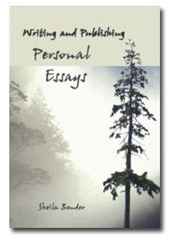
SheilaBenderIn two Part 1, and Part 2 of this series, noted essay expert Sheila Bender, author of the highly acclaimed  Writing and Publishing Personal Essays,  introduced the concept of essay writing as an adventure of personal discovery and described three freewrite exercises to start this process. In this final post, she explains how to harvest the riches of these exercises to open further possibilities for your writing.

Mining the Three Freewrites:

Whether you have done these freewrites in the course of one writing session or over several days, to find out what the freewrites have to tell you about an essay you might write, comb through them and jot down images and phrases that interest you.

When I look over what I have written, I am grabbed by:  “overwhelmed,” “dangerously close to the white line,” “shoulder to shoulder,” “heavenly bamboo,” “thorned bougainvillea,” “the plants survive” and “like me.”  I don’t know why exactly, but these words and phrases jump out. 

Next, I’ll challenge myself to write a paragraph that involves them all:

I live in Los Angeles shoulder-to-shoulder with millions, never far from others in our cars and apartments, on the busy beaches and walking and biking paths along them.  I was overwhelmed the first year I lived here with the sheer numbers of people, power poles strung with cable that buzzed audibly night and day, billboards and clogged freeway lanes.  Slowly I came to see what was planted, first the heavenly bamboo shrubs and of course the palm trees, draping bougainvillea along the banks up from the roads and the ficus trees lining the sidewalks.  I began to see the Morton Bay Figs, trumpet vines, stag horn ferns and exotic fruit trees, the kumquats and pomegranate trees.

It is perhaps not a surprise that distinguishing the plants coincided with making good friends and finding good work, that lonely, I saw only roads and cars and masses of people, and now more connected, I see flowers and trees, the way the people of LA cultivate what grows in this watered desert.  I struggle with my own container garden.  Against pests and fog, my diverse plants survive.  As I water them and watch people of diverse ethnic groups and cultural backgrounds drive and walk by my balcony, I realize I have come once again to value the American melting pot spirit that is alive and thriving in this city of angels and progress.  I have let the American Dream touch me once again.

From here, I could shape an essay that evokes the newly awakened American dream inside me.  I see that I might be talking about a process of growing numb to the dream for awhile before it reawakens in me.  I could talk about becoming jaded while coming of age in the 60’s when the country was engaged in an unpopular war and then again when raising children in the seventies and eighties and trying to teach environmentalism during a time of abundance and spoils. Now, watching and listening to people from all over the world raising families and seeking education, I am revived.  I believe that I could write this view of Los Angeles and of myself at this point in my life.

* * * * *

The way of writing that I am suggesting is aimed at opening writers to a state of not knowing exactly what will happen on their pages.  When we are i n this not-knowing state of being, words come through, and we start to figure out the terms of our explorations.  Teasing topics to the page in this way reminds us that every essay is written in response to the question, “What do I really know?” Finding out how we can put experience together into new knowing, we are on a treasure hunt; we search our way out of the not knowing.  This is the spirit that makes our writing come alive.

Sheila Bender is the author of over a dozen books, including her newest Behind Us the Way Grows Wider: New and Collected Poems, A New Theology: Turning to Poetry in a Time of Grief, Creative Writing Demystified and Writing and Publishing Personal Essays. To learn more about her books and her online classes and instruction, visit http://www.writingitreal.com.

Finding Starts in Personal Essay Writing, Part 2

writing-essaysIn the previous post, noted essay expert Sheila Bender introduced the concept of essay writing as an adventure of personal discovery. In this second of three parts, she continues with two more freewrite prompts.

A Second Freewrite

After writing from where you are, imagine yourself inside a place you can’t really write from, the pantry in your kitchen, a drawer, or perhaps a window box:

If I were sitting in the window box under the leaves of the trailing geraniums, I would look down at the impossible height and draw in my legs under my chin.  Would I feel cramped under scalloped leaves, next to the segmented stems?  Would a pink petal form a little rug at my feet or blanket my knees?  Nothing could protect me from the onrush of the watering hose, the torrents, the floods.  Would I sink into the spongy earth to arise like a swamp monster or get washed overboard to a new destiny, landing perhaps upon the heavenly bamboo or the thorny bougainvillea?

A Third Freewrite

Now open something in print and let your eye fall somewhere on the page. Use the words your eye falls upon as an opening for your writing. When I did this exercise last, I randomly opened William Kittredge’s collection of essays, Who Owns the West? to page 67 and pointed to these words:

Tess had worn a little path around the grave. She went down there and talked to him, she said. "I tell him the news," she said.  "Like all of us, Ray was given to a love of gossip and scandal.”

Knowing this passage was about mourning short story writer Raymond Carver, whose stories I had recently taught to an intro to fiction class, I wrote:

Like all of us, author Raymond Carver was given to a love of gossip and scandal. Although I never knew him, I’ve read and enjoyed his short stories, even taught one in particular, “The Cathedral.”  In this story, a narrator tells about the overnight visit of his wife’s former boss, a blind man from Seattle.  The narrator is a narrow-minded man with little real connection to others, and in the course of the evening, he does enjoy a moment of pure human (and therefore cosmic) connection with the blind man as they draw a cathedral together.  And gossip does seem to be a way of thinking in this story—the narrator uses all he has heard from his wife about this man to build notions about blindness that keep him from entering the moment.  I can certainly identify since I keep myself from living in the moment by leaning on structures in my mind.  One of those is the to-do list I seem to carry perpetually:

There are clothes at the cleaners waiting to be picked up, food to be found at the market, a resume to update and send out, and evening plans that require I bring a dish for the meal.  I have a set of papers to grade and more email than I want to answer at the moment waiting on the spool.  The cats are out of food and I have forgotten to cut their nails this month so they are sharp and leave scratches when they launch from my lap after a moth or a fly.  The outdoor plants need watering, on all three levels of my home.  The jasmine is in bloom.  I should fertilize.  Measure, mix, fill the jug, lift the heavy thing and hear the water rush into the pots.  Too much overflow in the dishes beneath the plants. Must empty that. They don’t like to get their feet wet, my horticultural friend reminded me.  No blooms on the bougainvillea, perhaps over watering.  Container gardening—there are rewards but the plants suffer if I am not attentive—cold roots, wet roots, underfed, overfed.  White fly, aphids. Bites out of leaves from something else I haven’t seen.  Somehow, the plants survive.  Like me!

Next post: In “Mining the Three Freewrites”, Sheila will conclude with instructions on how to tap the power of these freewrites to find a “new way of knowing” on the page.

Sheila Bender is the author of over a dozen books, including her newest Behind Us the Way Grows Wider: New and Collected Poems, A New Theology: Turning to Poetry in a Time of Grief, Creative Writing Demystified and Writing and Publishing Personal Essays. To learn more about her books and her online classes and instruction, visit http://www.writingitreal.com.

.

Finding Starts in Personal Essay Writing, Part 1

SheilaBenderToday’s post is the first of a three-part series by noted author Sheila Bender. Sheila has become one of the leading national experts on writing personal essays. Her book, Writing and Publishing Personal Essays, is in its second edition. With her books, her online classes, coaching, and myriad of other services, she has helped thousands benefit from the humble art of personal essay.

Although it might not be obvious, those of us who write personal essays can benefit greatly from not knowing what we have to write about.  That is surprising to people who think of the essay as researched knowledge with a professorial, didactic tone.  But to write an essay is really to “assay” or test out a hypothesis about something.  If writers walk around with a head full of ideas and think they have to commit to writing them, they miss the hypothesis part of the process, the part about finding something of interest to test.  In other words, the essay is an exploration, not an initial knowing.  Because of this, I like to utilize exercises for finding topics that model not knowing as a way of beginning essays.

After the following directions for a series of three freewrites, I will show you how to mine the collection of material you create to discover your hidden essay topic.

First Freewrite

Go to a place you have not previously come to write.  It can be the corner of a room or a chair facing a different window than you usually face; you might sit at a café or park bench new to you, or even your car will work if you do park somewhere other than your habitual spot.  In fact, just getting out of the driver’s seat and sitting in a passenger seat could make any parking spot new for the purposes of this freewrite.

Begin your freewriting by describing where you are and what you see where you are.  You can add in what you think you will be able to see in the near future.  Then involve your other senses to stay “in scene” and really deliver the experience of the place you are describing. A sound or sight, smell or texture, or even the taste of something you are eating or have waiting for you for lunch will offer new experience and associations.  So stay specific. Don’t be cursory.  Don’t write, “Here I am again writing before I go into work and there are cars as usual and I am tired as usual.” Instead stay in the moment and record details from where you are:

Here I am again writing in my journal before I go into work and I am parked dangerously close to the white line that separates my space from the next car’s slot.  That spot is empty now but within minutes someone will drive in and our cars shall remain close, shoulder-to-shoulder, for the eight hours of the workday.  I hear the fibers of my wool scarf like Velcro releasing as I pull the scarf from off my coat collar and I smell the boiled egg I’ve packed in my lunch today and think of the animals that have scent glands and release smells as warning or to mark territory like this sandwich might if I let it out on my desk. When I open the car door, pulling the hard plastic handle will be like a handshake I don’t quite want to make with a person I must depart from though I don’t feel our business is done.  I will leave my scarf in the car so I don’t later forget to replace it around my neck.  What secrets does it keep wrapped up here on the seat till I return?  I will enter the cement-chilled air of the basement garage heading toward the chrome-lined elevator.  I will go up and up, hoping the crowd of my thoughts will stay warm and hatching until I return.

Next post: Instructions and prompts for two more freewrites.

Sheila Bender is the author of over a dozen books, including her newest Behind Us the Way Grows Wider: New and Collected Poems, A New Theology: Turning to Poetry in a Time of Grief, Creative Writing Demystified and Writing and Publishing Personal Essays. To learn more about her books and her online classes and instruction, visit  http://www.writingitreal.com.

Does Practice Make Perfect?

HoopThis question came to mind when I read Jody Hedlund’s blog post, Do Writers Get Better the Longer They Write?” I like her conclusion, and want to add to it.

Her question reminded me of the old adage,

Practice makes perfect.

Added to this adage is a truism some noted author of the stature of Steven King (maybe it was him … I’ve forgotten) stated: “You can’t call yourself a master of the art of writing until you’ve put in 10,000 hours.” Or was it 10,000,000 words? The point was, it takes a lot of practice to become a masterful writer.

What’s the truth of the matter? Practice does not make perfect. The practice of perfection makes perfect. This evolution of the concept came about when sports gurus discovered that basketball players who visualize sinking 100 perfect shots each day improve significantly more and faster than those who physically shoot 100 baskets a day for the same length of time. Shooters make plenty of bad shots. Visualizers never miss.

Obviously if you want to improve your writing, you’ll need to do more than keep your fingers moving. Jody Hedlund has an important suggestion regarding finger movement. Here are three for the “more than” angle:

Read the work of great writers of memoir and fiction

Rather than repeating tips in a previous post, I’ll add to them:

  • Pay attention to how the writer uses description and dialog.
  • Notice the structure of the story. How is it unique?
  • How does the writer manage the pace of the story and the flow of tension?

Look for ways to incorporate what you learn into your stories.

Practice awareness

Make it a practice to monitor your internal state and notice how you feel in different situations. What body cues do you experience? How do you physically respond? How might your behavior or speech change? Incorporate this awareness into your story for a sense of authenticity and develop connection with readers.

Pay attention to the world around you and use idle moments to explore fresh ways of describing what you notice. Look for unexpected links and connections. You many not have thought of it this way, but this is a form writing practice.

Play with words

Go back over your drafts sentence by sentence and think of the words as building blocks. Question each one. Does it add value to the sentence? Is it as precise as it can be? Would rearranging the words make the sentence flow more smoothly?

Bottom line

The key element in each of these tips is attention, which is another way of thinking about visualization. Basketball players visualize that ball sliding directly through the center of the rim and their muscles record the sensation of putting it there. When you read, you are developing a sense of what good writing looks and sounds like. That’s the writers equivalent of knowing what the ball looks and feels like going into the basket.

Paying attention to your surroundings and visualizing great descriptions is the same as shooting mental baskets. Mental writing can be as valuable as moving your fingers.

Playing with words draws upon the insights you derive from reading. Slowing down and paying attention to what you have written allows you to exercise your new insights.

Jody Hedlund urges you to challenge yourself. So do I. Add to her challenge the challenge of becoming ever more aware and attentive.

Write now:  Read a great book, write a review of it, think of descriptions of your surroundings as you move through your day, and/or play with the words in a favorite story.

Photo credit: Max Barñers

Write Like Nobody Will Read

Polish DancersDance like nobody’s watching,
Write like nobody will read.

These words darted into my monkey mind as I gazed at Christmas lights, thinking back to high school days when folk dancing was a favorite activity. A motley mixture of adults and teenagers gathered each week at the Rec Hall for a medley of line and couples’ dances from many nations. College kids home for Christmas made holiday dances especially festive.

There were never any lessons – you just picked the dances up as you went, with occasional pointers from old-timers. Any athletic ability in our family went to my sister and brother. I was one of those kids always picked last for whatever team was forming in P.E., so, although I loved the music and the dancing, I was never a picture of grace. On some level I knew this, but put it out of  mind. I was having fun. At least until the night Kelly gave me some startling advice.

“Quit trying to make like a ballerina,” she said with a sneer. “Do you have any idea how ridiculous you look?”

Ouch! Where’s the nearest hole? I fled to the ladies’ room to do battle with my Inner Critic.

Kelly was a couple of years older than I and home on break from college. She had studied ballet practically all her life, and she was good enough to turn pro. Undoubtedly watching my awkward attempts was painful for her, and tact had never been her strong suit. Perhaps she meant well, but her words stung. Fortunately she disappeared back to school, and I soon got over the humiliation and enjoyed dancing as much as ever, perhaps more.

I didn’t discount her message. After thinking it through, I did begin to relax into the music more, and seemed to move a bit more fluidly. If I was still a little awkward, so what? It didn’t seem to bother anyone but Kelly. We were there for the joy of dancing, not to put on a performance, and in general we were an accepting group.

Today as I recalled that horrific moment, I made the obvious connection to writing. There was a time when my writing was almost as awkward as my dancing. I have drafts of two short stories I wrote in 1978. They are utterly dreadful! I keep them as benchmarks for measuring progress. When I went to college I fell away from folk dancing, so I’ve had little opportunity to refine those skills. But I have continued writing for over thirty years now, and with lots of feedback, study and practice, I’ve made progress.

Today I often dance at home alone. I dance because I love to dance. I dance like nobody is watching, which is easy, because they aren’t. I write the same way. I write thousands of words nobody will ever see for every hundred I share. Maybe if I took up folk dancing again, I’d do better at it for all the private practice.

My advice for you: Forget the Kelly’s in life. Dance like nobody’s watching and write like nobody will read. If a Kelly wanders in, look for what you can learn and forget the rest.

Write now: about a Kelly experience in your life. How did you react? Did you shut down or keep slogging away? What did you learn then? What can you learn now for revisiting the event?

Image credit: Brendan Lally