Showing posts with label Exercise. Show all posts

Respecting Your Writer’s Voice

Writer-Voice“It’s critically important to find an editor who will respect your writer’s voice and not try to change it into her own.”

Electric agreement surged through  the room during a Penn Writers self-publishing workshop offered last weekend by acclaimed Pittsburgh author Kathleen Shoop. Heads nodded, and a ripple of “Mmm hmm” rose and fell.

I exchanged nods with friends sitting on both sides. Then a memory tempered my thought. Ten years ago a group fondly referred to as “angel editors” banded together to help a mutual friend – I’ll call him Will – hammer a complex memoir into publishable shape..

Aside from structural concerns, as editors we faced a delicate challenge: Transforming Will’s voice from a stilted style with big words and convoluted, page-long sentences into something that flowed smoothly into readers’ eyes, ears and brains. Will finally agreed that we needed to streamline the language without compromising the message or completely losing his voice. The resulting book went into a third printing.

Will’s purpose for his book was to inform a wide, general readership. Thus his voice had to be changed for reader appeal.

Conversely, when compiling a vast array of drafts and notes my mother left behind, I changed only documented factual mistakes, a few flagrant grammatical errors, and typos. Since she was no longer around to discuss style and voice, I left things like her strings of dots and signature clichés so it sounded like a letter from Marje.

Marje’s purpose for writing was to leave a legacy of personal and family history for posterity. Leaving it in her words and phrasing was an additional way of documenting the writing style of her generation of women.

Where is the balance? These are two extreme examples. In general, when I edit a story, I find ways to smooth rough edges and make words flow more smoothly. My edits are only suggestions. My fix for a phrase that sounds awkward to me may grate on the author’s ear.

The extent to which I change things depends in large part on the author’s purpose. If I’m helping a friend finish a family project, I’m less inclined to tinker. In my opinion, a bit of colloquialism and cliché lends authenticity. If an author hopes to sell truckloads of books to the public, buckets of red ink may flow.

So, you see, how much an editor (that includes friends and critique groups) should mess with your voice depends on your purpose. If you plan to appear on stage, appropriate makeup will emphasize your message. Stage makeup is out of place on a mountain trail.

Experience and practice are additional factors. A polished writing voice is not necessarily the sign of an expensive editor. Writers follow a learning curve much like musicians. Beginning piano students do well to tap out Chopsticks. Ten years later, they may perform Beethoven sonatas with ease. In between lie thousands of hours of practice with gradual improvement.

Your writing voice will likewise gain tone and force as you seek constant feedback and work to improve. That does not make your voice less authentic. It reflects the years of practice you put in and becomes natural and authentic for you.

As you continue down your writing path, you’ll discover that each story has a unique voice. Some are humorous, some sassy, some sad or mournful. Let your stories whisper their way, and your voice will grow in range.

Write now: if you have some, read a few unchanged stories you wrote several years ago and consider how you might change them today. Even if you’re a beginner, start a practice of keeping versions of stories to help keep track of how much your writing has developed. If you change a story after more than a year has elapsed, rename it to preserve the old version so you can compare. Think of this as your growth chart and celebrate your continuing improvement!

Mouse Shoulder Break

Nerves_of_the_left_upper_extremityI call it mouse shoulder. Doctors and physical therapists  talk about ulnar nerves. Whatever the technical term, it means I’ve been spending way too much time at my computer than is good for my body. My little finger tingles all the time. My shoulder hurts.

The good news is that I caught this early and it’s treatable, but not with pills. Pills can help, but they aren’t the answer. If I just take pills and power on through, it will continue to get worse. The bad news is that along with exercises, massage, and so forth, the treatment involves severely curtailing my time at the keyboard. That means cutting way back on blogging, Facebook, Forums, email, and all those things that have come to seem such necessary aspects of daily life.

Sometimes, wise people tell us, our bodies send us signals when change is needed. Those wise people urge us to pull out pen and paper and begin to dialogue with our affected parts. Oddly enough, writing by hand on a lap desk is still okay. This seems a clear message to spend extra time with my journal.

It’s a good time to plan, to make lists, to outline and organize, to do the creative parts of writing that are easy to overlook. It’s time to get out of a rut that’s beginning to wear deep. Raking leaves is good therapy. Painting walls. Going to the gym. Reading books.

So I’m taking a break for a week or few, and shall return when the time and shoulder feel write. Please get in touch with questions. I will check comments and email now and then.

Write now: pull out your journal and spend twenty minutes or more writing, by hand, on paper, about some physical symptom that annoys you. Let your body dictate the words as they flow freely onto the page. You may shift into dialogue. But don’t try to talk down the messages. These are jewels, as powerful as dreams. Listen and heed.

Image credit: Gray’s Anatomy via Wikipedia.

Finding Starts in Personal Essay Writing, Part 3

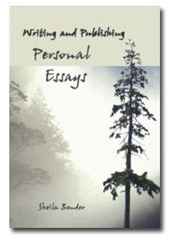
SheilaBenderIn two Part 1, and Part 2 of this series, noted essay expert Sheila Bender, author of the highly acclaimed  Writing and Publishing Personal Essays,  introduced the concept of essay writing as an adventure of personal discovery and described three freewrite exercises to start this process. In this final post, she explains how to harvest the riches of these exercises to open further possibilities for your writing.

Mining the Three Freewrites:

Whether you have done these freewrites in the course of one writing session or over several days, to find out what the freewrites have to tell you about an essay you might write, comb through them and jot down images and phrases that interest you.

When I look over what I have written, I am grabbed by:  “overwhelmed,” “dangerously close to the white line,” “shoulder to shoulder,” “heavenly bamboo,” “thorned bougainvillea,” “the plants survive” and “like me.”  I don’t know why exactly, but these words and phrases jump out. 

Next, I’ll challenge myself to write a paragraph that involves them all:

I live in Los Angeles shoulder-to-shoulder with millions, never far from others in our cars and apartments, on the busy beaches and walking and biking paths along them.  I was overwhelmed the first year I lived here with the sheer numbers of people, power poles strung with cable that buzzed audibly night and day, billboards and clogged freeway lanes.  Slowly I came to see what was planted, first the heavenly bamboo shrubs and of course the palm trees, draping bougainvillea along the banks up from the roads and the ficus trees lining the sidewalks.  I began to see the Morton Bay Figs, trumpet vines, stag horn ferns and exotic fruit trees, the kumquats and pomegranate trees.

It is perhaps not a surprise that distinguishing the plants coincided with making good friends and finding good work, that lonely, I saw only roads and cars and masses of people, and now more connected, I see flowers and trees, the way the people of LA cultivate what grows in this watered desert.  I struggle with my own container garden.  Against pests and fog, my diverse plants survive.  As I water them and watch people of diverse ethnic groups and cultural backgrounds drive and walk by my balcony, I realize I have come once again to value the American melting pot spirit that is alive and thriving in this city of angels and progress.  I have let the American Dream touch me once again.

From here, I could shape an essay that evokes the newly awakened American dream inside me.  I see that I might be talking about a process of growing numb to the dream for awhile before it reawakens in me.  I could talk about becoming jaded while coming of age in the 60’s when the country was engaged in an unpopular war and then again when raising children in the seventies and eighties and trying to teach environmentalism during a time of abundance and spoils. Now, watching and listening to people from all over the world raising families and seeking education, I am revived.  I believe that I could write this view of Los Angeles and of myself at this point in my life.

* * * * *

The way of writing that I am suggesting is aimed at opening writers to a state of not knowing exactly what will happen on their pages.  When we are i n this not-knowing state of being, words come through, and we start to figure out the terms of our explorations.  Teasing topics to the page in this way reminds us that every essay is written in response to the question, “What do I really know?” Finding out how we can put experience together into new knowing, we are on a treasure hunt; we search our way out of the not knowing.  This is the spirit that makes our writing come alive.

Sheila Bender is the author of over a dozen books, including her newest Behind Us the Way Grows Wider: New and Collected Poems, A New Theology: Turning to Poetry in a Time of Grief, Creative Writing Demystified and Writing and Publishing Personal Essays. To learn more about her books and her online classes and instruction, visit http://www.writingitreal.com.

Finding Starts in Personal Essay Writing, Part 2

writing-essaysIn the previous post, noted essay expert Sheila Bender introduced the concept of essay writing as an adventure of personal discovery. In this second of three parts, she continues with two more freewrite prompts.

A Second Freewrite

After writing from where you are, imagine yourself inside a place you can’t really write from, the pantry in your kitchen, a drawer, or perhaps a window box:

If I were sitting in the window box under the leaves of the trailing geraniums, I would look down at the impossible height and draw in my legs under my chin.  Would I feel cramped under scalloped leaves, next to the segmented stems?  Would a pink petal form a little rug at my feet or blanket my knees?  Nothing could protect me from the onrush of the watering hose, the torrents, the floods.  Would I sink into the spongy earth to arise like a swamp monster or get washed overboard to a new destiny, landing perhaps upon the heavenly bamboo or the thorny bougainvillea?

A Third Freewrite

Now open something in print and let your eye fall somewhere on the page. Use the words your eye falls upon as an opening for your writing. When I did this exercise last, I randomly opened William Kittredge’s collection of essays, Who Owns the West? to page 67 and pointed to these words:

Tess had worn a little path around the grave. She went down there and talked to him, she said. "I tell him the news," she said.  "Like all of us, Ray was given to a love of gossip and scandal.”

Knowing this passage was about mourning short story writer Raymond Carver, whose stories I had recently taught to an intro to fiction class, I wrote:

Like all of us, author Raymond Carver was given to a love of gossip and scandal. Although I never knew him, I’ve read and enjoyed his short stories, even taught one in particular, “The Cathedral.”  In this story, a narrator tells about the overnight visit of his wife’s former boss, a blind man from Seattle.  The narrator is a narrow-minded man with little real connection to others, and in the course of the evening, he does enjoy a moment of pure human (and therefore cosmic) connection with the blind man as they draw a cathedral together.  And gossip does seem to be a way of thinking in this story—the narrator uses all he has heard from his wife about this man to build notions about blindness that keep him from entering the moment.  I can certainly identify since I keep myself from living in the moment by leaning on structures in my mind.  One of those is the to-do list I seem to carry perpetually:

There are clothes at the cleaners waiting to be picked up, food to be found at the market, a resume to update and send out, and evening plans that require I bring a dish for the meal.  I have a set of papers to grade and more email than I want to answer at the moment waiting on the spool.  The cats are out of food and I have forgotten to cut their nails this month so they are sharp and leave scratches when they launch from my lap after a moth or a fly.  The outdoor plants need watering, on all three levels of my home.  The jasmine is in bloom.  I should fertilize.  Measure, mix, fill the jug, lift the heavy thing and hear the water rush into the pots.  Too much overflow in the dishes beneath the plants. Must empty that. They don’t like to get their feet wet, my horticultural friend reminded me.  No blooms on the bougainvillea, perhaps over watering.  Container gardening—there are rewards but the plants suffer if I am not attentive—cold roots, wet roots, underfed, overfed.  White fly, aphids. Bites out of leaves from something else I haven’t seen.  Somehow, the plants survive.  Like me!

Next post: In “Mining the Three Freewrites”, Sheila will conclude with instructions on how to tap the power of these freewrites to find a “new way of knowing” on the page.

Sheila Bender is the author of over a dozen books, including her newest Behind Us the Way Grows Wider: New and Collected Poems, A New Theology: Turning to Poetry in a Time of Grief, Creative Writing Demystified and Writing and Publishing Personal Essays. To learn more about her books and her online classes and instruction, visit http://www.writingitreal.com.

.

Finding Starts in Personal Essay Writing, Part 1

SheilaBenderToday’s post is the first of a three-part series by noted author Sheila Bender. Sheila has become one of the leading national experts on writing personal essays. Her book, Writing and Publishing Personal Essays, is in its second edition. With her books, her online classes, coaching, and myriad of other services, she has helped thousands benefit from the humble art of personal essay.

Although it might not be obvious, those of us who write personal essays can benefit greatly from not knowing what we have to write about.  That is surprising to people who think of the essay as researched knowledge with a professorial, didactic tone.  But to write an essay is really to “assay” or test out a hypothesis about something.  If writers walk around with a head full of ideas and think they have to commit to writing them, they miss the hypothesis part of the process, the part about finding something of interest to test.  In other words, the essay is an exploration, not an initial knowing.  Because of this, I like to utilize exercises for finding topics that model not knowing as a way of beginning essays.

After the following directions for a series of three freewrites, I will show you how to mine the collection of material you create to discover your hidden essay topic.

First Freewrite

Go to a place you have not previously come to write.  It can be the corner of a room or a chair facing a different window than you usually face; you might sit at a café or park bench new to you, or even your car will work if you do park somewhere other than your habitual spot.  In fact, just getting out of the driver’s seat and sitting in a passenger seat could make any parking spot new for the purposes of this freewrite.

Begin your freewriting by describing where you are and what you see where you are.  You can add in what you think you will be able to see in the near future.  Then involve your other senses to stay “in scene” and really deliver the experience of the place you are describing. A sound or sight, smell or texture, or even the taste of something you are eating or have waiting for you for lunch will offer new experience and associations.  So stay specific. Don’t be cursory.  Don’t write, “Here I am again writing before I go into work and there are cars as usual and I am tired as usual.” Instead stay in the moment and record details from where you are:

Here I am again writing in my journal before I go into work and I am parked dangerously close to the white line that separates my space from the next car’s slot.  That spot is empty now but within minutes someone will drive in and our cars shall remain close, shoulder-to-shoulder, for the eight hours of the workday.  I hear the fibers of my wool scarf like Velcro releasing as I pull the scarf from off my coat collar and I smell the boiled egg I’ve packed in my lunch today and think of the animals that have scent glands and release smells as warning or to mark territory like this sandwich might if I let it out on my desk. When I open the car door, pulling the hard plastic handle will be like a handshake I don’t quite want to make with a person I must depart from though I don’t feel our business is done.  I will leave my scarf in the car so I don’t later forget to replace it around my neck.  What secrets does it keep wrapped up here on the seat till I return?  I will enter the cement-chilled air of the basement garage heading toward the chrome-lined elevator.  I will go up and up, hoping the crowd of my thoughts will stay warm and hatching until I return.

Next post: Instructions and prompts for two more freewrites.

Sheila Bender is the author of over a dozen books, including her newest Behind Us the Way Grows Wider: New and Collected Poems, A New Theology: Turning to Poetry in a Time of Grief, Creative Writing Demystified and Writing and Publishing Personal Essays. To learn more about her books and her online classes and instruction, visit  http://www.writingitreal.com.