Showing posts with label Self-publishing. Show all posts

It’s All About STORY

Story Story

I was stunned when conversation at my book club drifted into comments on memoir in general. I’d just mentioned that I’d been appalled at the proliferation of typos and other errors in a memoir I recently read that was, sure enough, self-published.  “I cringe when I read something like that because it casts all self-publishers in a bad light.” But even so, I’d been mesmerized by the story and seconded the recommendation of a previous reader.

I could never have anticipated the ensuing, spontaneous discussion. How I wish I’d had my phone’s recorder running. I did scribble a few notes, summarized below:

“I’m more forgiving about sloppy writing and errors in memoir … I’m more interested in hearing their story than how they tell it.”

“I can overlook a lot of structural stuff because the story is what counts.”

“Memoir is about real people, things that actually happened. Most of them are not professional writers and I don’t expect them to sound like one.”

“Flaws make memoir credible. If it’s too polished, I wonder how much truth got scrubbed out by editors.”

“You can’t critique a memoir because you haven’t walked in that person’s shoes. I’m just fascinated by other people’s stories.”

Wow! I recognized an opportunity to listen and learn rather than steering the discussion. I kept my astonished thoughts to myself to avoid biasing things.

Members of this group are voracious and discerning readers. Every Tuesday afternoon 12 – 20 women (men are welcome, but never attend) meet at the library. A high number have advanced degrees. Several are retired teachers or professors. A few of us also write. But most of all we read, widely and constantly. We each read whatever appeals to us and report back to the group, some in more detail than others. At least half the gals at any given meeting report on more than one book. Rarely does anyone pass.  A significant percentage of the reports include some form of the observation, “It didn’t work for me, but other people may like it.”

In general we collectively hold books to high standards, so, I have full respect and regard for their thoughts about memoir. I cannot imagine a better qualified focus group to address this issue, especially since it arose spontaneously. They don’t write, teach or promote memoir, so they have no reason to be anything but frank.

Perhaps today’s comments ring even more true, because in thinking back, I recall a couple of memoirs that got a thumbs down after comments like “It was too dry and didn’t have much to say.” Celebrity memoirs full of false humility that fails to mask self-promotion also get blasted. The story has to ring true.

Does this mean we should forget about editors and publish first drafts? Of course not! I take it to primarily mean that we should make sure our heart and soul stays in our story and that it retains our unique voice. We still need beta readers to find holes, inconsistencies, and parts that don’t make sense or ring true. And I don’t think these gals will mark you down for a tightly written manuscript with a compelling plot and story arc, strong tension and character development, rich scenes, and no typos. All those fiction devices work, but only if the story rings true.

The bottom line in their remarks is STORY. It’s all about the STORY. Those dry, flat memoirs that got ripped lacked STORY. Do what you need to do to make your story clear, focused and active, and don’t hide it under too much gloss and device. But take heart that if you do slip up a bit, or can’t afford thousands of dollars for a top-notch editor, or you’re just writing for family. Don’t despair. Write it true, write it real, and write from your passion and heart.

Respecting Your Writer’s Voice

Writer-Voice“It’s critically important to find an editor who will respect your writer’s voice and not try to change it into her own.”

Electric agreement surged through  the room during a Penn Writers self-publishing workshop offered last weekend by acclaimed Pittsburgh author Kathleen Shoop. Heads nodded, and a ripple of “Mmm hmm” rose and fell.

I exchanged nods with friends sitting on both sides. Then a memory tempered my thought. Ten years ago a group fondly referred to as “angel editors” banded together to help a mutual friend – I’ll call him Will – hammer a complex memoir into publishable shape..

Aside from structural concerns, as editors we faced a delicate challenge: Transforming Will’s voice from a stilted style with big words and convoluted, page-long sentences into something that flowed smoothly into readers’ eyes, ears and brains. Will finally agreed that we needed to streamline the language without compromising the message or completely losing his voice. The resulting book went into a third printing.

Will’s purpose for his book was to inform a wide, general readership. Thus his voice had to be changed for reader appeal.

Conversely, when compiling a vast array of drafts and notes my mother left behind, I changed only documented factual mistakes, a few flagrant grammatical errors, and typos. Since she was no longer around to discuss style and voice, I left things like her strings of dots and signature clichés so it sounded like a letter from Marje.

Marje’s purpose for writing was to leave a legacy of personal and family history for posterity. Leaving it in her words and phrasing was an additional way of documenting the writing style of her generation of women.

Where is the balance? These are two extreme examples. In general, when I edit a story, I find ways to smooth rough edges and make words flow more smoothly. My edits are only suggestions. My fix for a phrase that sounds awkward to me may grate on the author’s ear.

The extent to which I change things depends in large part on the author’s purpose. If I’m helping a friend finish a family project, I’m less inclined to tinker. In my opinion, a bit of colloquialism and cliché lends authenticity. If an author hopes to sell truckloads of books to the public, buckets of red ink may flow.

So, you see, how much an editor (that includes friends and critique groups) should mess with your voice depends on your purpose. If you plan to appear on stage, appropriate makeup will emphasize your message. Stage makeup is out of place on a mountain trail.

Experience and practice are additional factors. A polished writing voice is not necessarily the sign of an expensive editor. Writers follow a learning curve much like musicians. Beginning piano students do well to tap out Chopsticks. Ten years later, they may perform Beethoven sonatas with ease. In between lie thousands of hours of practice with gradual improvement.

Your writing voice will likewise gain tone and force as you seek constant feedback and work to improve. That does not make your voice less authentic. It reflects the years of practice you put in and becomes natural and authentic for you.

As you continue down your writing path, you’ll discover that each story has a unique voice. Some are humorous, some sassy, some sad or mournful. Let your stories whisper their way, and your voice will grow in range.

Write now: if you have some, read a few unchanged stories you wrote several years ago and consider how you might change them today. Even if you’re a beginner, start a practice of keeping versions of stories to help keep track of how much your writing has developed. If you change a story after more than a year has elapsed, rename it to preserve the old version so you can compare. Think of this as your growth chart and celebrate your continuing improvement!

Tips for Dealing with Details

eyeball-bulge

Several pages into a highly recommended memoir, a factual error popped my eyeballs nearly out of my head. Can you find the mistake?

In September 1963, the Cuban and Russian governments placed
          nuclear bombs in Cuba.
In October 1963, the Cuban Missile Crisis ended….
In November 1963, John F. Kennedy was assassinated.
In December 1963, I was born….

The Cuban Crisis was in 1962! Both that event and the JFK assassination are indelibly burned into my memory. The author can’t remember, I thought, but how could something this obvious slip by the editing involved in a traditionally published book? I checked Wikipedia to be absolutely sure, then kept reading. Along the way, I found half a dozen typos, and by the time I finished, I’d found several loose ends in the story along with an apparent contradiction.

But still, I do appreciate the book and its many strengths. The story is powerful and the author’s voice superb. I understand the book’s appeal. The mess saddens me on the author’s behalf.

In one sense I felt vindicated that such casual editing was released by an established publisher when self-published authors are widely slammed for flooding the market with slop. But the point is to write your personal best, not to meet standards.

Whether you are writing a few stories for family or a major opus for the world, these guidelines will help you smooth wrinkles in your stories.

Check your facts. Always validate times, dates or places, if you’re sure you know. Those erroneous dates for the Cuban crisis may be accepted as factual reality by younger readers. Your error about a birthplace or date could throw genealogists into a tizzy years down the road.

Look for loose ends. They may be subtle. For example, this author doesn’t mention how she generated income, but despite a divorce, she spent money like it grows on trees. She says she remarried. To the man she had the amazing relationship with?

Look for conflicts. She reports reflections of someone with her son’s name who met a celebrity she was about to meet. It makes no sense that her young son would have met this person before she did, or that he would relate such a mature impression. Ebooks make searching easy. No other person with that name was mentioned at any other time. Confusing!

Look for missing information. She cites results of certain studies with assurance. The topic is new to me and I’d like to read more. I don’t need footnotes, but I’d love to see an appendix with references and suggested reading.

Rely on beta readers. You aren’t likely to notice loose ends or missing information, because you fill in the blanks from memory as you read. Even family members may gloss over omissions like these. Discerning readers who aren’t privy to the backstory will pick them up in a flash.

Don’t rely too heavily on professional editors. I don’t know what shape this manuscript was in when it arrived on the editor’s desk. Perhaps she did as much as she was able in the time allotted to meet deadline or budget. Maybe loose ends fly under her radar. If you are paying for editing, remember that more time means more money, so have things in the best shape you can before you seek help. Professional or not, nobody is perfect, and any given reader will fail to notice something. Have two or three more people read for further edits and errors after the formal edit is done.

Be gentle with yourself. Readers love this book in spite of its flaws. Write great stories, give them your best shot, and then chill. If you pour your heart into them, readers view mistakes with compassion – if they notice them at all. Many won’t.

Write now: if you don’t already have a writing group or a list of trusted beta readers, find or start a group and begin a search among friends, local or online, who can read pre-release versions and give you reliable feedback.

Lessons Learned on the Amazon Path

Amazon-eveningNo, I have not been on vacation to the Amazon recently, though I wish I had – except not right now during its rainy season. I’m referring here to the unexpected twists and turns on the path to the Kindle Direct Publishing (KDP) arm of Amazon.com  as I completed my journey toward publication of Adventures of a Chilehead.

I wrote about early details of this project in three posts in June: “Chile or Chile? Check it Out,” “Lessons Learned”, and “Story Album to Memoir.” In July that early manuscript flowed through email to a team of beta readers. After incorporating their sage advice about need for further detail, spots that needed an edit and more, I thought final layout was all I needed to do before the book was ready for publication.

That predictably became complicated, and pressures of preparing for classes I was teaching in September resulted in setting the project aside for more than two months. When I reopened the project in late October, I was stunned. I read a paper copy of the manuscript and realized it still needed a lot of work. Here are a few of the lessons I learned (or relearned) in the process:

Wine, cheese and stories improve with proper aging. This is not news to me. I often open story files I haven’t looked at for months and years and see dramatic improvements I could make. We get too close to our work to be objective. Setting it aside and immersing our thoughts in something else for a time allows us to return with fresh vision and perspective.

In the future, I’ll schedule in these breaks before final publication. I always underestimate the time required anyway.

Expect unexpected glitches. This time the unexpected glitch was a section break meltdown in my print version of the manuscript.  Since this was a print document, having the precise type of section break (odd page, next page) was not as important as having some section break to control page header changes. I did an end run and arm-wrestled that gator to the ground. Then, after all was said and done, I checked online and found the solution.

In the future, I’ll turn to Google right away. 

Proof-read in many modes. Again, this was not news. But sure enough, a paper printout looked different from anything digital. When I read the.mobi file proof from the KDP site, I found several more rough spots that needed further sanding. When I ordered my print proof copy, I filled it with flags. Not until I saw that final print version did I realize I’d failed to check for stragglers (those stray single words at the ends of paragraphs) after reducing the margins by .2”. As long as I was making those changes, I found even more opportunities for improvement.

In the future I’ll print a paper copy of the final pdf version before uploading.

Remember that stories of any size are always a work in progress – like life itself. At some point it’s time to realize it’s as good as it’s going to get. Click the Publish button and get on with it. You can go back and make changes later if you want, but at some point it’s time to turn loose and move on.

So, it’s done. My path finally led to the river. You can purchase your copy of the Kindle version of Adventures of a Chilehead: A Mini-Memoir with Recipes on Amazon right now. The print version should be ready for orders by December 6. I had so much fun writing this book, I hate to see it finished, but it is time to set it free and hopefully watch it soar. I’ll tell you more about some of the elements that made it such fun very soon.

Write Now: If you are working on a story that’s driving you nuts, set it aside. Let it age for two or three months. Pull out an unfinished story or project that’s been sitting around for a few weeks or longer and work on that.  Your old story will sound fresh to you and you’ll quickly find ways to improve it. Meanwhile, your problem story will stir around under the radar and reemerge with fresh energy.

Writing Compelling Description

frontcover 600The Heart and Craft family of fine publications has expanded. Today marks the official debut of The Heart and Craft of Writing Compelling Description.

Chapters in this book may sound familiar to some. Each of the forty-eight chapters appeared as a post on this blog. Many may wonder why I published this book when all the content is available online. Here’s the story.

I already had a short anthology of description-related posts that I’ve used in various ways over the past few years. One gray January day, I whimsically decided to transform that document into a $.99 Kindle short. I thought it might take … maybe three hours. That was three months ago!

Many of my favorite posts were missing, so I sorted through nearly six hundred posts. Forty-eight made the cut. Next I shuffled them into some semblance of order, checked for dead links, and double-checked permissions for graphics. Sharing on a blog  the public can read for free is one thing. Using images in a for-profit publication is another. Some had to be changed. The posts needed more editing than I realized. A volunteer team of friends and writing group buddies offered  remarkable suggestions and the quality improved.

As I struggled with the introduction, I had an epiphany about the entire process of writing description:

Description is anything that shapes the reader’s perception of your message or story.

That insight blew out the walls of  my boxed-in concept of description as adjectives, similes and metaphors, opening a universe of creative options I had not previously noticed in those posts as I wrote them.

As the collection grew, friends convinced me this project had outgrown the original $.99 intention. They wanted to have a collection of those posts at their fingertips where they could easily refer to them, so I crafted a print version and turned to Amazon’s free CreateSpace publishing service as my printer and distributor.

During the ensuing weeks, various cheerleaders, with Gutsy Sonia Marsh at the fore, held my feet to the fire to develop a cover everyone was happy with. Writing group friends helped with content edits. Thanks especially to Elizabeth Kim, Carol Broz and Tom Imerito. How I valued their help with the book description! Who thinks about these aspects of publishing?

Hillary Clinton coined the phrase “It takes a village.” That phrase is equally true of publishing. Anyone can write a book, but it takes a village to ensure it’s a solid, well-written, well-crafted book the world can benefit from. I especially appreciate enthusiastic “beta readers” who have (or soon will) post reviews. I can’t begin to describe the sense of elated humility I feel as I read those reviews and personal comments.

The biggest differences between publishing this book and The Heart and Craft of Lifestory Writing (released seven years ago) is that this time I made final decisions on everything, and I control the business end. Even that book was a non-traditional experience. Although the earlier cover was professionally designed, it built on my concept, and I did all layout – an unheard-of arrangement when working with a traditional publisher. I love doing layout!

Controlling graphics for eBook conversion had a steep learning curve. I’ve now tamed that beast, and I can save you a lot of time if you ever need to know the secret.

Thanks again to all who have helped along the way, and I hope everyone else finds as much value in this new volume as you have!

Write now: I invite you to click over to Amazon and use the “Look Inside” feature to read the introduction to The Heart and Craft of Writing Compelling Description, and skim the reviews. Then either buy a copy of this new book and write a review. Or find a book you’ve recently enjoyed and review it. Reviewing is the best way to find hidden insights you missed on the first reading and milk even more goodness from the volume. It builds community with other readers, past and potential, as well as the authors.

Professional Looking Books the Easy Way

BookPageWhen I wrote The Heart and Craft of Lifestory Writing to help readers begin writing their lifestories, I knew that some readers would eventually be ready to publish story albums – collections of short stories – or full-length memoirs. To help them produce professional looking volumes, I included instructions for assembling and preparing the documents to take advantage of free Print-On-Demand services like CreateSpace.com. I gave detailed instructions for using Styles to simplify formatting and ensure uniform results. I explained how and why to adjust line spacing for easier reading and suggested a number of reader-friendly fonts readily available for free download. I gave instructions for setting custom page size and effective margin settings. You’ll find everything there that you need to know to create a “real” book that doesn’t scream BEGINNER BOOK!

But, I admit it, there is a learning curve, and it’s more effort than many people want to invest. Until now, if you didn’t feel up to the challenge, have the time to try, or have a friend or relative you could cajole into helping, you could either settle for the home-made look or write a big check to a book designer or layout service.

I have great news: Joel Friedlander, veteran book designer, publisher of The Book Designer.com  and author of over 700 helpful articles for self-publishers, just launched a new service offering affordable, professionally designed templates that allow you to produce a polished book project with Microsoft Word. These templates relieve you of all decisions about line spacing, margin settings, header arrangement, font choices and more.

All you need to do is to write, edit and polish your manuscript, paste it into the template, and follow the comprehensive set of instructions to add header information, apply body text and title styles, fill in publication information and so forth. Add a cover and upload to CreateSpace and you’ll amaze everyone with your stunning results.

You may be wondering if I’ve used one of these templates. No, I have not, and I’m not getting a commission or any other incentive from this recommendation, but I know a good thing when I see it. I have used the same process they did to create templates (I even tell you how to create your own templates in my book), so I know how they work. It may be a little tedious, even stressful at first, but it isn’t rocket science, and it’s way easier than starting from scratch. You’ll also find templates for producing eBooks that coordinate with the look of your print project. That alone is worth the cost of the template.

If you are even thinking of someday publishing a volume for your family or the world at large, pay a visit to Joel’s sites. Look through the wealth of general information at The Book Designer.com and download a copy of his free eBook, Ten Things You Need to Know About Self-Publishing. Then click on over to Book Design Templates.com and check out the selections. While you are there, look for the Guides link on the menu bar where you can download copies of his free Book Construction Blueprint and  Template Formatting Guide eBooks. They are “must read” material, even if you don’t plan to use his templates.

As powerful as they are, current Book Design Templates don’t currently include one key element you’ll probably want: automated magic for inserting photos. Fortunately you can find step-by-step instructions for doing this beginning on page 264 in The Heart and Craft of Lifestory Writing.

You put an enormous amount of time and thought into writing your stories. You owe it to yourself and your stories to make them look as good as they sound.

Write now: take a break from writing and read Joel’s free e-Books, then watch a few YouTube video tutorials on using Styles to ease your way whether you use his templates, the instructions in my book, or wing it on your own.

Dancing in the Rain

PotatoFarmingElizabeth-Anne Kim recently published two collections of life stories, DANCING IN THE RAIN (free Kindle download Thanksgiving Day through Sunday, Nov. 25, 2012) and WHAT MY MOTHER DIDN’T KNOW, as Kindle Shorts. These memoir pieces were largely unplanned. In this guest post, she explains how incidental writing can turn into something surprising.

If you can be an accidental life story writer, that's what I am. I didn't mean to publish independently either; it just sort of happened.

After nearly four years in Korea, my husband and I transitioned our family back to the United States in the spring of 2010.  I found myself in a new setting with two children who needed me close at hand. Traditional career options were not going to work. I decided to try writing. I had previously done a bit of writing work, and I felt pretty confident in my ability to transition back and forth between genres.

What I didn't feel comfortable with was my ability to stick to a deadline all by myself.

ADHD runs in my family, and I desperately need deadlines, lists, and accountability. Finding writing groups I could join with two little boys in tow was difficult. Finding writing groups that met consistently was even harder! Fortunately, I ran across a life writing group at a nearby library that met religiously on the second and fourth Wednesday of the month. Proud to have found a group that would give me a solid writing deadline, I told myself I could learn to write memoir.

I did learn. Sharon's book, The Heart and Craft of Lifestory Writing, has helped. I am writing a full-length memoir—but this isn't it. Once again, serendipity stepped in. In response to a county library initiative, our life story group concept was expanding to other libraries. I started facilitating a life writing group at my own local library, and I needed some stories that were more relevant to the general population. Those stories essentially boiled down to my stories as a child and my stories as a parent.

Until that point, I had only blogged about my children, who are bright, creative, active little boys who also happen to have some mental health issues. Reactions from the writing group and others in the community cemented two things for me. First, many parents are grappling with mental health issues in their children now. Secondly, while there are plenty of heartbreaking memoirs out there and lots of self-help books for children with ADHD and spectrum disorders, very few people are writing about the joy found in life with these children. And that was my intent—to connect with others who were determined to enjoy their sometimes rather difficult children.

I began with four solid stories. I thought about building up enough stories for a complete memoir, a feat which would require quite a bit of time and would have no guarantee of eventual publishing success. I thought of my community. Those of us struggling now need encouragement now, not a few years down the road.

That conviction in and of itself, however, probably wouldn't have pushed me to publish independently either.

I was convinced instead by a combination of an upcoming project in our life writing group that I would like to convert to book form (and would therefore need a book to practice on first!) combined with Will Bevis's Kindle Shorts. If you haven't read Will Bevis's work, please do! It's hilarious, and I never begrudge the $0.99 I spend on it. In fact, I appreciate the brevity of the pieces. I will finish his work (and laugh the whole time).

With the project looming over my head, I began investigating the Kindle Short and Kindle Direct Publishing (KDP). It requires no initial monetary investment by the writer, takes care of all the sales taxes and online sales, and offers free promotions. It merely requires that there be no other electronic formats of one's e-book out there while that e-book is enrolled in KDP. So essentially, you can publish and un-publish in KDP. It allows me to get stuff out there in a format to test the waters. If I decide that I want to expand this material, which I think I'm going to do, it allows me to incorporate it into something larger by taking it down at the end of my contract period and putting it in a different format. It also allows me to test my voice as well as give a preview. As I write that longer memoir, I'm thinking of taking the stories that don't fit and putting them into a Kindle Short to use as a promotional piece later on. KDP will NOT work for my group project, but it has really allowed me to enter publishing at the shallow end of the pool. I'm extremely grateful for that.

Like many authors, I'm a little overwhelmed at the promotional end of the publishing process, but I think that KDP offers the perfect place to start. I have no initial costs to pay back, so my mistakes in promotions are not disastrous to my bank account. Because I'm confident in my stories, I'm satisfied that putting them out there, in whatever small capacity, will eventually help build my career, and I fully expect that as I publish more, the books will sell each other.

Elizabeth-Anne Kim, mother, writer, editor, teacher, records her personal thoughts at Kim Kusli, her pedagogical reflections at Umm, Teacher?, and tips for life writers at Lives in Letters. She is also currently coordinating the Share a Pair of Stories initiative.

Write now: Write about something annoying and go on to find the joy in it. Write about your most recent annoyance and include thoughts on how your attitudes might seem when viewed from another perspective. Empathize with yourself and gain a big picture attitude. Then turn your frustrations into a story we can all laugh along with by walking us through the whole situation with a few well-placed asides.

Tech Tips for Clean Manuscripts

Manuscript-cleanupI’m a  soft touch when a friend or relative asks for help getting a manuscript ready for uploading to a Print-On-Demand service like CreateSpace. More than half a dozen times these requests have ended me saying, “Just send me the file and I’ll fix it, but before you start another one, you have to promise to learn a few basic skills.” Then I spend hours cleaning up formatting garbage before applying the simple tweaks that convert it to a lean, clean, beautiful piece of work.

For those who grew up in the typewriter age, it’s natural to position text with spaces, both horizontally and vertically. It’s hard to unlearn some of those old habits, but if you want to take advantage of recent developments in affordable and accessible printing technology, you’ll do yourself and your pocketbook a favor by overwriting those mental typewriter files.

The tips below will ultimately save you time and maybe money. If you pay someone to do your layout, they will charge for the time it takes to find all the places you used spaces to center a title or pressed “Enter” 23 times to make a new page. Ebooks absolutely require a  squeaky clean manuscript.

Things to avoid and why

Using spaces to center anything. This locks you into a specific font and size, and your approximated efforts will lack crispness.

Center lines by using the Center Align icon on the toolbar.

Using spaces (or tabs) to position anything. As above, this will produce variable results.

Options include using tabs (only if you are sure you won’t convert to an eBook format), altering paragraph indentation (right-click and select the paragraph option), using tables or text boxes.

Using tabs at beginning of paragraphs. This advice may sound odd indeed. It has not been an easy habit for me to break. However, as page sizes, line lengths and font settings change, you may want to change the tab setting. Although you can control the tab setting in your paragraph style, using tabs is not advised for eBook conversion, so you’ll retain flexibility if you stay away from them as much as possible.

Set the first line indentation on the Normal or Default style. More about styles below.

Double-spacing between paragraphs. This is okay in a simple, short letter or story, but controlling paragraph spacing with styles is far preferable.

Bone up on Styles.

Entering two spaces at end of sentences. This is a hold-over from typewriter days, and it’s a really hard habit to break. Problems arise when you justify text to make even margins on both sides. Software distributes the extra spacing in spaces, so a double-space can become glaringly obvious.

Routinely use Find and Replace on completed manuscripts to replace all double-spaces with single ones. Obviously this will also kill any spacing you did with multiple spaces – another reason to avoid that technique.

Things to Do and Why

Learn to use Styles. Using Styles seems cumbersome at first, but once you get the hang of it, you’ll have a level of control you never imagined and save way more time in final layout than you invested in setting up your styles. With Styles you can

  • change things like font size, line-spacing, or paragraph. alignment in your entire document with a single edit.
  • change chapter or section headings without affecting paragraph text and vice-versa.
  • automatically create a Table of Contents.
  • save time and money on preparation for publishing.
  • ensure consistency.

If you haven’t used Styles, do a YouTube search for your version of Word (or whatever software you use), and create your own class.

Download the Smashwords Style Book. Mark Coker, founder of Smashwords, the leading free eBook conversion service, has written a book that details everything you need to know to get your manuscript squeaky clean and prepare it for eBook conversion. His tips work equally well to prepare for printing. He has generously made the book available at no cost.  You can download it as a pdf or any eBook format except Kindle from this link.

Write now: If you’ve never used Styles, open an old document, then watch a couple of YouTube videos, and play around with Styles in your document.

Why I Self-Published

CherryBlossomsInTwilight-coverThis week I’m pleased to feature an invited guest post from Linda Austin, author of Cherry Blossoms in Twilight, and a colleague from the Life Writers Forum and Story Circle Network.

My mother has a lot of interesting stories of growing up in Japan during and around WWII. I wanted to write her memoir. Although it started out as a family project, this memoir became something I thought would interest a lot of people, particularly educators as Japanese civilian stories from WWII are rare. This project took so long that I began noticing signs of Alzheimer’s in my mother, and then the newspapers began writing about the 65th anniversary of the end of WWII and I knew I had to get busy.

After three months of drop-everything-to-write, I was able to hand a softcover print memoir to my mother in early September 2005, in time for her 80th birthday, barely in time to publicize it in conjunction with the anniversary of the end of WWII. Cherry Blossoms in Twilight was self-published through a local printer featured in the newspaper along with an article about the St. Louis Publishers Association. This article led me to self-publish – I had no time to bother with finding a publisher because I wanted this book for my mother before she lost her ability to read or understand what I had done.

My mother, our family, friends and strangers raved about the book, but I wasn’t satisfied with it, especially after I joined the St. Louis Publishers Association (SLPA) and learned so much about publishing. I produced a second edition using everything the SLPA taught me. I tweaked the story to better suit what readers might want, had a new cover by a professional cover designer, and uploaded the book to Lightning Source for print-on-demand and an excellent distribution system. Schools, libraries and bookstores could easily buy it, and I’m proud to say Princeton University carries a copy. Amazon’s CreateSpace was not in existence then, only Amazon Advantage (Take-Advantage, I called it).

I’ve been a board member of SLPA for over six years now, with my nose in everything to do with publishing. Yes, I’d self publish again. I’m working on a book of poems inspired by my mother’s dementia and my visits to the nursing home, and I’ll use CreateSpace because I won’t need distribution (poetry books don’t sell well). I’m also formatting Cherry Blossoms to upload to Kindle Direct Publishing. I’ve used Lulu.com to publish hardcover and softcover short memoirs for elder folks – just for the families, though. Lulu was very easy to use and perfect for producing a couple dozen copies, but using it to publish for the public is expensive, as it is with most publishing services companies.

With the advent of e-books and affordable, good quality print-on-demand technology, there’s never been a better time to take charge and self publish. But, you’d better know what you’re getting in to and what you’re doing or you could spend a lot of money unnecessarily or end up with a book that won’t sell (or both). Self-publishing is the shorter route, not the easy route, and many authors balk at marketing.

I advise new authors to read everything they can about publishing – and marketing. (Marketing actually starts with writing.) Every author these days must market his or her own work. Traditional publishers are struggling with Amazon, the bad economy, the advent of easy self-publishing, and the popularity of e-books. They can’t afford to market much and are more careful than ever about taking on the risk of unknown authors. You can wait ten years or more for a traditional press to accept your work, which may never happen, try for a small press (easier to be accepted, but buyer beware), or take the reins, study the road map, and make your own way into the realm of publishing.

Linda uses her website, Moonbridge Publications, to encourage others to capture life stories. She has collected and created some resources to help get started on the journey of memoir writing and publishing. Self-publishing is an intricate topic way too big for one post, but articles listed under the resources tab of the Moonbridge Publications website will help new authors navigate the field of publishing choices and make smart decisions that result in a professional-looking book without breaking the bank.

End of the Line for Lulu

EndOfLineFor several years I’ve been an enthusiastic supporter of Lulu.com for those wishing to self-publish a small number of volumes of their lifestory or memoir. I’ve posted several times about my experience publishing my preschool memoir, The Albuquerque Years on Lulu. 

Over the past five years, many friends and students have followed my advice and lead, using Lulu to publish their projects. I’m now recommending Amazon-owned CreateSpace, the no-fee Print-On-Demand provider of choice. Let me explain why I’ve removed The Albuquerque Years from Lulu’s website.

Without asking for my permission or notifying me, Lulu converted my document to ePub format and uploaded it to the Apple iStore and the Barnes & Noble digital catalog, setting the price at $2.99.

That was not okay with me! If that isn’t illegal, it’s certainly unethical. I immediately removed it from those catalogs.

I was never given the opportunity to review the conversion for formatting errors. The Albuquerque Years includes over two dozen embedded photos, which are notoriously difficult to position in ePubs. When I finally discovered how to download the ePub file, I noticed that the pictures do display between paragraphs, but not always between the ones they are relevant to. It needs some work before I re-release it, probably via Smashwords.com, as a free download.

I never added a “royalty” markup to the book, intending for any interested readers to purchase it at my wholesale cost, which has risen from about $2.79 five years ago to $3.99 today.

To my surprise, tens of unrelated people opted to purchase a paper copy. Today, if the book were still listed on Lulu, the “retail” price would be $7.99. I’m relieved that nobody (including me!) has ordered a copy since this outrageous inflation began. I certainly don’t want anyone thinking I caught the greed bug.

A LiveChat customer service agent (Lulu does not offer the option of phoning them directly, toll-free or otherwise) fed me some corporate line about “the stated current manufacturing price”, but was unable to explain why my wholesale price was lower. I can’t blame him. He’s just doing his job. I refuse to support the executive attitudes behind his explanation.

The free eBook (pdf) dowload link disappeared.

I intended for the pdf version to be free, as it was for over four years. Just before I “retired” the project (I discovered you cannot delete published projects), I discovered that the link to download the free pdf ebook was missing. I have fixed that. The link to The Albuquerque Years in the right sidebar now connects with my personal server for free digital downloads. (Click here now to get your own copy if you don’t already have it.)

Lulu’s pricing has become unpredictable.

Over the past year or two they have begun sending out a steady stream of “special offers” like 10% off, free shipping, 20% off, third book free, etc. Although I’m a die-hard bargain shopper, when I’m ready to buy a book, I don’t want to feel like if I waited another week, the price would drop, and I especially resent having retail prices inflated to cover this system.

By contrast, CreateSpace offers consistent pricing far lower than Lulu’s, free phone support, and they scan your uploaded document for typos and punctuation/grammar errors. Wow! The volumes I’ve seen coming off their presses are first rate in quality. Forums are full of great recommendations. Jonna Ivin is delighted with her experience using them to publish Will Love For Crumbs (see her guest post on this topic). I plan to upload a project myself to give them a whirl in the near future.

Write now: if you haven’t already done so, visualize a completed volume of your life story. It may take the form of a collection of individual stories or a memoir integrating those stories into a unified account. You may be writing more about family history. Perhaps your book will include lots of photographs. Let your vision grow and pull you forward. Set up an account at CreateSpace to add magnetism to that goal. 

Rejection Was Not an Option

Guest Post by Jonna Ivin

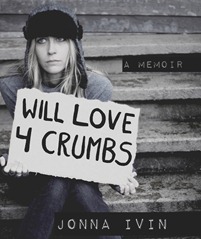
Jonna Ivin used Amazon’s CreateSpace service to self-publish her  memoir, Will Love For Crumbs. In this invited guest post you will read the inside story behind her decision and her experience carrying it out.

Will Love For Crumbs CoverWhen I was first asked to write about my experience in self-publishing, the thing that kept running through my mind was, “I have nothing to add on this topic that hasn’t already been written about. Knowing this going in I decided to do what I always do when faced with a new challenge, write from my own experience and write the truth.

The truth is, when I finished writing my memoir Will Love For Crumbs, I didn’t have the first clue what to do with it. I knew one thing for sure, I had no desire to write letters to publishers, wait to be told I could submit a few chapters then wait some more, maybe be told I had been accepted and then spend more and more time waiting for my book to finally be released. Of course I knew all along this process that the possibility of rejection would hang over my head. But rejection was not an option for me. That was the second thing I knew for sure.

I figured the best way to avoid being rejected was to not ask to be accepted because If I didn’t ask permission then no one could tell me no. It was the first time I was completely prepared to call the shots in my own life, well, maybe not prepared, but determined. Being firmly set on knowing what I didn’t want, I then focused on going after what I did want. What I wanted was to see my project through to the end. I wanted to hold a printed copy of my book in my hand and know that I had finished what I said I was going to do. For me the decision was simple, I would self-publish. But where to begin? I knew nothing about self-publishing, but what I did know was as long as someone out there had done it before me, then all I had to do was follow their path. And so I began to Google it.

I read everything I could on self-publishing and most of what I read kept leading me to Amazon. From there I learned that there were two options, Kindle and paperback. I went for both. Why not? I had nothing to lose. I won’t go into the actual step by step process because Amazon and CreateSpace have already laid it out much better than I could ever explain it. I simply took each step one at a time and did what the instructions told me to do.

I was alone at the office late one night when the moment came for me to hit the publish button. I was nervous, excited and I’ll admit, a little scared. Okay, a lot scared. I’d written about the most personal parts of my life and now all of it was floating around cyberspace for anyone to read. I was terrified people would actually read it, but even more, I was terrified that they wouldn’t. I posted a little blurb on Facebook announcing to my friends and family that my book was available, then drove home, crawled into bed and went to sleep, once again having no idea what the next step would be.

Will Love For Crumbs began selling a few copies a day, and I was slowly building up my social networks, adding friends, joining groups and participating in conversations. I think it’s really important to be strategic when participating on social media sites. Most importantly you must be “social”. Going in and flooding a site with links to your book is not only boring, but most often annoys people. I put my focus on memoirs and relationships and when I found interesting articles or books on these topics I reposted them. I’m always looking for new ways to reach a wider audience and supporting other writers is a great way to start.

I also took advantage of the KDP Select Program to offer my book for free. Valentine’s Day was approaching and I thought since my memoir is called Will Love For Crumbs it would be a funny tie-in to the holiday. I offered free downloads for three days, using the tag line of, “Don’t worry about your crappy love life – read about mine instead.” During the promotion there were over 21,000 downloads of my book. I was beyond thrilled with the results.

I’ve been asked by some people, “Why would you give away your book for free? Aren’t you afraid of all the money you’ll lose?” My answer is always the same, “I didn’t lose anything. Those 21,000 people would have never even heard of my book if it hadn’t been available for free. I would gladly give 100,000 copies of my book away. The whole point for me is to reach the widest audience possible and in order to do that I have to reach beyond family and friends.” And it worked. After that weekend I began to get more and more reviews on Amazon and Goodreads which continued to lead to more sales. I began to receive numerous friend requests on Facebook, opportunities for interviews and guest blogs but more importantly readers started to reach out to me to say that I had written a book that described how they had felt and what they had experienced in their lives. That alone is worth any number of free books.

My best advice to anyone who is thinking of self publishing is to just go for it. Write the best book you can and then throw it out into the Universe and see what comes back. You have nothing to lose and everything to gain, the playing field is even. No one can tell you no and rejection is not an option.

Write now: Read  a guest post on Memoir Writer’s Journey about Jonna’s experience with writing her memoir, read my review of Will Love For Crumbs, and visit Jonna’s  website and Facebook page..