Showing posts with label Kindle. Show all posts

Mini-Memoir – Great Things Come in Small Packages

Mini-memoir,-h

In a post on the U.S. edition of the British Guardian website, journalist Anna Baddeley cites several mini-memoirs published by celebrity authors. In conclusion she opines that mini-memoir is “An exciting trend in journalism that one hopes will soon take off over here.” I hope so too, as a reader (what's not to like about a book you can finish in three hours or less), as a writer (what's not to like about a book you can finish in two or three months rather than years?), and as a teacher (more of my students can publish!).

So what is a mini-memoir? Basically, mini-memoir is the non-fiction equivalent of a novella. To date, this short form has not received much attention, though you can find a few in Amazon if you search on that term. One of the titles that pops up on this search is Adventures of a Chilehead: A Mini-Memoir with Recipes, by Yours Truly. The term seems to be used in two ways. Some use it to recount memories limited to a tightly focused topic. Some overlap the definition of mini-memoir with flash memoir, the topic of my most recent post.

I couldn't recall hearing the term before when I popped it onto the cover of Adventures of a Chilehead. As far as I knew, I was coining a phrase, one that seemed apt for a concise collection of short stories crafted around a unifying theme.

Here's how the book evolved: A dozen years ago I wrote two stories featuring adventures I’ve had eating hot chile. About four years later I wrote a third, "Great Balls of Fire," within days of the featured event, almost before my mouth quit burning. I considered that story to be my declaration of independence from stomach-scarring scoville levels.  For eight years I referred to these three stories as my "Chilehead Trilogy." I wanted to do more with them, to turn them into what I refer to in The Heart and Craft of Lifestory Writing as a "story album" (otherwise known as an anthology).

Last year the light dawned. I could publish that trilogy as a Kindle book, just for the heckuvit. Just for fun. When I began working toward that end, I thought of more stories. Three stories evolved into ten chapters, plus the section of recipes. What began as a simple Kindle compilation expanded enough to work as a print version.

Weaving the eight stories into a cohesive whole, ensuring adequate background without repetition was a challenge, Drafting the introduction and concluding chapters even more so. But as typically happens with memoir, while massaging those stories and reflections, my love for this pungent fruit grew even deeper, along with my understanding of the way it grounds and roots me in the land I hold dear after  fifty-some years away.

Aside from the subject matter and recipes, this book differs from full-length memoir in an important respect. It's focused more sharply. It's about chile and me. Nothing more, nothing less. I mention relatives and relationships, but they stay in the background. I mention place, but only in passing. Yet within that strict focus, you can see changes in my thinking. Learning and growth did happen. I wrote as much as I have to say about chile, and let it go at that rather than forcing the issue and straying from truth, chasing elusive word count.

Just as tiny memory fragments power flash memoir, themed memory clusters illuminate mini-memoir, a great hit with busy readers. With Kindle and maybe CreateSpace, you can transform stacks of loose stories into themed mini-memoir for friends and family — and the rest of the world if you wish.

Write now: pull together an assortment of related stories. Look for the common thread linking them together. Find a logical order, reduce repetition and add elements to showcase that thread. Share with friends for feedback, add a cover and the requisite promo material and you're good to go to Amazon.

Adventures of a Chilehead — Formal Debut

Chilihead Cover KindleToday is the official debut of Adventures of a Chilehead. It’s a quiet affair. No big party – it’s too cold and icy right now. No champagne – but I will celebrate and toast the book with a bowl of chile, complete with guacamole topping  and a beer.

Books are much like debutantes —  when they make their formal debut, the whole community has watched them grow up and mature. Likewise, regular followers of this blog have read a number of posts about this book's progress.

You know, for example, that it began as a simple anthology and grew organically into a true memoir. You know that I learned many lessons along the way, and one that’s seldom discussed is the matter of length. People often ask how long a memoir should be. As with any story, a memoir should be as long as it needs to be to tell the story.

This book is short. You can read the stories in a couple of hours. And yet it does have all the components of a formal memoir:

  • It has a story thread or theme, my love of hot chile, that runs through and ties individual scenes together.
  • It remains tightly focused on that theme.
  • It has a story arc, progressing from my first public involvement with surprisingly hot chile to the present, demonstrating change of perspective along the way.
  • It is comprised of scenes, with a new adventure in each one.
  • It hits the highlights without becoming mired in the mundane.

The book is short because it does remain focused tightly on its topic. If I’d wanted to make it longer, I could have pulled in other stories, or broadened the topic to food or cooking in general. But that was not my purpose. This is a tribute to  my beloved chile, and to the goddess Capsacia, who revealed herself in the process of writing. I said all I had to say on that topic. Thus I coined the term, “mini-memoir.

I think of this term as the memoir equivalent of a novella, a written, fictional, prose narrative normally longer than a short story but shorter than a novel. Novellas have no specific word count. They are generally more highly characterized than a simple short story, but less layered and complex than a full-length novel.

Although I had not heard the term “mini-memoir” before, I found it a delight to work with. Like a novella, it’s long enough to sink your teeth into, but short enough to avoid becoming bogged down. Especially with the advent of eBooks, mimi-memoir offers great potential. I chose to do a print version of this one, primarily because several people asked for one. They want to have the recipes handy in the kitchen. But a series of short eBooks would work just fine.

If you have several minis, you may eventually want to bundle two or three into a single print volume. The possibilities are limited only by your imagination. If you haven’t already read it, pop over to Amazon and order a copy. If you order print, the Kindle version is included for free.

Write now: look through your pile of finished stories and find a cluster of related ones. Consider ways of organizing them into a mini-memoir, using the “Story Album to Memoir” post as guidelines to help you organize your thoughts. If you don’t have more than a couple of finished stories, think of a theme, make a list of story ideas, and start writing, one story at a time. Don’t fret about weaving them together until you have them all finished.

Writerly Resolutions for 2013

2013-GoalsWriters benefit from New Year Resolutions as much or more than anyone. I realize we are already four days into the year, and for many, thoughts of resolutions last about as long as ice cubes in New Year’s Eve drinks.

But it's not too late. Durable, productive resolutions take time to craft. Besides, you need to do more than write two or five words about an outcome. You need to use your writerly skills to flesh out that description. Tell yourself or the world what it will look like, taste like, feel like (both tactile feel and emotional), and so forth. Then draft at least a rudimentary plan of getting from here to there, so you can track your progress.

I have two goals I’ll mention here. One is relatively new. In November I featured a guest post by Elizabeth Kim, who wrote about her experience publishing two Kindle Short eBooks, Dancing In the Rain and What My Mother Didn’t Know. Each of her books is what I refer to as a story album. Each is comprised of six or seven poignant and touching short stories that focus on a common theme.

This was not a new idea to me – I include instructions for compiling story albums in The Heart and Craft of Lifestory Writing – but I have not, to date, published one of my own. Now that it’s become easy to do this in eBook format, it’s time to get the show on the road. I already had four stories about my adventures as a chilihead (someone addicted to the endorphin rush that follows hot chili intake and considers a day without chili rather like a day without sunshine). I have resolved to finish three more and publish this eBook story album by … April?

Process: finish drafting one story, then draft the other two on the list. Edit all three. Compile all seven stories into a single document, format, upload to Kindle and Smashwords. Celebrate.

I’d be more specific about dates, but my second goal may nudge this one aside. I have firmly resolved that this is the year I will finally finish the book on sensory description that I began a couple of years ago. Delays have made the content richer, and now it’s time to finish it and send it out to the world.

Surely you’re curious about this second project. I hope so! I’m working on finalizing the content, and will be announcing the title shortly with the advent of a Facebook page for it. You’ll be hearing more about it here, and I’ll be having book-related events. Stay tuned for details and excerpts! Subscribe to the blog if you haven’t already so you won’t  miss a post about it.

Write Now: Set at least one writerly goal you want to accomplish by the end of 2013. This may be a goal to write twelve stories, one a month. It might be to finish the draft of a memoir. It might be to journal at least five times a week through the year, or complete a story album of two dozen stories. Whatever it is, be sure you do believe you can complete it. Then write a description of the completed project, as discussed above, and create a simple outline of steps to get from here to there.

Dancing in the Rain

PotatoFarmingElizabeth-Anne Kim recently published two collections of life stories, DANCING IN THE RAIN (free Kindle download Thanksgiving Day through Sunday, Nov. 25, 2012) and WHAT MY MOTHER DIDN’T KNOW, as Kindle Shorts. These memoir pieces were largely unplanned. In this guest post, she explains how incidental writing can turn into something surprising.

If you can be an accidental life story writer, that's what I am. I didn't mean to publish independently either; it just sort of happened.

After nearly four years in Korea, my husband and I transitioned our family back to the United States in the spring of 2010.  I found myself in a new setting with two children who needed me close at hand. Traditional career options were not going to work. I decided to try writing. I had previously done a bit of writing work, and I felt pretty confident in my ability to transition back and forth between genres.

What I didn't feel comfortable with was my ability to stick to a deadline all by myself.

ADHD runs in my family, and I desperately need deadlines, lists, and accountability. Finding writing groups I could join with two little boys in tow was difficult. Finding writing groups that met consistently was even harder! Fortunately, I ran across a life writing group at a nearby library that met religiously on the second and fourth Wednesday of the month. Proud to have found a group that would give me a solid writing deadline, I told myself I could learn to write memoir.

I did learn. Sharon's book, The Heart and Craft of Lifestory Writing, has helped. I am writing a full-length memoir—but this isn't it. Once again, serendipity stepped in. In response to a county library initiative, our life story group concept was expanding to other libraries. I started facilitating a life writing group at my own local library, and I needed some stories that were more relevant to the general population. Those stories essentially boiled down to my stories as a child and my stories as a parent.

Until that point, I had only blogged about my children, who are bright, creative, active little boys who also happen to have some mental health issues. Reactions from the writing group and others in the community cemented two things for me. First, many parents are grappling with mental health issues in their children now. Secondly, while there are plenty of heartbreaking memoirs out there and lots of self-help books for children with ADHD and spectrum disorders, very few people are writing about the joy found in life with these children. And that was my intent—to connect with others who were determined to enjoy their sometimes rather difficult children.

I began with four solid stories. I thought about building up enough stories for a complete memoir, a feat which would require quite a bit of time and would have no guarantee of eventual publishing success. I thought of my community. Those of us struggling now need encouragement now, not a few years down the road.

That conviction in and of itself, however, probably wouldn't have pushed me to publish independently either.

I was convinced instead by a combination of an upcoming project in our life writing group that I would like to convert to book form (and would therefore need a book to practice on first!) combined with Will Bevis's Kindle Shorts. If you haven't read Will Bevis's work, please do! It's hilarious, and I never begrudge the $0.99 I spend on it. In fact, I appreciate the brevity of the pieces. I will finish his work (and laugh the whole time).

With the project looming over my head, I began investigating the Kindle Short and Kindle Direct Publishing (KDP). It requires no initial monetary investment by the writer, takes care of all the sales taxes and online sales, and offers free promotions. It merely requires that there be no other electronic formats of one's e-book out there while that e-book is enrolled in KDP. So essentially, you can publish and un-publish in KDP. It allows me to get stuff out there in a format to test the waters. If I decide that I want to expand this material, which I think I'm going to do, it allows me to incorporate it into something larger by taking it down at the end of my contract period and putting it in a different format. It also allows me to test my voice as well as give a preview. As I write that longer memoir, I'm thinking of taking the stories that don't fit and putting them into a Kindle Short to use as a promotional piece later on. KDP will NOT work for my group project, but it has really allowed me to enter publishing at the shallow end of the pool. I'm extremely grateful for that.

Like many authors, I'm a little overwhelmed at the promotional end of the publishing process, but I think that KDP offers the perfect place to start. I have no initial costs to pay back, so my mistakes in promotions are not disastrous to my bank account. Because I'm confident in my stories, I'm satisfied that putting them out there, in whatever small capacity, will eventually help build my career, and I fully expect that as I publish more, the books will sell each other.

Elizabeth-Anne Kim, mother, writer, editor, teacher, records her personal thoughts at Kim Kusli, her pedagogical reflections at Umm, Teacher?, and tips for life writers at Lives in Letters. She is also currently coordinating the Share a Pair of Stories initiative.

Write now: Write about something annoying and go on to find the joy in it. Write about your most recent annoyance and include thoughts on how your attitudes might seem when viewed from another perspective. Empathize with yourself and gain a big picture attitude. Then turn your frustrations into a story we can all laugh along with by walking us through the whole situation with a few well-placed asides.

Hooked on eBooks

iPad-ReaderI’ve been known to scoff at new devices. Before I plugged in an Epson ProWriter in 1982, I made no secret of my disdain for ugly, “unreadable” 9-pin computer printer output. You can guess how fast I changed my tune after I plugged in that ProWriter.

I had the same impression of eReaders. My brother-in-law was hooked on his Sony reader when we visited them in 2008. “I can’t imagine I’d like that as well as a paper book. Nothing can replace paper,” I countered.

Last fall, after receiving an iPad as a gift, I immediately installed eBook readers to preview the eBooks I planned to write. Besides the built-in iBook reader, I loaded Kindle, Nook, Kobo, Stanza, Bluefire and Overdrive. It was clear that eBooks are the wave of the future, but I still had no intention of abandoning paper for my own reading.

To get the hang of it, I loaded a dozen free eBooks, though I was slow to begin reading. Then I took the iPad on a cruise and I was hooked. Although the iPad is a bit heavy, it’s no heavier than a hardcover book, and it’s bigger than a dedicated reader. In fact … with the iBook reader in two-column landscape mode, it looks quite similar to a paper book.

Do you detect a change in tone? Sure enough.

A couple of weeks ago I read three library books. Paper books. I can’t highlight sections of library books. I can flag them, but if I want to copy sections to refer back to later in quotations or reviews, I must retype the material. I can’t insert notes in the book with reflective thoughts about the content. I still support libraries 100%, but I did keep wishing that material was on my iPad!

Now I have two books at hand that I’ve promised to review. One is paper, the other pixels. I bet you can guess which one I’m reading first.

What I like about eBooks

As mentioned earlier, I can highlight material for future reference.

I can open a note and write my thoughts about a passage, effectively turning the entire book into a series of journaling prompts. I can copy these notes into a document later if I wish.

I can instantly find highlights and notes through the reader’s indexing system.

I can search for words and names – if I forget who a character is, within seconds I can locate the answer. Try that in a paper book!

Built-in dictionaries are expanding my vocabulary. There’s no excuse to overlook unfamiliar works.

I’m nearly always online when reading, so if a question arises, Safari is a tap away. Yes, this slows me down, but it vastly enriches the reading experience.

I can set it to a dark background to read in bed at night without disturbing my spouse.

I don’t have to go in the other room to to check something in another book – unless it’s an old paper book.

iPad vs. Readers

I lack experience with dedicated readers, but I do like the versatility of the iPad. I can read both mobi (Kindle) and ePub (Nook) formats as well as pdf files.

IPads display full color in books – a featured available now on the Kindle Fire and sure to appear on more readers soon.

I don’t know about copying material from hardware readers. I must open Kindle books on my PC if I want to copy a passage. You’d need to do that from a standard Kindle anyway, because there would be nowhere to put text after you copied it.

Readers weigh less.

Readers are smaller.

Readers cost less. Way less.

Summary

I’ll still read paper books, but with less protective passion than before. When I publish future books, I’ll make Print-On-Demand paper copies available, but I see eBooks as the primary way I’ll be selling and sharing books in the future.

By the way, EReader apps work equally well on android tablets, and presumably will do likewise on the forthcoming Windows tablet.

Write now: Please write a comment with your thoughts about eBooks and readers. Are you Pro or Con? What reader are you using? Do you plan to publish any of your work in eBook form? What about your lifestory?

Rejection Was Not an Option

Guest Post by Jonna Ivin

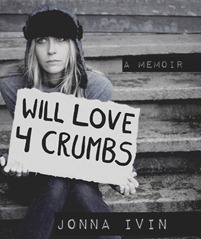
Jonna Ivin used Amazon’s CreateSpace service to self-publish her  memoir, Will Love For Crumbs. In this invited guest post you will read the inside story behind her decision and her experience carrying it out.

Will Love For Crumbs CoverWhen I was first asked to write about my experience in self-publishing, the thing that kept running through my mind was, “I have nothing to add on this topic that hasn’t already been written about. Knowing this going in I decided to do what I always do when faced with a new challenge, write from my own experience and write the truth.

The truth is, when I finished writing my memoir Will Love For Crumbs, I didn’t have the first clue what to do with it. I knew one thing for sure, I had no desire to write letters to publishers, wait to be told I could submit a few chapters then wait some more, maybe be told I had been accepted and then spend more and more time waiting for my book to finally be released. Of course I knew all along this process that the possibility of rejection would hang over my head. But rejection was not an option for me. That was the second thing I knew for sure.

I figured the best way to avoid being rejected was to not ask to be accepted because If I didn’t ask permission then no one could tell me no. It was the first time I was completely prepared to call the shots in my own life, well, maybe not prepared, but determined. Being firmly set on knowing what I didn’t want, I then focused on going after what I did want. What I wanted was to see my project through to the end. I wanted to hold a printed copy of my book in my hand and know that I had finished what I said I was going to do. For me the decision was simple, I would self-publish. But where to begin? I knew nothing about self-publishing, but what I did know was as long as someone out there had done it before me, then all I had to do was follow their path. And so I began to Google it.

I read everything I could on self-publishing and most of what I read kept leading me to Amazon. From there I learned that there were two options, Kindle and paperback. I went for both. Why not? I had nothing to lose. I won’t go into the actual step by step process because Amazon and CreateSpace have already laid it out much better than I could ever explain it. I simply took each step one at a time and did what the instructions told me to do.

I was alone at the office late one night when the moment came for me to hit the publish button. I was nervous, excited and I’ll admit, a little scared. Okay, a lot scared. I’d written about the most personal parts of my life and now all of it was floating around cyberspace for anyone to read. I was terrified people would actually read it, but even more, I was terrified that they wouldn’t. I posted a little blurb on Facebook announcing to my friends and family that my book was available, then drove home, crawled into bed and went to sleep, once again having no idea what the next step would be.

Will Love For Crumbs began selling a few copies a day, and I was slowly building up my social networks, adding friends, joining groups and participating in conversations. I think it’s really important to be strategic when participating on social media sites. Most importantly you must be “social”. Going in and flooding a site with links to your book is not only boring, but most often annoys people. I put my focus on memoirs and relationships and when I found interesting articles or books on these topics I reposted them. I’m always looking for new ways to reach a wider audience and supporting other writers is a great way to start.

I also took advantage of the KDP Select Program to offer my book for free. Valentine’s Day was approaching and I thought since my memoir is called Will Love For Crumbs it would be a funny tie-in to the holiday. I offered free downloads for three days, using the tag line of, “Don’t worry about your crappy love life – read about mine instead.” During the promotion there were over 21,000 downloads of my book. I was beyond thrilled with the results.

I’ve been asked by some people, “Why would you give away your book for free? Aren’t you afraid of all the money you’ll lose?” My answer is always the same, “I didn’t lose anything. Those 21,000 people would have never even heard of my book if it hadn’t been available for free. I would gladly give 100,000 copies of my book away. The whole point for me is to reach the widest audience possible and in order to do that I have to reach beyond family and friends.” And it worked. After that weekend I began to get more and more reviews on Amazon and Goodreads which continued to lead to more sales. I began to receive numerous friend requests on Facebook, opportunities for interviews and guest blogs but more importantly readers started to reach out to me to say that I had written a book that described how they had felt and what they had experienced in their lives. That alone is worth any number of free books.

My best advice to anyone who is thinking of self publishing is to just go for it. Write the best book you can and then throw it out into the Universe and see what comes back. You have nothing to lose and everything to gain, the playing field is even. No one can tell you no and rejection is not an option.

Write now: Read  a guest post on Memoir Writer’s Journey about Jonna’s experience with writing her memoir, read my review of Will Love For Crumbs, and visit Jonna’s  website and Facebook page..