Showing posts with label Facts. Show all posts

When Memories Morph

Robin,-1201-Montrose,-Albuquerque,-1947I’m gobsmacked. I pulled up this picture of my kid sister in that ancient stroller/ walker. I planned to stick it in an email to a cousin to illustrate a story snippet about our  grandfather and my dad the day they poured a big square concrete pad in that back corner. I was three at the time, and I remember that while he smoothed concrete, Granddaddy smelled like whiskey and cigarettes, the point of my story to Cuz. That pad served two doors, the one you see, and one you don’t. The second should be around the corner to the left. That second door opened into the dining area. Or so I’ve always thought. Until today.

I strained toward my screen in bewilderment. Where is that door!?  I KNOW it was there! Holy cow! How can this be? I mentally scramble inside that small dining room on a day before my mother and grandmother knocked a wall down while the men were out hunting. Before the wall came down, Mother had her sewing machine in that room along the soon-to-vanish wall. Until this very minute, I would’ve sworn to you that the door was behind her left shoulder as I sat facing her on the floor to her right, making tangles in thread while trying to sew.

Okay. I get it. The door was never there. I edit it out of memory and the picture still looks right. My earliest memories are in that Albuquerque house where we lived until I was six. This is not the first mind-shattering discovery about memories of that yard. Previous pictures have shown my sandbox was not where I remembered it being, and a willow tree did not have two of its four trunks amputated. What gives?

I have no idea why I remembered these things wrong, but neuroscience is no help here. This just happened. No need to explain. These morphed memories are not just a factor of my young age when they formed. Like most everyone, I’ve learned through the years that my memory often differs from what others remember, and I’ve seen evidence to back those others up more than once. The question is how that affects my story. I ask myself these two questions:

Does it matter? In the case of this house, yes. It matters to me to stick with the evidence and note that my memory was different. Since I have no emotional attachment to the earlier memory, it’s an easy switch. If no evidence is at hand when my sister and I remember a room color differently, I might flip a coin or stick with my version. If details change the truth of the story, they matter.

When it does matter . . . If I discovered I was wrong about something I was emotionally invested in, something that did change the truth of a story, things would become more complex. Using a hypothetical example, let’s say that while Nora was settling her father’s estate, she was stunned to discover documents proving that her mother was his second wife. He’d been married for several years and divorced before he met Nora’s mother, and furthermore, Nora has half-siblings she never knew about.

That extreme example would set off a hurricane of memories and emotions ─ and maybe research ─ leaving a new story in its wake. In stories about her father, Nora may choose to honor her original memories of her dad as a staunch church member and strong advocate of family values, then reflect back on them in the light of what she’s learned and what it all means to her. Perhaps her story would focus on how things changed. But if she wrote stories exclusively within the period before learning this fact, she may choose to write from the perspective of what she believed to be true at the time.

So whether you remember wrong or learn something new, memories morph. When you discover discrepancies, it’s your choice whether to make that discovery part of your story or the focus of your story, or to honor the truth of the memory that shaped your life and made you who you are. It’s your story. Write from your heart and be true to your Story.

Personal Truth vs. Factual Truth

Water-Pistol

Rereading old stories often sparks new insights. Ditto with old blog posts. En route to finding an old post about something else, I found “My Brain on Story.” That post is based on an incident where a witness to a mock crime testified that what turned out to be a plastic water pistol was the gun that fired the shot she heard.  Rereading the post led me to reconsider the controversy about Truth I reported there. My son-in-law’s adamant position was that although the perception that a water pistol was a bullet-firing weapon was real, it was not true. I disagreed, clinging to my assertion that the perception was true.

Today a flash of insight penetrated my skull. Sally’s perception of an actual gun and speeding bullets was personal truth  or perceived truth. The documentable fact that the gun was a water pistol was factual truth. While not every instance of questionable truth has documentable evidence to prove it “right or wrong,” in this situation , the matter can be settled. I still maintain that each form of truth is equally valid, but I’ll concede they are different.

Bottom line, in my opinion, it still does not matter. We’re still talking about terminology and the fact that perceived or personal truth plays a powerful role in our lives.

Sally’s personal truth that a pistol was aimed at her and that shots were fired is still as true today as the day it happened in 1984. I did not stay in contact with Sally, but I can say with absolute certainty that she remembers that personal truth, how real it was, and how stunned she was to hold the water pistol. I’m willing to wager that her life turned a corner that day.

The timing of this discovery is amazing. Life has intervened, and that new volume of advice for writing your lifestory is not finished, though I’m deeply engrossed in it again. I believe it’s no coincidence that I’m currently working on the chapter on memory and truth.

This flash of insight holds two jewels for that chapter:

1. Truth comes in at least two versions, maybe more. Each or all are equally valid, just different.

2. Insight and understanding evolve. I’ve written about this before. Lessons sink in and begin to grow when their seed sprouts, and some seeds can take a long to sprout.

My life is full of slow-cooker lessons and evolving understanding. What are some things you’ve been slow to learn?

Six Things I Learned Going from Memoir to Fiction

CB-covers

Invited guest post by Carol Bodensteiner

Long time readers may be surprised to find a post about writing fiction on this blog about life writing. While it’s true that my focus is on memoir, lifestory, journaling and other forms that draw upon actual experience to express personal truth, sometimes the freedom of fiction is more effective in conveying truth. Carol Bodensteiner found this to be true. She has successfully written in both genres and her experience moving from memoir to fiction has lessons for all.


I’d been a business writer all my life, so I was used to working with facts. Memoir was a logical first writing step. Growing Up Country: Memories of an Iowa Girl, tells the stories of my childhood growing up on a family farm in the middle of the United States, in the middle of the 20th Century.

When I finally raised my head from writing, publishing, and marketing the memoir, I looked around for what I’d write next. I turned to family-inspired fiction, which I’d never written before.  My novel, Go Away Home, which I indie published in 2014 and was acquired by Lake Union Publishing (an imprint of Amazon Publishing) later that year, is the result of that effort.

The road from memoir to fiction brought many adventures and a lot of learning. Here are six things I learned along the way.

1) A family story can be a great launching pad to fiction.

Go Away Home was inspired by my maternal grandparents. My grandfather died of the Spanish Flu in 1918. Throughout my life, I’ve been intrigued by my connection to this major world event. As someone used to writing from facts, a family story gave me a starting point: A story I cared to write and people and places that were familiar.

Writing the story as fiction was necessary for many reasons. One was that I didn’t have enough facts to write it any other way. Of course I never knew my grandfather and even though my grandmother lived until I was well into my 20s, I never asked her a single question about him or their lives together. And she was not the type to share. So though the story began with family, it is fiction.

2) Don’t get stuck on the facts

Once I got into writing the story, one of the biggest challenges was letting go of the facts. Since the genesis of this story rose from people in my family, and I knew a bit about the people, places, and events, my inclination was to use those facts. But I quickly found that the facts didn’t work for the story I was ultimately telling. They didn’t create a good story arc. There was no drama. On his website, Write the Truth, Robert McKee said, “The weakest possible excuse to include anything in a story is: ‘But it actually happened.’”  Having gone this route, I believe him.

3) Do get stuck on the facts

Since Go Away Home is historical fiction, research was critical to creating the time period accurately. Clothes, transportation, hairstyles, technology, colloquialisms. The list of topics I researched and fact checked was long. Readers of historical fiction really care about the details. Writers must, too.

Research also helped shape the story. One example: Family lore was that my grandmother went to a sewing school. Research revealed that the town in question didn’t have a sewing school, rather that young girls apprenticed with seamstresses as a way to learn an important life skill and to meet a man to marry.  The idea that seamstresses were invited to their clients’ house parties had terrific dramatic potential, so I ran with that.

Another bit of fact to fiction. My grandmother took pictures, but the whole part in the book about the main character’s work for a photographer and her relationship with him is entirely fiction.  Most of the book is that way. Tiny fact. Huge fiction.

4) Planner vs. Pantser

Writers fall into two general camps: Planners and Pantsers. I wrote my way into Go Away Home, discovering the story through countless re-writes – by the seat of my pants. I always knew the end of the story; I didn’t know how we got there. In the first draft, the story started in 1900 and my main character Liddie was 10. In the second draft, the story started in 1915 and Liddie was 19. In the published draft, the story starts in 1913 and Liddie is 16. Believe me – those changes create seismic waves throughout the story.

Having used this highly inefficient “pantser” approach once, I’m reasonably certain that I’m a “plotter” at heart and will be more plan-ful in future writing.

5) Fiction is freeing

While I thought it would be easier to start with some facts because that was what I was used to, the reality was there was great freedom in starting with nothing. As the story developed (pantser), it became clear that connections were missing. I needed a scene to show my main character’s inexperience with men. No problem. I made up a guy. I found it was great fun to let my imagination run. Over and over, I filled holes with scenes that met a plot need.

6) New craft to learn

I learned a lot about creative writing as I crafted my memoir, much of which was also applicable to fiction. Dialogue, scene development, visual characterization – all come into play in both genres. Plotting was a new challenge in fiction writing, as I noted earlier. Developing multi-dimensional fictional characters was another challenge.

I used a number of techniques that contributed to creating the real, individual people living in my novel. I visualized people I know who were somewhat like the characters I had in mind. Writing exercises helped to identify key traits and to express them in fresh ways. I used Enneagram research to flesh out the positive and negative traits of various personality types.

From memoir to fiction, from craft to research, I will always be able to learn something new about writing, and for me, that’s great fun.

Go Away Home is available on Amazon in paperback and ebook formats.

Growing Up Country is available on Amazon in paperback, ebook, and audio book formats.

Carol Bodensteiner – Bio

Carol Bodensteiner is a writer who finds inspiration in the places, people, culture and history of the Midwest. After a successful career in public relations consulting, she turned to creative writing. She blogs about writing, her prairie, gardening, and whatever in life interests her at the moment. She published her memoir Growing Up Country in 2008. Her WWI-era, debut novel Go Away Home was acquired by Lake Union Publishing, an imprint of Amazon Publishing. It launches July 7, 2015.

Carol’s online links
Website/blog 
Twitter
LinkedIn
Facebook

Write now: think of an interesting ancestor or other person who has influenced your life that you know relatively little about. Drawing on Carol’s experience, write a short story about how you imagine this person’s life might have been. Don’t worry about facts. Just let that story rip. Have fun with this!

What Does It Mean to Fit In?

puzzleAll my life I’ve wanted to fit in, or so I thought. Now I wonder. What is it that I wanted to fit into? Some might say their jeans, but so far, my jeans have fit fine. I wanted to fit in with others, to blend seamlessly with the group. To be an insider. To be like others. Suddenly I wonder: just what does that mean? What was I hoping to be like? And who were these people I wanted to fit in with?

Last month travel writer Annabel Candy published a blog post, 35 Ways I Don’t Fit In, and she challenged readers to make their own list and link back to her post. When I sat down to make my list I realized that any given item is far from unique. Each specific attribute will be shared by a multitude of others – like DNA, it’s the total combination of shared elements that makes me unique. In no particular order, I’ll list  35 of the countless elements that add up to my unique experience and self.

1. I love chili, the hotter the better – up to a point. Inspired by Elizabeth-Anne Kim, I’m working on a Kindle Short about my adventures as a Chilihead.

2. I spent my public school years in Los Alamos, moving there after the Manhattan Project chaos had settled down and Los Alamos was closer to being a “real” town.

3. I have visited all fifty states, and lived in eight of them.

4. I love working with Photoshop.

5. I’d rather be writing than nearly anything else – except traveling and playing with Photoshop.

6. I almost never use recipes when I cook.

7. One of my two earliest memories was sitting on the floor by my mother’s knee with a needle and thread and scrap of fabric. I knew I was only  making tangles, but that didn’t matter. I was sewing!

8. In 1961 I placed second at the state level in the New Mexico Make-It-Yourself-With-Wool contest.

9. I began violin lessons in fourth grade.

10. In high school I played string bass in the New Mexico All-State Orchestra.

11. My favorite afterschool activity in high school was drama club, known as the Olions. I always worked backstage.

12. I love to drive stick shift cars and still own one.

13. I have hiked the Milford Track and Tongariro Crossing in New Zealand.

14. I have walked across edges of Antarctic glaciers.

15. I can’t carry a tune by myself.

16. I love walking in the woods.

17. I do not enjoy gardening or yard work.

18. I do not like talking about myself!

19. I love solving puzzles.

20. I do things in binges, i.e. writing, playing computer games … even cleaning.

21. I used the kitchen clock as a calculator to keep score when my sister and I played tiddly winks as preschoolers.

22. I love taking pictures, but don’t give a fig about f-stops and all that jazz. That’s what Photoshop is for!

23. I have a great-grandmother and great-great-grandmother buried in Oakwood cemetery in Austin, Texas, right behind Ima Hogg, less than two miles from my daughter’s house.

24. I graduated from Boston University.

25. I was once a movie star’s houseguest at his beachfront home.

26. I was treated to a reed kayak ride on Lake Titicaca on my most recent birthday after dancing with village women.

27. I began using AppleWriter on our Apple ][+ computer right after Halloween in 1982 – 30 years ago!

28. I have six grandchildren living in three states.

29. I have made every type of clothing article from hats to shoes, lingerie to winter coats.

30. I was always the last one chosen for softball in grade school.

31. Many of my best friends live in my computer.

32. I’m a lifelong supporter of public libraries.

33. To my chagrin and amazement, I love ebooks!

34. While failure is not an option, giving up often is.

35. I quit wanting to fit in. I like my unique mix of me, and realize the joke was on me. When I quit trying, I fit in with most groups. 

Any life writer will recognize this list as thirty-five story ideas. You know lots of facts about me that you probably didn’t know before, but not the story behind the facts. I could easily cluster these ideas, combining them into perhaps a dozen or fifteen stories. That’s how a memoir is formed. Find your key ideas, cluster and arrange to fit a story arc, then let those fingers fly!

Write Now: Compile a list of 35 things that make you uniquely you, then write some of the stories. Post your list to your blog or Facebook, and please, link back! I’d love to hear a few of your items in a comment too.

Nobody Remembers Your Story the Way You Do

PhoneCallMy daughter recently sent me a copy of an article she’d written with the following note in her email: “… I’m kind of stealing your stories here and wonder if it’s okay and if you want o me to change anything …”

I was pleased that she had the professionalism and courtesy to alert me and ask permission first.

I read the article with interest. It was strong and well-written, but I saw with dismay that although she had the general sense of my experiences right, most all the specifics were inaccurate. I called her and set the record straight, giving the story my blessing.

This experience underscores three fundamental facts about the importance of writing your own life story.

If you want your story written right, write it yourself.

My father is a great story teller. I’ve spent untold hours listening to him tell about his father’s job killing prairie dogs for the USDA (I think it was the USDA – I’m not entirely sure, which emphasizes my point here), teaching cadets to fly bombers during WW II(I always forget the full list of models) and endless others. The fact is, I don’t even remember all the subjects, much less the details. Fortunately he has written many of his stories – but nowhere near all of them. There are still huge gaps. Most of his stories will die with him, along with fragments of family history that he’s the last to remember at all.

I’m doing my part to perpetuate them. I’ve been turning on my tiny digital recorder while he talks – when I have it handy and remember. That’s better than nothing, but he lives 2500 miles away, so our time together is limited and editing or transcribing recordings is hard, time-consuming work.

Sharing stories with others is a great way to set the record straight.

If my daughter had not written her story and shown it to me, she would never have known the actual facts, and I would not have realized this. There was no harm in the way she told the story, but setting the record straight gave her a little more insight into the relationship I had with my mother and a couple of other things.

Had she not written this story, these facts would never have all been on the table at the same time, and neither of us would have connected the dots.

Collaboration fills in blanks in family history.

The fun part is that had my daughter not written this story, I’m pretty sure I never would have – at least not that way. Her approach of  writing and checking facts worked well, even though that wasn’t her specific intention. She was simply being respectful. If you have family members available to collaborate with on writing family history, seize the moment.

Write now: write a story based on your memory of a relative’s experiences that hold meaning for you. Show the story to your relative and ask for their version. You may want to change your story to incorporate their edits. Another possibility is to incorporate their version as additional observations, for example, “In Aunt Gussie’s version of this story, Uncle Herman … )

Photo credit: Ken Banks

Fact or Fiction?

fact-or-fictionAn ongoing debate rages in the memoir world about Truth. What are the limits? How much creative license is too much? Where do you draw the lines between memoir and fiction?

The case for fictionalizing memoir is growing increasingly prevalent and strong. Proponents claim that all memory is fiction to begin with, since memory is based on perception and perception has to be interpreted. No two people perceive things exactly the same way, ergo perception is fiction. Thus all memoir is fiction, so we might as well call it that to begin with and avoid controversy.

Other positive points the fiction camp claims include:

Freedom to disguise characters and place, thus shielding yourself from disgruntled acquaintance, relatives, and lawsuits.

Freedom to embellish details as you wish.

Freedom to distort circumstances to enhance a point.

Freedom to write in third person and include other people’s points of views.

Freedom from concerns about inaccurate or incomplete memory.

Some truth can be expressed more poignantly in fiction than sticking to real life circumstances would allow.

Your muse has more room to dance, play, and toss out delectable insights when unfettered by reality constraints.

These are all valid points and they have artistic merit. There are times when fiction is a powerful alternative. But if you look closely, you’ll notice nearly all those points are based on fear. When the fiction decision is made from fear, it may be a cop-out. This fear may stem from the possibility of censure or offense, from insecurity about writing skills, or from anticipated consequences for baring your soul.

A case can be made that these are all surmountable, and that the rewards of writing your truth in your voice as your true story are likely to be greater than the rewards of writing fiction. Some point out that writing fiction is no guarantee that people won’t attribute it all to your personal experience anyway, as Kathryn Harrison found out when she wrote The Kiss.

Harrison’s first published book was a novel, Thicker Than Water, about a consensually incestuous relationship between a man and his twenty-year-old daughter. Critics claimed it was really a memoir. In truth it was fiction, though based on her own true story. According to her account while keynoting a writer’s conference I attended a few years ago, after writing her third novel, she became blocked and had to write the incest story as a memoir, The Kiss, to get it out of her system. Critics read the memoir and claimed it was fiction. She read parallel passages at the conference, and the memoir was more sparsely written with fewer details.

So how do you know which form will work best for you? It’s always a personal decision and the author’s choice. If you want more information to guide you through this choice, be sure to sign up for the 2011 Fall Memoir Writing Telesummit sponsored by the National Association of Memoir Writers. Eight experts will join NAMW founder Linda Joy Myers to discuss various facets of topic Truth or Lie — On the Cusp of Memoir and Fiction.

Click here to see the list of speakers, times, and topics, and sign up for this free event. Even if you can’t listen live, everyone who signs up will receive a link to listen to replays.

Write now: pull out a favorite memory and write the story as fiction to explore the difference it can make.

Don’t Get Tripped Up By Details

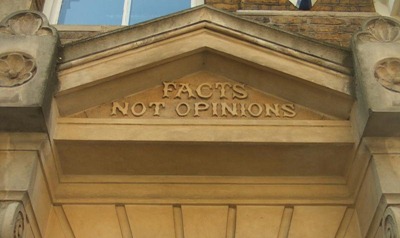
facts-not-opinions In life writing and memoir circles, Truth is always one of the hottest topics of discussion. In general, nearly everyone recognized that no two people see things quite the same way. The important thing is to write the story the way you remember it, to be true to your self. If people disagree, so be it. Suggest they write their own story.
Many details in your stories are a matter of personal memory, and there is no way to go back and check, so it’s your word against somebody else’s. There is no way to resolve such disputes, so write what you recall and let it go at that. However, there are a few instances involving verifiable facts where your memory can trip you up.
For example, I recently read a draft of a friend’s memoir. It included several paragraphs about Toastmasters. As it happens, I was an ardent member of Toastmasters for many years. I immediately noticed several discrepancies in the terminology used by my friend, whose involvement was relatively fleeting.
I just finished reading a book that mentioned Elmwood, a noteworthy historic house in Cambridge, Mass. I decided to locate Elmwood on Google Maps, and found it described in Wikipedia. The author stated that it was a nineteenth century residence. As I learned, it was built in 1767, a century earlier.
I mention these  seemingly petty points to show that there are some types of detail that people can check and call you on, and sooner or later somebody probably will. Fortunately these two examples are not the type of detail that will do any damage. For example, referring to Toastmaster evaluations as critiques will simply make it obvious to insiders that you weren’t seriously involved with the program, and in a way that error conveys a truth that’s far from damning. Misrepresenting the age of a building you admired from afar as a child – if that’s what you always understood or thought, hardly a problem.
Neither of these examples involve the sort of details authors would think to check. Other types it could matter more. For example, getting the dates of a ancestor or current relative’s birth or death wrong could set off all sorts of controversies among family genealogists in future years, and could cause friction sooner. Names matter (unless they have been deliberately changed). That’s the sort of thing you can check.
The best way to avoid errors like this in your final story is to check obvious facts yourself (that’s so much easier to do today than it would have been even ten years ago). Then follow my friend’s example and have a few people read final drafts to catch typos, find minor errors spell- and grammar-check overlook, and find flukes like this that you could never notice.
Write now: write about some of the landmarks you grew up noticing, including what you remember about their history. Then check them out to see if you find any surprises. You may be intrigued to learn all sorts of new information about them in the process and perhaps that will influence your story in some way. At least you’ll know your details are accurate. Another option is to pull out some old stories and do a little fact checking on ages, dates and similar details. 
Photo credit: Matt Brown