Showing posts sorted by relevance for query inner critic. Sort by date Show all posts

Inner Critic — Guide, Guard, or Enabler?

You will never, ever, in a million years be that creative and write that well!
With nuclear force, Gretchen (my Inner Critic) burst onto the scene shouting these words and a stream of related ones as I began reading Three Bites, a 675 word life story by Leslie F. Miller, found on the most excellent Brevity28 website. Leslie’s imaginative description totally blew me away and seemingly raised the bar out of reach. I knew what was happening; still, I was stunned by Gretchen’s outburst. What was this all about?

Two days later, still reeling from that attack's aftershocks, I journaled about it, using the technique I’ve evolved of posing questions — to myself or whatever source of inspiration may be floating around — and then just writing without further thought. I’ve found many powerful answers that way.

The answer that morning seemed ambiguous. It didn't address Gretchen's outburst at all. Within a sentence or two, my words turned to the day my hubby and I set out to climb Cathedral Rock near Sedona. We both wanted the heady experience of scaling the sheer slopes. He wanted to take pictures. I was curious about the vortex energy Native Americans and mystics associate with the site. I wanted to experience it myself — or not.

The first half of the trail wound gradually up and around the base. Then we had to scramble up a fairly steep rocky area. Did I really want to do this? Was it worth it? “Come on. This is nothing. Keep moving!” Hubby urged. I kept going. Sure enough, in minutes we were on the next level and moving along a fairly level path.

Finally we came to the last ascent, and it seemed to go straight up to heaven, figuratively if not literally. Well, maybe only maybe a couple of hundred feet, but still ... In truth, my fear was not about climbing up. I knew I could make it up with no problem. Getting down again was another matter. Heights make me queasy, and I’m more aware of them going down.

“I don’t think it’s worth it. I don’t need to go clear to the top. This is good enough,” I whined. “You go on up if you want, I’ll poke around down here.”

“You’ll always regret it and hate yourself if you quit. Come on.” His voice was gentle, encouraging, and I knew he was right. I would hate myself later if I wimped out. Up I went.

The view from the top was spectacular, and he got some great photos. I sat for about half an hour gazing out, and I wish I could say I was transported somehow, but if the energy is there, my receiver was not tuned into that frequency. All too soon we headed down again, hoping to also make it up Bell Rock several miles away. The slopes I’d feared descending turned out to be no big deal, and the exhilaration I felt from having overcome my reluctance surely equaled anything The Force could have offered.

Recalling this adventure reminded me that Gretchen could be doing any of several things. She could be posting trail markers to help my stay on the path that makes the best use of my talents. She could be guarding me from danger. Or, she could be giving me the excuse I need to wimp out and avoid the challenge and exhilaration of scaling new heights of achievement.

In the final analysis, I decided that this time Gretchen was functioning as an enabler for my Inner Wimp. Guides and Guards give reasons.
Enablers use fear and intimidation. I won’t be deterred by stories that seem to eclipse my humble efforts. I shall continue to approach reading as a source of inspiration and use it as a springboard for expanding my vision rather than lapsing into meaningless comparisons. And I’ll keep writing, revising, and writing some more, honing my skills with practice.

Regardless of the whines of my Inner Wimp, I’ll take the next steps, writing and revising, slowly scaling my way to that peak, strengthening my writing muscles in the process. Climbing that rock is a robust metaphor for writing. I’d hate myself if I quit trying to improve. My work will never sound like Leslie Miller's because I’m not Leslie Miller. But I can do a fine job of telling my stories my way, and what more could anyone hope for?


Afterward: Perhaps the joke was on me. I recently learned that the Cathedral Rock vortex is not at the top of the rock as I thought, but down at the bottom, across Oak Creek, nearly a mile away. We actually did hike there another day, passing the site without realizing it. But I’m still glad I climbed the rock, and now I know that the most powerful results may not come from the most strenuous effort.

Write now: have a freewriting conversation in your journal or on scrap paper with your Inner Critic about (her?) motivations. Explore previous times, perhaps unrelated to writing, when you have overcome your fears and consider how that relates to your writing. Did you have coach or cheerleader urging you on? Where can you find that sort of support for your writing?

Magic Spell to Brighten Dingy Gray Writing

Writing from an adult state of mind often results in dingy gray writing that has all the appeal of instruction manuals for installing dishwashers. The roots of gray writing go all the way back to childhood. Remember when you first started coloring in a color book? The day you made the sky bright orange and scribbled the grass purple and put pink leaves on the tree? And your mother looked aghast at your proud efforts. “You know the sky is blue. Why did you make the grass purple?” And you knew failure.  Even if you don’t remember, your Inner Critic was born that day, and life became a little less fun. So here you are now, wanting with every fiber of your being to amaze your family and friends with wondrous webs of enchanting words, and you sit staring at blank paper with your solar plexus squooshing your guts up into the back of your throat and you think of orange skies and you can no more write brightly blossoming words than fly to the moon.
TAKE HEART!
BE BRAVE!
Maori boys jumping in riverReclaim your right to chose your own colors. Release your Wild Child, listen to your heart, then color and write on your own terms. That’s the only way to amaze anyone with wondrous writing.

If you dare to try something zany, here’s a special magic spell Sarabelle taught me for keeping Gretchen out of my way. To cast the spell, you’ll need a medium-sized glass jar or drinking glass, your favorite pen or pencil and plenty of unlined paper (best for writing outside the lines, which this spell is all about). Place the jar next to your paper and pen.


Now, sit comfortably in your chair, ready to write, and rest your write hand on your paper. Place your other hand over your solar plexus (the soft triangle where your ribs begin to spread apart). Press gently and notice any sensation of tension or tenderness there. Close your eyes and take a deep, slow breath, filling your lungs comfortably full. Concentrate on the feeling of your breath entering your body. Exhale gently, relaxing and feeling peaceful as the breath departs. Feel your solar plexus relax. Repeat six times, feeling more calm and relaxed each time.

On the seventh breath, fill your lungs completely. Raise your write hand and place it below your mouth in a cupped position. Push on your solar plexus with your other hand as you exhale forcefully, “blowing” the Inner Critic out into the palm of your waiting hand. Quickly close your hand and grasp the critic firmly to keep it from slipping away. Use your other hand to raise the glass jar to one side, and slip the critic underneath, quickly snapping the jar down to capture it inside. You may or may not be able to see it. That doesn’t matter. Know it’s in there, and promise to call it when you need it, but be firm in telling it to sit there quietly. Slide the jar to the back of the desk.

You are now free to write all the
wondrous words you dream of.
To celebrate your freedom, pick up your pen and write a story about the most beautiful flower you’ve ever seen or can imagine. Write about seductive scents and ethereal lighting. Write about running around the yard blowing soap bubbles. Write about your favorite toys. Write about swinging clear up to the sky and digging to China in the sand. Write with joy and abandon and don’t worry at all what it sounds like.

Inner Critics often need lots of training before they'll stay put in their jar, but you can repeat this magic anytime yours gets loose and turns your writing dingy gray again.

Write now: about other joyous memories. Write about scary things as if you are a child telling your Grandma. Write a story about your IC. When did it appear? How does it influence you? What would you write if it were to disappear? Let your words whirl, soar and spin with joy and glee. Write like nobody is reading, and ... HAVE FUN playing with words!

Introducing Gretchen, My Inner Censor and Critic

It’s been nearly two years since my Muse, Sarabelle, introduced herself to me. Those of you who have read my occasional reports of Sarabelle’s influence know that she tends to be a bit feisty at times.

This morning as I sat musing about some seldom visited memories from long ago, Sarabelle tapped me on the shoulder and delivered some surprising news: She is only one of the entities on my Inner Writing Team. In short order she introduced me to Gretchen, my Inner Censor/Critic, and Betty, my Inner Editor. Then, as suddenly as she appeared, Sarabelle vanished, leaving me to my own devices to get acquainted with her colleagues.

With a bit of trepidation sparked by her forbidding appearance, I choose to begin with Gretchen. I
’m immediately transported to the hallway of a prison, in front of iron bars across gray cells. The cells are surprisingly bright, lit by a small barred window, high on the wall. Despite the light, there is no color in this scene.

Gretchen stands before me, a study in black and white herself. Her austere black leather outfit and knee-high boots match her stick-straight, raven tresses, in sharp contrast to her pale complexion. Her eccentric outfit bares her right shoulder for ease of motion as she keeps unwanted memories and stories at bay. Measuring no more than five feet in height, and wiry in build, she’s surprisingly small for someone who appears so menacing. She stands facing me, silent and staring, with arms tightly crossed, black whip clenched in one hand, and a huge ring of keys on her other wrist. She is not the sort of person I generally care to deal with, but I must get acquainted. The significance of her sudden appearance is immediately apparent.

“Gretchen, I’m pleased that we are finally meeting. I appreciate all the fine work you’ve done over the years guarding my darker memories. Now I need your assistance in visiting them.”

“That is forbidden!” she barks in reply. “They are locked in here for good reason. They will make you unhappy and hurt you. They can hurt other people. It’s for your own good that I do this!” Her earnest fierceness is almost comical in its intensity.

“I understand. I have no intention of opening the gates and letting these monsters run amok, but I need to talk with them to gain some important insights. I’ve been getting appeal requests from several and need to evaluate their cases.”

She responds with a long string of admonitions warning me of dire consequences, questioning my motives, my judgment, even my writing skills, and generally tries to scare me off. My resolve begins to weaken, but then I recall why I’m here. Those memories are part of me, and I’m determined to know them better, liberating the ones that can be absolved. Many have served their sentences and are due for release. Others may have gotten a bum rap to begin with. I realize that reason will not work. I’ll have to pull rank to get past her.

“Thank you Gretchen. No one can fault you for lack of dedication. Here is a list of four memories I wish to visit today. Please bring them to me in my study. I’ll expect them to arrive in five minutes. That will be all.” With that, I return to my study, settling into a comfortable chair with a cup of fresh coffee and a pad of paper, ready to proceed with the interviews.

Right now I have my work cut out for me dealing with those old memories. I’ll find Betty some other time.

Write now: about your muse, Inner Censor, or Inner Editor. Do these entities have names? What do they look like? How do they act? What do they say when you talk to them? If you’ve never had a conversation with any of then, do some writing practice in dialog form and see what emerges. You are bound to be as surprised as I was at what emerges.

Lifestory Writers Need a Village

Writers

Fellow blogger Linda Austin included a reminder in a post on MoonbridgeBooks that at least for stories about the larger family, the more family members you involve in the process, the more complete and vibrant the book will be.

Amen to that! Especially when you’re writing about multiple generations within your family. The principle still pertains when focus is solely on self, but in the latter case, you may be better advised to rely on a group of writing buddies rather than relatives. Writing buddies won’t try to hijack your story and feed your inner critic by reminding you “That’s not the way it was!” or “You sure do have a creative memory” or “Why would you write about that?

Whether writing about self or family, every lifestory writer needs a village of collaborators at various stages. These are people you can turn to for inspiration, encouragement, feedback and more. Your writing buddies, whether a formal group or scattered people, can help neutralize Inner Critic assaults. They can tell you when you’ve talked about people without saying who they are or jumbled your timeline. They can warm your heart with wows. They can jog your memory. They can throw logs on the fire and hold your feet to it to keep you writing when the coals run low.

I might quit writing without my village. Mine consists of students, former and present. Local writing groups. Losing my Pittsburgh groups was the biggest wrench in moving to Austin, but Austin is crawling with writers, so I was quickly at home. NAMW is an important part of my village. Most of my village lives in my computer. You are part of it, especially when you leave comments here or on Facebook.

You’ll notice I’ve been slow to post lately. Ditto on working on my book. Hey villagers, keep my feet to that fire. Let me hear it!

If you don’t already have one, find a village, online or in town. Write your heart out, then craft the draft. Persist with your writing. I invite you to share your experience with your writing village in a comment. Or leave a suggestion for others on how to find or build a village of their own. Or tell me to get off the dime and WRITE!

Writing With All Your Senses — A Learnable Skill

Sunday MorningWhen beginning writers read flowing prose full of dazzling descriptions, they may think, “I’ll never in a thousand years be able to write like that!” They may grow depressed and consider throwing their computer off a bridge. None of us are immune, as I pointed out in a past post, Inner Critic — Guide, Guard, or Enabler

When you hear that voice, rest assured that your Inner Critic is the source, and those words are both true and false. They are true because our writing voices are as personal and unique as our speaking voices. You could study and practice for fifty years and be equal in skill and reader impact, but you’ll never write exactly “like that.”

They are false because writing dazzling descriptions is a learnable skill. It takes practice and dedication and seeps into remote corners of life, but the results are worth the effort. In my experience, a three-pronged approach has worked well to hone description skills to a keen edge. One prong involves reading, another involves awareness of surroundings, and the third is deliberation.

I’m a deliberately slow reader. I savor words as a gourmet savors flavors. I always have a pad of sticky flags at hand when I’m reading a novel or memoir so I can flag words and phrases I admire. Some books may have only a couple; others bristle with them. When I read an innovative description, I roll it around, saying it out loud to practice the sound and feel of it, letting it sink deeply into my mind. I imagine how that author may have come up with it.

After I finish the book, I head for my computer and type the flagged passages into a Word document I’ve set up like a primitive database. I have over three dozen books logged there, perhaps half the number I’ve read since beginning the log. I review the file now and then when I need inspiration.

Turning to awareness of environment, when I see something unusual in my surroundings, I ponder ways to describe it. I consider its color, texture, shape -- anything unusual about it. I think about things it may remind me of as I search for metaphors and similes. I try to think out of the box and stretch to find new ideas, relying on the exercise I just mentioned — thinking about how other authors come up with the phrases I admire.

Finally, as I edit, I deliberate and seek fresh ways of stating things and artful ways of arranging the words I use. Free association and visualization are helpful.

This is art, and it has a musical component. You hear a lot about a writer’s voice. This is something we each develop. I may admire Rosamund Pilcher from daybreak to dusk, but my writing will never sound like hers. It won’t sound like Sue Grafton’s either, and certainly not like Steven King’s, or William Zinsser’s. My writing will sound like Sharon Lippincott’s, as it should. My challenge is to continually strive to stay on pitch and in rhythm to keep my voice as crisp and clear as it can be.

I will be sharing description writing secrets and strategies in an online class, Writing With All Your Senses, offered by Story Circle Network in January and February. Click for class and registration details.

Write now: scan the room around you and find one specific item that catches your eye, then write about it. Describe it in an unusual way, and strive to involve all your senses.

Photo credit: Rochelle

How to Read Like a Writer

One of the best workshops a writer can take is found between the covers of books, and if you have a library card and return your books on time, it doesn’t need to cost a penny. Of course I’m talking about reading, often, widely, and deeply. Reading the work of others fires your imagination, and exposes you to myriad voices and ways of expressing thoughts and opinions.

Before I give you tips on how to turn your reading time into your own personal writer’s workshop, please heed this caution: Reading the polished prose of successful writers can put your Inner Critic on steroids. “I can never write that well,” it screams into your brain, hiding behind the first person pronoun as a disguise. “Why bother? My life is so dull, and my writing plain as dirt. I don’t know grammar and forget to run spellcheck. Nobody cares anyway. Why should I bother?”

Here’s what you shout back to that Inner Critic, out loud if nobody’s listening or you’re holding a cellphone to your ear: “I’m a student. I’m learning. I write better today than I did last (year, month), and next year I’ll be even better. If you look at the details, my life is amazing, and I’ll use this book to find a way to show that to other people.”

You don’t have to stick to reading memoir. Well-written novels, mysteries, travelogues, and other topical non-fiction books are also useful. Here are tips to make them do double duty for you:

  • Take notes. Since I generally read library books, I don’t make notes on the page, but I do stick in Post-It flags when I find an especially delectable description or a section that lights my fire. Right now I’m reading Christina Baldwin’s amazing book Storycatcher: Making Sense of Our Lives through the Power and Practice of Story. This book is like rich chocolate to me, so I’m taking my time with it. I’m only about a quarter of the way through, and it already looks like a porcupine, with pink quills sticking out the edges. Later I’ll sit at my computer as I go back through and transcribe notes from those sections. That works better for me than taking notes longhand on paper, but you’ll find your own system.
  • Ask the same question about the book as a whole. What did you like? What didn’t work as well? What questions are you left with? Why would you or would you not recommend this book to a friend?
  • Analyze. When you find those glowing sections, ask yourself what grabs your attention? What makes this section work especially well for you? Jot down the answers and create your own text or checklist to use when you are writing.
  • Review it. Write a review of the book. This may be a long and detailed or a few sentences. Post your review on Amazon if you feel brave and have an account. The process of writing the review helps you hone your writing skills and practice putting random thoughts in logical order.
  • Discuss it. Join a book discussion group, at your library or bookstore, or start your own. You can also find online book discussion groups. You can learn even more from hearing how other people experienced the book.
For a powerful set of examples of how to wring the last bit of juice from the books you read, visit Jerry Waxler’s blog, Memory Writer’s Network and browse through his 150+ insightful analyses and reviews.

Books are indeed a powerful workshop, but I also encourage you to sign up for occasional classes, workshops and writing groups. Books can inspire your ideas and help you craft your content, but they will never supplant the value of feedback from compassionate and insightful readers. You’ll also benefit from reading books about writing, participating in teleseminars and listening to podcasts about writing. For further guidance and inspiration, get involved with the Life Writer's Forum (see box in left column to join) or the National Association of Memoir Writers.

Write now: write a short review of the last book you read. If it’s been awhile, visit the library and check out a few. Bring home several. You don’t have to read them all, but it’s helpful to browse through them and you’ll help the library by keeping circulation stats high.

Giving Helpful Feedback

edit2

Kathy Pooler’s Memoir Writer’s Journey blog post, “The Art of Constructive Feedback in Writing and in Life”, blew me away. Everyone who works with children in any capacity should read her account of the way her grandson’s soccer coach interacts with his team. Everyone who works with people should read the post and pay close attention to the juxtaposition of that style with the feedback she got on an early writing assignment that shut her down for decades.

Her post especially hit the spot because I’ve been deeply reminded lately that strong writing – deep, meaningful writing – generally benefits from feedback of one sort or another, and yet awkwardly given feedback can do more harm than good. In an attempt to prevent such a negative outcome, writing classes I teach, I always give each student a copy of the follow  Feedback Ground Rules:

  • Stories you hear in this room stay in this room! This is crucially important for classes and writing groups to ensure people feel safe enough to share honestly and openly. This caution is not just about story content, it’s about writing skills. Who wants to run the risk that a fellow writer or student might blab to others the sort of thing your own Inner Critic is screaming? You need to respect everything about the writing process. If you want to share an amazing story, ask the author. Most likely the answer will be yes.
  • Be care-fully honest. Don’t white wash your feedback, but strive for compassion and tenderness when you point out aspects of a story that don’t work for you.
  • State at least two or three strong points for each piece. This may include memorable (velcro) words and phrases, a feature of the story structure, great description, moving content, anything at all.
  • Limit comments about needed improvements to the two or three most compelling ones. Respect each person’s need to grow writing skills gradually.
  • Avoid opinion — I like it, I didn’t like it, that was a great story. Opinion isn’t inherently bad, it’s just too easy to fall back on opinion rather than exert the mental effort to quantify why you liked or disliked a piece.
  • Tell how you felt about it — how it affected you. Were you inspired, amused, touched, saddened … ?
  • What worked especially well?
  • Did the story seem to be missing anything?
  • What one or two things can you suggest to make it even better?
  • Avoid the temptation to start telling related stories — make a note of them on your story idea list.

That last item is not specifically related to feedback, but it is a frequent sidetrack in classes and writing groups. I encourage people to keep paper handy to write these ideas down while they’re fresh so they can go home and write the stories.These same rules work with one-on-one critiquing, although in this case, you may do more line-editing. Find out from the author just what information he or she needs and wants. If it’s an early draft, there’s no point in pointing out every missing comma. Stick with conceptual and structural comments.

Should you find yourself in an unenlightened group and be subjected to a barrage of negativity, have a firm talk with your Inner Critic. Tell her something like “Consider the source. Some of those comments were valid, but I’m not going to throw the baby out with the bathwater, and I’m' not going to assume their mean spirits meant anything other than that they don’t know much about how to be helpful. I’ll keep writing.” You may bring this up with the group and suggest some ground rules (you are welcome to copy the ones above), or you may just find a new group.

Be kind with yourself and others, be patient with all concerned, and remember that neither writing nor feedback skills are mastered in a single sitting.

Write now: jot down some thoughts about feedback experiences you’ve had. Were they negative or positive? If they were negative, use the “Is it true” technique to explore the implications.

Joy Writing

Photo by Jurvetson
You know the image of the writer as a starving, tortured soul, each agonized word blurred on the page by sweat beads dripping from his brow. He writes in longhand, on a hand-hewn log desk, by candlelight, wrapped in rags against the wintry blast, with only a crust of bread to sustain his unworthy efforts, and page after page of tormented efforts are wadded into balls and tossed into the fireplace for a bit of added warmth. He makes frequent stops to sharpen the quill with which he writes or to fill the inkwell into which he dips that plume. He may occasionally resort to chopping kindling to gather his erratic thoughts, mind churning in sync with his stomach. In the depths of his heart, he knows these efforts will pay off. His words will be pressed upon millions of pages and stir the hearts of readers with passion second only to his.

You know the image. You may even relate to that image and fear to write because of it. I say to you now, forget it! It’s only a myth. Writing doesn’t have to be this way. Listen to your muse. Loosen up. Write for the sheer fun of it.

“Fun?” Your unspoken question reverberates even unto my heart and ears. Yes! I said fun. Joy. Pick up your pencil and take a joy break.

Maybe before you take write for joy, a little physical action is in order. When was the last time you zoomed around your yard, arms dipping and rising like an airplane? I admit this is not one of my daily activities, but I did try it last summer. I swooped around, dipping and diving, making airplane sounds. I marched like a majorette with knees rising high. I whirled and twirled, stopping just short of falling in a heap on the asphalt. After six or seven minutes, I felt loose as a goose, both mentally and physically. I felt young at heart, and considerably younger in body.

You can do the same thing indoors, moving wildly to magic music, something with a strong beat and lots of energy. For now, try it alone. Or blow some bubbles if you have a bottle around. Catch a few on your hand.

Now, you are ready to write. Start a story with “Once upon a time there was a little (girl or boy, your pick). S/he lived in ...” You take it from there. Make it wild. Transcend gravity. Fly. Swim under the sea. Leap tall buildings with a single bound. Be totally outrageous. Nobody is going to read this, unless you decide to share.

How did that feel? Why don’t you write this way all the time? Because your inner critic won’t let you, that’s why. Talk back to your critic (in my case, Gretchen). Say something like, “Gretchen, I know you have my best interests at heart, but I need a break. I need some joy. Please sit back, have some milk and cookies while I write. You can check it over later.”

By the way, your words will surely flow most freely if you write by hand, on paper, but that’s only one option. Do what feels write to you. Write it your way, with joy.

Start out with easy, childlike topics, and as you grow more comfortable, you’ll find it ever easier to write joy-fully, even about dark topics, knowing that your playful spirit will find the hidden blessing within. You’ll have a fresher attitude, less stress, brighter descriptions. You’ll knock away your blocks with a writer’s rush, and generally juice up your writing. Your
writer’s voice will sing. But best of all, it’s fun!

Just in case you were wondering, this child-like joy writing originates on the creative, write side of your brain, not the reasonable, rational, linear left.

Write now: with joy. Follow the directions above and write something fun, like blowing bubbles and hopping inside one to travel away to a magical place.

The Ultimate Oak Leaf

I occasionally use the following two paragraphs in a PowerPoint presentation during writing classes to illustrate the point that stripping words to their bare essence is one of the most effective ways to emphasize the power of your message:
I look up at the gnarled oak tree, starkly outlined against the sky and see a single dry leaf clinging tenaciously to the largest limb. Every other leaf in the woods fell to the ground weeks ago when we had that last fierce wind, but this leaf may still be there until the tree buds in the spring. The leaf reminds me of my mother, clinging stubbornly to life long past the time when it seemed her body was ready to let go. (83 words)

Lifeless oak leaves cling tenaciously to skeletal branches. Well into winter, they stubbornly resist gales, unwilling to separate from the reality they've known. My mother was the ultimate oak leaf. (30 words)
The most common response after several seconds of silence is “How do you get from number one to number two?

I can answer with assurance, because I wrote those two paragraphs several years ago in response to a writing group challenge to pare a paragraph by at least fifty percent to expose the key message. I rose to the challenge. The process was similar to stripping layers of paint from a flea market find to expose the beautiful wood underneath. This second paragraph is only thirty- six percent of the original, and the uncluttered point is in sharp focus. I assure you that getting it to that point took more than ten minutes! I nipped, tucked, rearranged, and reworded. I kept pecking away, leaving and coming back over the course of nearly a week. I probably revised it thirty-seven times before I got it to the point where I’m no longer tempted to change anything.

Even those of us who know that stories are much like infants (emerging from the womb pliable and bloody) tend to forget the amount of work polished writers put into their creations. Keep that in mind as you do battle with that inner critic lashing out at you with statements like “You’ll never be able to write like that!” or “You aren’t creative enough to come up with such stunning images.”

Talk back to your critic. Firmly insist that you can do anything if you practice and learn. You need time and patience, and you are entitled to as many drafts as it takes. Add words where they are needed to flesh out a description, and then get out the pruning shears. Remember that less is more.

Write now: take a first draft paragraph and remove at least twenty-five percent of the words to strengthen the message. Rewording is allowed. The focus is on thought and word count, not the specific words. Post a comment and let us know how you did.


Ten Years of Lessons about Lifestory Writing, Part 1

LS-Lessons-Learned-1

As I consider lessons I’ve learned about the heart of lifestory writing, I think back to the first class I taught for the Carnegie Mellon University Osher Program ten years ago. I’d taught several classes on this topic before without qualms. But here . . . at Carnegie Mellon . . .  ropes of anxiety bound my chest. My Inner Critic exploded to life:

What do you really know? What are YOU doing in these hallowed halls? You might bluff your way through a Senior Center class, but this is CARNEGIE MELLON. They expect the best. They expect EXPERTISE!

In case that wasn’t enough, within minutes one woman in that first class boldly announced that she had just graduated from the University of Pittsburgh’s nationally renowned MFA program in creative non-fiction.

You’re screwed! She knows more than you do, and she’ll know you’re a fake. Quick! Run out of the room RIGHT NOW! Go home and don’t answer the phone for a year.

I’m not a quitter! I’ll give it my best shot, and we’ll see where it goes. Besides, with that one possible exception, I know more about lifestory writing than anyone in this room, and that’s something. 

Taking a deep breath, I plunged in. I was weeks away from the official release date for The Heart and Craft of Lifestory Writing, published by Lighthouse Point Press. I knew quite a lot, but Inner Critics are hard to placate or silence. I took a deep breath and plunged in after explaining that although I knew a lot, I didn’t know everything, that I continued to learn more, and we’d all learn from each other.

The class went well. CMU Osher invited me to teach again. And again. Eventually I also taught for the University of Pittsburgh Osher LLI program, across Panther Hollow from CMU. Teaching for the Osher programs at CMU and Pitt are among my most treasured memories of the years I spent in Pittsburgh. I’d always dreamed of teaching at an esteemed university. That dream came true in an unexpected and welcome way. As classes progressed, some students were new, but many returned, time after time. “I don’t write when I’m not in a class, and I always learn something new in yours.”

Well, yes. They learned something new because I continue to learn something new and share what I learn. May that always be so! Much of what I learned came from reading their stories with them. I recently stopped to survey what I’ve learned over the past ten years. Some lessons come from experience and others from newly published research. It’s challenging to sort them into a linear list, because many are intertwined, but I’ve given it my best shot and you can read the first four of ten items on the list below:

1) You don’t learn this stuff all at once — I began with piles of short stories. I polished them as well as I knew how. And I kept reading and writing and revising. I learned about scenes and story arc and building stronger connection with readers. I discovered that the more I wrote, the more perspective I gained on life and myself. What a bonus! The adventure continues, and I hope I never quit learning.

2) You don’t learn this stuff alone – I’m more firmly convinced than ever that writing is best done as a collaborative, team sport. You can improve your writing by yourself, but you’ll learn more and learn faster in a class or a writing group. At the very least, find some trusted critique partners online.

3) One of the best ways to improve your writing is to read – Painters study works of the masters to learn technique. Writers can do the same thing. Find fiction or memoir writers you love and pay attention to how they structure stories and use words to pull you in. Read voraciously and constantly. Join a book group.

4) Importance of clear purpose and focus — I learned this more deeply from reading students’ stories than my own. Some stories seemed to ramble without any point. “What are you trying to tell us? What’s the most important thing you want readers to remember?” I ask. They get it.

To be continued in the next post.

By the way, that MFA grad? I quickly discovered that she had not covered this subject in her studies. Furthermore, I couldn’t tell from her stories that she’d ever had a class of any sort. Who knows? Moral of that story? Never make assumptions! Claim whatever power you have and forge ahead.

What writing life lessons have you learned? I invite you to share in a comment.

To Spell, or Not to Spell, That is the Question—Cont.

My last post on spelling and grammar hit nerves around the world. Comments varied, but one way or another, all support spelling. Some also exposed a couple of Inner Critic origins: fear of appearing stupid, and teachers (of all sorts) who feed that fear. Penelope expressed the thought in a comment that you can’t teach people to write from their hearts, “except, of course, to tell them to stop worrying about grammar.” Ybonesy recalled the horror of spelling bees. Pat shared the story of her son, whose creative writing instructor committed homicide on his desire to write. Leah, agreed that getting the story out is primary. Ken, a young man from Singapore, supports learning spelling and grammar, even if they are “broken” in daily use.

Experience supports claims such as the ones expressed in comments that teachers care often involved in the primary care and feeding of Inner Critics. When I have students come to class confessing something like, “I started to write ... ages ago ... but I took a writing class and when the instructor told us (we had to get up at 5 am every single day and write for two hours, or never to end a sentence with a preposition, or all work had to be in 12 pt. Courier font, double-spaced, or ...) I just gave up,” I get angry! My face turns red, and adrenalin flows. I flay those instructors to bits, for all to hear.

Write when you feel like writing,” I rage, waving my whole body. “Write in the middle of the night if you want. Write every day at the same time, once a week on Sunday afternoon, or only when your muse nudges you. The important thing is that you do write!” I go on to emphasize that the story is what matters, and until the story is written, there is no reason to even think about spelling and grammar.

When I work with students, whether that’s in a workshop or coaching, my primary focus in on contents. Most need help first with finding and writing their memories and stories. If some students have the basics down and wants to take their writing to a higher level, we can work on that, but only when they are ready and express that desire.

Those who do want to share stories more widely, and perhaps publish them one way or another, are likely to want to take their writing skills to a higher level. This is the time to get serious about editing. Even then, in classes and my book, I urge them to get the contents in good order, making sure they have covered the bases on the 5 W’s and arranged the contents to flow smoothly before they delve too deeply into grammar. Spelling is generally easy to do early in the game, with spellcheck. However, we all know that write, rite and right will all pass muster with spellcheck.

Believe this truth in your core: Write from your heart, and other hearts will understand. And be very careful who you listen to for advice. If a teacher, or anyone else, pours cold water or red ink on passionate writing, insert earplugs until you can flee!

Write now: about a time when criticism stopped you in your tracks. This doesn't necessarily have to be about writing. Write about your feelings after being judged harshly in any respect. Share the story or shred it, as you see fit.

Q & A About Keeping a Journal


Photo by Julie Jordan Scott

Journaling is one of the most intensely personal activities you can indulge in and one of the most powerful self-care ones, plus it's a gold mine of material for memoirists. Because it is so personal, there is no right way to do it, but many beginners still have questions. Below are a few of the most common.

Do I have to write by hand?

No. There is some evidence that writing by hand slows your thinking to an orderly pace, giving meditative-like benefits, but the edge is slight. If you are able to catch the gush of your thoughts better on a keyboard, go for it.

How should I choose a journal?

It doesn’t matter if you use a hand-bound volume covered in Italian leather, a composition book from the Dollar Store, a folder full of loose paper, software like LifeJournal. or a basic text editor. What does matter is that you choose something you feel comfortable with, and then use it.

When is the best time to write?

Many people prefer to write first thing in the morning, but that doesn’t work for everyone. Write when you can — during coffee or lunch breaks at work, on the bus, after dinner ...

How often should I write?​

To get the most meaningful results, you should write at least several times a week. In her multi-million copy best-seller The Artist’s Way, Julia Cameron advises writing three pages, first thing, every day, and millions of people around the world follow this advise. She does not specify page size. If you skip a day or few for whatever reason, Just pick it back up and keep going as soon as you can.

How much time should I spend?

As stated above, Julia recommends three pages. That may take ten minutes or an hour. Write for as long as you feel the urge and have the time.

What should I write about?
Anything at all. You can keep a log of the weather, record your comings and goings, rant and rave. You can keep a gratitude journal. One key to using it for enhanced health and enlightenment is to focus on feelings, emotions and reactions. The more you get your inner thoughts on paper, the more self-aware you become, the more alternate perspectives you’ll find, and the more stress you are likely to relieve.

Should I share my journal?
That’s a personal choice. If you think others might read it, you’ll filter what you write. You’ll gain the most insight if you keep it private. Hide it or keep it elsewhere if you don’t trust people you live with. Then always write the Truth as you know it, and watch that Truth transform.

What other tips should I know?
Two key questions have generated huge pay-offs of insight for me: “Is this true?” and “What can I learn from this?” After I write one of those questions on the page, I just write down the answer without serious thought. Writing dialogue with people from the past — or even imaginary people — is also powerful for surfacing hidden thoughts and wisdom.

Another tip is to write as fast as you can without concern for punctuation, grammar or even making sense. Just get it on the page and don't let your inner critic stop you!

Do I need lists of topics to write about?

No. But using them can seed some amazing essay material.

What if I lapse?
My advice about writing in your journal is the same as writing life stories: Anything you write, anything at all, is better than writing nothing. Even if it is just a few paragraphs a couple of times a year.

Where can I find more information?
My favorite websites about journaling:
     International Association for Journal Writing
     Writing Through Life
     Center for Journal Therapy

My favorite books
about journaling:
     One to One, Christina Baldwin

     Journal to the Self, Kathleen Adams.

Write Now:
if you don’t have a journal, find some paper or open a new file and start one. If you do have one. pull it out and write an entry.

Delayed Disclosure

If you search the blog archives or click on the Purpose label, you’ll find a pile of posts about reasons for writing your lifestory. One of the most cogent reasons is eloquently expressed by Rich Turner on the Memorablia page of his website, The Grammar Curmudgeon.

He writes:

“... Our daughter, who has become interested in genealogy, was urging me to write my memories. She was prompted to this view by our discovery, after my mother's death, of a journal that my mother had kept. Our daughter transcribed the journal, scanned in pictures from old family albums, and put it together in a book that she distributed to most known survivors – my nieces and nephews (her cousins), my brother's widow, and so on. She asked me to edit it, and, when I did, I became aware of experiences my mother had that I never knew about and of a side of her personality of which I was completely unaware. I also realized that there is something to be said for passing on, in some permanent form, what we recall of our inner and outer lives to our children and grandchildren.”
I was struck by the part about becoming aware of experiences his mother had and facets of her personality he’d never seen. My mother and I were relatively close, and had a relationship of mutual respect and support. However, as a mother of grown children myself, I’m fully aware that there were limits around what my mother expressed directly, and I know she had a plethora of thoughts and ideas I can only guess at. How I wish she'd lived long enough to finish the lifestory she began writing!

It’s not that I didn’t care, and it’s not that she wouldn’t tell, but there were boundaries to our communication, and these boundaries hold for nearly any pair of people. The first is time. There is simply never enough time on either end of the phone/email/IM/whatever to cover everything. The time we spend living our lives and thinking our thoughts far exceeds the time available to share them or listen to others. Thus whatever we convey is going to pass through the filters of condensation.

Another boundary is priorities. Most of us want to be supportive of our offspring and keep up with new things. Those of us with grandchildren are always eager to hear of their exploits, and there’s the tendency to want to hear about our children’s job tragedies and triumphs or latest romantic adventures. So we often spend the vast balance of time in listening mode than telling our own stories.

Personality quirks may also play a part. In general, some of us are more inclined to share personal news and insights than others, and listeners have different styles of responding. If you happen to have a parent who is a low discloser, and a child who is inclined to blurt out spontaneous reactions like, “That herbal healing nonsense is total &#*%!!” that child is not going to hear much about the parent’s evolving interest in holistic healthcare.

I can only speak for myself here, but I tend to be of the low disclosing type, especially around those who may not agree with my thoughts. I’m certainly not likely to think out loud and explore new ideas with someone who is sure to pounce and put me through the third degree.

So, for better or worse — and perhaps after my departure
my children and later generations may (like Rich Turner or Francesca’s children in The Bridges of Madison County) read stories they don’t have time for right (or may not be ready to understand) now. If they care enough to read, they may learn of adventures they never knew I had and aspects of my thinking and personality they never guessed at. That remains to be seen. For now, I write because I love to write, I learn more about myself from my own writing, and what other reasons does one need?

Write now: about boundaries around your own writing; about boundaries in communication with your parents and your offspring. Do you choose these boundaries and accept them, or do they irritate you? What part does your Inner Critic play, and what part does the reaction of the others play? Have your boundaries changed over the years?

There Is No Process!

News Flash: I'm honored to a guest blogger today on my good blogger buddy Karen Walker's Following the Whispers blog. Click over and pay her a visit.

Yesterday I drove thirty miles to hear Tawni O'Dell speak at Westmoreland Community College. Tawni's first published novel, Back Roads, was an Oprah pick in March 2000. Tawni is a stunning speaker — funny, profound, intimate, and brilliantly articulate. I hung on every world for nearly two hours. Her long, face-framing mane of dark frizz gives the impression of an ultra-high-energy person attuned to other spheres, and perhaps she is. She told us that her characters "find her," not the other way around. She must write the books to get these people out of her head.

Being invaded by characters is not a situation faced by memoir writers, (though perhaps it isn't so different from being obsessed with how to tell our memoir story), but she did make some points I especially appreciated. One was to always listen to our inner sense of how to write. "You cannot learn to write a novel in a classroom!" she insists. "I don't have a process. Each of my books has taken a different path to completion. So I can't tell you how to write, how to manage the process." She does support taking classes, because you never know where you'll find an idea that clicks, and (she didn't say this, but it is consistent with things she did say), you can sharpen specific skills in classes and gain an understanding of the craft, if not the process.

I especially appreciated the reminder about the importance of finding our own way through our stories. She wrote five complete manuscripts and collected over 200 rejection letters before she made that breakthrough, that she should write her way, and write what she knows about rather than what she thought people wanted to read. That's when her writing because authentic. That's when Oprah found her.

I appreciated hearing it from her, because I was teetering on the brink of being pulled into writing a Formula Memoir, a process I discuss in my memoir blog, A Los Alamos Girlhood. I also appreciated it because four or five years ago while writing The Heart and Craft of Lifestory Writing, I strongly emphasized that point, that you must discover and work with your unique writing style.

Driving home through the drizzly April day, appreciation of the fresh, delicate beauty of newborn spring vacillated with flashbacks to Tawni. Rounding a corner I became aware of a message bouncing around my head: Trust the process. Trust the process. Aha! If this isn't confirmation to pull a Sinatra ("I'll do it my way!") I don't know what is.

Back to Tawni's thoughts on taking classes, she considers reading to be the best teacher. She reads voraciously, for both story, and also to analyze what makes the book work. What does she like about it? What can she learn? That seeps into her subconcious, and looking back through past volumes, she can see her own progress and growth as a writer. So I'll keep reading, novels, memoirs, books about writing. I'll keep writing and practicing, and perhaps some will find inspiration in my outpouring. And I'll also keep teaching now and then, because some of us do need to hang out with other writers and get feedback on our work. And because it's fun!

Write now: jot down some thoughts about your way of writing. Are you following a formula, or writing from someplace deep within you? Do you let your Inner Critic warn you away from some innovative approach burning within you? What else may make you hesitate?

Expert Advice: The Pro’s and the Con’s


If you haven’t discovered the TED Lecture series, I suggest you waste no time exploring their phenomenal videos about leading edge ideas, presented in TED sponsored programs.  I’ve embedded one of my favorites for your viewing pleasure. Noreena Hertz is an expert speaking on the dangers of becoming addicted to the advice of experts.

Her words appealed to me on just about every level, perhaps because I was raised in a family of die-hard do-it-yourselfers who lacked the resources of Google to solve every problem. We didn’t even go to the library. We just figured things out and did them! That’s a hard mental habit to shake.

Over the years I’ve come to have a healthy respect for those who know more than I do about any given topic, and I’m eager to benefit from their experience. But I’ve learned the hard way to listen to those skeptical whispers.

Those lessons are part of my Story. But the real tie-in for this video in this blog is an inferred message for writers in any genre. We can and should study the work of others. We’ll benefit from reading
books about the craft of writing and taking classes to get more guidance. We’ll benefit from participating in writing and critique groups, forums, and writing organizations. We may even benefit from hiring editors and coaches.

BUT, when all the books, classes, and feedback are finished, regardless of the source, we need to listen to that little voice within reminding us, “This is my story.  This is what I need to say, and this is how I need to say it.” When it comes to your life, your Truth, YOU are the expert!

Speaking of experts, I modestly proclaim that I’m developing more than average expertise on the topic of the health benefits of expressive writing. Earlier this week “Writing With Feeling Feels Good,” my
first post of a monthly series on this topic, debuted on the Women’s Memoirs site. The content is relevant to anyone, so you fellows are warmly invited to click over and take a look too. Don’t be deterred by the name. Matilda and Kendra assure me everyone is welcome.

Write now:
do some journaling or free writing and conduct a written dialogue with your Inner Critic. Explore the whispers you hear urging you to defer to expert opinion. You may want to make this a round table and include your Inner Cheerleader to remind you of your own wisdom, power, voice and skill. Write about following the experts in your writing life and life in general. You may want to expand some “expert stories” into story form to share with others.

Living Color

I’m a great fan of Natalie Goldberg. Not long ago I read her book, Living Color. The book is filled with Natalie’s glorious art, in all its aberrant color. Natalie explains her color choices on page 3:
I was delighted one day to paint an adobe house blue. Stepping through the belief that I must paint mud brown, I experienced an explosion of energy and freedom. It was as though that blue paint were a sword slashing through illusion, bringing me into direct connection with the house’s essence. Objects began to dance unhinged from their proper pigment. That man is green, those sheep are maroon, that horse is scarlet, I suddenly wanted to shout with a new-found freedom as I gazed around me from the hilltop where I had drawn the blue house.
Her explanation about using color to learn metaphor is hazy, but I was intrigued with the idea of playing with color that way. It reminded me of a post I wrote in September about the origins of the Inner Critic. I felt bold. I wanted to play with color, and I wanted to do it the easy way, so I Googled my way to The Coloring Spot and found ready-to-color pictures. In the interests of full disclosure and truth, I’ll admit that I did my coloring on a fresh layer in Photoshop® with a virtual felt-tip pens. It would have been easier to print the pictures and color with crayons!

I began with the Great Wall of China. I didn’t give specific thought to choosing color. I just picked orange for the sky and went from there. I did add a big yellow sun, because the picture told me it needed a sun, and I didn’t want to mess with the sun. The sun is what it is. Everything else is negotiable. I also added a person (me) walking on the wall. I didn’t bother to add the other thousands of people who were there with me. I feel lonely without them, so next time I’ll draw more people.
 

The Great Wall was so much fun I turned to Mt. Rushmore. As I began scribbling, my inner child grew tired. My Brat started arguing with my Good Girl. Mommy had to put the colors away.So, I had fun. I had lots and lots of fun. Did I learn anything about writing? Sort of. I did some writing practice and discovered that I can write nutty, bizarre descriptions, wild as you can imagine. I wrote about a man who needed to have his lawn mowed to keep it out of his eyes, and a walking flower garden (a woman in a wild floral print dress. I can crumple these up and toss them into the trash when I'm done if I want. My mind grows a little wider this way. I’ve put out a few feeder roots out of my thought ruts toward more colorful descriptions.

In a few days I’m going to get out my crayons and color with my three-year-old granddaughter. I want her to know it’s okay to make the sky orange if she wants to (just in case she hasn't figured this out). I’ll invite Natalie to sit with us, in spirit if not body, since she has no children or grandchildren of her own. I know she’d have fun.

Write now: take a break with your box of crayons or marking pens, or Photoshop. Dare to color outside the lines and use unexpected colors. Be brave. Be bold. Have fun. Then go back to your writing and write something utterly ridiculous and audacious. See how it feels to use big juicy words for tiny topics.

Triumph at the End of a Rocky Road


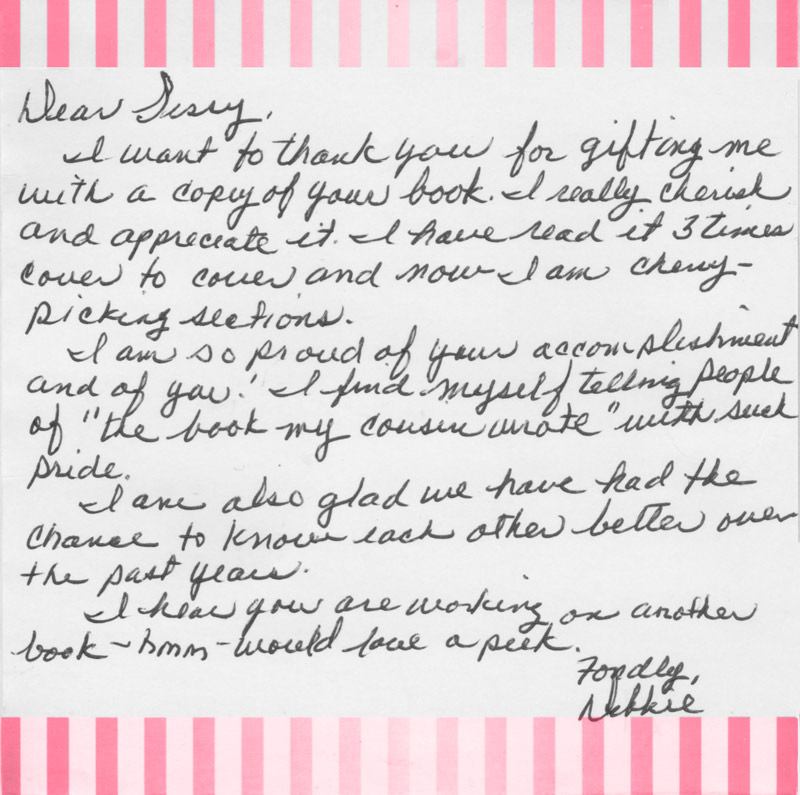
The note above shows one of a rapidly growing list that Carol B has received from family members after privately publishing a volume of family history laced together with relevant aspects of her personal story. She swells with happiness at each one. These notes are more than usually rewarding. The road to this outcome has been rocky. Her stories sizzle with intrigue. That eventually presented a problem.

Carol, her parents, and a family friend (I omit her full name at her request to protect her family’s privacy), spent decades gathering stories and documents from county records and other sources, documenting purchase and sale of property, births, deaths and marriages, police and jail records, newspaper articles and pictures. Piles and piles of pictures. She took careful notes as relatives chewed the fat at family events.  She even sought out help from her local historical society to gather added information.

Eventually she wove memories and facts into stories. Lifestory writing group members pointed out unclear areas, missing material and more. Her strong writing grew polished in both content and structure. Then forces of darkness emerged.

Her family’s history includes mayhem, madness and murder. It’s all a matter of public record, and mostly forgotten, though ripples remain in family attitudes and traits. Still, she was loathe to publish it all without warning the family. She told everyone whose names appeared in the book what she was up to and asked their permission to share stories relevant to their immediate family members. With the exception of one person within her family, she was offered nothing but support and encouragement.  She did not have anyone else read her book, as she was not willing to write a book by committee.  As it turned out, the faith that family members had in her was almost unanimous. Others showed their trust by giving full permission to use their names and their particular family stories.

However, there was one family member who, without even reading the book, objected on principle. “There is no reason to dig all that stuff up again.”  Said Person would not discuss it with Carol and did not respond to numerous requests to be named in the book, then cut off  direct communication.

Carol’s inner critic went nuts. What if I’m sued?  Maybe I’m too critical. Maybe my book is too negative.  Even if I do expose the people in my book to public scrutiny, these are the stories of my family. What should I do?

Her voice had the sound of defeat as she told me, “That person has gobs of money and can afford to sue me on a whim. Maybe that will happen. Maybe I should just drop it. Maybe I should just share the Word file with anyone who wants to read it.”

“You’ve told dozens of people you’re doing this, and they all want to see it finished. What about them? Will you be letting them down? You’ve set aside funds to see it through. How can we work around this?”

Note to readers: don’t try to handle this alone. Get plenty of perspectives. 

“Do you think I’ve been too critical?  Is my book too negative?”

“NO! But I’m not always the best judge of emotional tone. Let’s get one more opinion.” I recommended another writer I know who excels in this area. Her response was supportive. Carol regained her grip.

She decided she would proceed with the project with these caveats:
  • She omitted all references to Said Person beyond a couple of picture captions where she cites the relationship without a name.  She decides to include a vintage photo of Said Person, but includes only a first initial and maiden last name.  To do otherwise would have made her uncomfortable, since she did not want to purposefully leave anyone out of the family history.  She also decided to mail Said Person a copy of the family history book. To date, there has been no acknowledgement of receipt though communication on other subjects has been resumed. 
  • In the Acknowledgments she states: “I have remained faithful to the stories that were passed down through the family and relied on my own memories and those of other family members for additional tales. Throughout the process, I maintained my belief and intention to cause no harm.”
  • The back cover includes a disclaimer of sorts: “… For decades she has collected stories from relatives and public records. She compiles those stories with personal reflections to tell the family’s story with truth and honesty to the best of her understanding.” 

She also firmed up her decision to keep publication as private as possible.

This last step required thinking out of the box. Carol is facing serious health problems and wants to ensure that her extended family will be able to independently order additional copies for years to come.

In line with her decision to keep the book private, she vowed to avoid all promotion and publicity. She is eager, however, for others to know of her experience, even though they won’t be reading the book. Buoyed by the outpouring of gratitude from family members, such as the note above, she has asked me to share that story, hoping to inspire others who battled doubts about sensitive disclosure to persist and find their own way around obstacles.

I’m happy to oblige, emphasizing to readers that publishing privately with limited distribution can be a strong and rewarding option for those who shy away from telling all to the world at large.

As the fan letter notes, Carol is hard at work on a second volume, a personal memoir. Will this one also be kept under wraps? Who knows? If she opts for open publication, you’ll be among the first to know.

Points to Ponder: What tense material might slow down your writing project? What creative workarounds can you come up with? Who can you turn to for support and fresh ideas?

Points to Ponder: What tense material might slow down your writing project? What creative workarounds can you come up with? Who can you turn to for support and fresh ideas?

Seven Secrets about Writing

IanMathieHeadshotIan Mathie, my Scottish/African writing buddy, recently tagged me on Facebook to share seven secrets about writing. I accept this challenge as great sport, and following Janet Givens’ example in her response to Ian, I’m  posting my reply here as the path to Facebook.

Secret #1: Writing is fun!
That is, it’s fun if you write about happy memories and ideas and send your inner critic to her room. Write with color. Write outside your usual boundaries. Write with attitude and guts. More guidelines here.

Secret #2: Writing can be painful.
Dark memories can be searing to write about when they cause you to relive past pain. You may wonder why anyone subjects themselves to this torture. They do it because …

Secret #3: Writing can be healing.
The simple process of dumping that cauldron of trauma onto the page lets you see things in new light and from new perspectives. Memory fragments coalesce into coherent story. Making sense of chaos settles your mind and paves the way for healing your heart. More about this here and here.

Secret #4: Writing builds bonds
in so many ways. Sharing stories around campfires built strong tribal bonds in ancient times. Today our campfire may be blogs and Facebook or email, but the well-written tale still builds bonds of friendship and support. Sharing your lifestory with friends and family builds bonds between generations. Participating in a writing group or class builds bonds of understanding and empathy among members. The more you share, the easier it gets and the more you want to continue.

Secret #5: Writing great imagery adds color and spice to your world.
"His voice is low and soft, a piece of silk you might keep in a drawer and pull out only on rare occasions, just to feel it between your fingers. She reaches into space, and a cool bird-boned hand takes hers."

When I read that rich imagery in Anthony Doerr’s novel All the Light We Cannot See, I quivered with delight. Doerr inspires me to stretch even further to find new ways to express what I experience and imagine. My experience of my world becomes a bit larger. My creativity is enhanced by his, and will hopefully inspire others in turn.

Secret #6: Writing is 90% editing.
It doesn’t have to be. Spontaneous outpourings serve a purpose, but even text messages might be more effective with another few seconds of thought. Witness the fun on DamnYouAutoCorrect.com. Writing like Anthony Doerr’s cited above takes years of practice and perceptual growth as well as hundreds of hours of editing. I find the time I spend editing and imagining new ways of expressing my thoughts a source of deep pleasure. 

Secret #7: Writing doesn’t always involve moving your fingers.
I practice writing much of the time. I search for metaphors for sunset. I look for imagery to describe the dinner table daffodil. I consider what I really want to say in a blog post while I’m raking leaves. Some of my best writing comes to me while I’m in the shower or driving down the road.

Write now: Take up this challenge yourself and jot down seven of your own discoveries or secrets about writing. Post one or more in a comment.

Dare to be YOU!

What the heck has happened?Why am I having so much trouble writing? I asked myself these questions as I wrote in my journal this morning. In recent weeks I have noticed my writing has begun to feel stale and forced, lacking the joy I usually feel. Sarabelle has been conspicuously absent and I’ve been feeling boxed in, pressured.

As the answers flowed from my heart into my fingers, I discovered the reason. I’ve been trying to force my writing and even more so my workshop content into conformance with the examples of others. Not the expectations of others, but my own expectations of what people want to read and how they want to learn, and those expectations have been based on how other successful people are doing things. I also admit there was a tad bit of competition in there, and fear of being left in the dust. These emotions spring from my Inner Critic do not foster creativity and growth!

Before I write another word, I must emphasize that as Herm pointed out in a recent post, learning from Other People’s Examples and Experience is a brilliant way to avoid traps yourself. It’s well worth the effort to study what others have done and analyze what makes it work (or not), applying the results to your own work. However, beware lest you fall into the trap of imitation, the sincerest form of flattery, but a most insincere way of writing.

Posing questions and then beginning to write without thought or predetermination is a powerful way of gaining insight, and the technique came through for me like a magic wand. I quickly reconnected with my core identity of Explorer, one I’ve been aware of for years. I am an adventurer. I delight in discovering new places and ways of thinking and making connections between people and ideas from various sources. I take joy in finding new ways of doing things and overcoming obstacles. I love writing reports of my findings. I enjoy pushing my own limits and helping others do the same.

Formulas and detailed maps don’t work for Explorers. We must find our own way, sometimes using the latest technology and other times falling back on the basics, (like walking, chopping wood for a fire, or writing with pencil and paper). We read the situation and do what’s called for. We shun routine maintenance. We focus on climbing the current hill.

This thought-full re-vision rekindled my passion for the memoir I’m working on, and reminded me that I must avoid the trap of hammering my course content into someone else’s mold. That’s the surest way to bore students and stifle real learning.

So, I discovered that I do dare to be ME — my own unique, juicy, creative self . I don’t want to be responsible for running an empire with all the schedule anchors and promotion that involves; I want to travel light and write and teach footloose and fancy free. I invite you to learn from my experience, and dare to be YOU! Live and write your life your way.

Write now: pick up your journal or a handful of blank paper and write a burning question at the top. This question can be about your writing or anything else that’s puzzling you. Then free your mind of preconceptions and expectations and let the answer flow from your heart into your fingers.