Showing posts with label Writing Classes. Show all posts

An Empty Wallet Is No Excuse

Empty Wallet

Passion soared when I read this Facebook comment:

Being a writer is my dream. But I can’t afford to take writing classes.

I was not the only one to reply. The following list includes points made in other responses along with additional thoughts of my own:

  • Anyone who makes words visible on screen or paper is a writer. You do not need to be published.
  • Your local library is full of books about how to write.
  • The web is full of blogs, tutorials, newsletters, free webinars, and other resources to sharpen writing skills.
  • Whether you can afford to take classes or not, find a local writing group. I summarize their benefits in this post.
  • Do a web search to look for a group, and also ask at your library. All the dozen-plus successful memoir/lifestory writing groups I’ve been involved with have been library sponsored.
  • Keep an eye open for free or nearly so classes. Senior centers and community colleges are likely locales.
  • Online writing groups may be as good or better than local ones.
  • Check sites like the ones on this list for free on-line writing classes targeted to specific skill topics.
  • Search for “free online memoir writing courses” to find free classes and groups. Caveat: free classes are often a come-on for pricey follow-up classes and/or coaching services. Take advantage of what you can get and keep expectations low.

So, you see, you can learn to write well with an empty wallet. Don’t put it off. Start now. Eventually you can even publish for absolutely free via CreateSpace and Kindle, though you’re likely to attract more readers with a small investment in a good cover and some editing beyond what your writing group and beta readers can give you. Your own efforts are perfectly acceptable for limited family and friends’ distribution.

Beyond any thoughts of publication, WRITING IS GOOD FOR YOUR HEALTH. I’ve written extensively about that, especially in my archived blog, Writing for the Health of It.

Now you know an empty wallet is no excuse. What else might be holding you back from following your dream of becoming a writer?

Image by Damon D’Amato, http://ow.ly/vzrI30f4kMT, used by permission via Creative Commons license.

Ten Years of Lessons about Lifestory Writing, Part 1

LS-Lessons-Learned-1

As I consider lessons I’ve learned about the heart of lifestory writing, I think back to the first class I taught for the Carnegie Mellon University Osher Program ten years ago. I’d taught several classes on this topic before without qualms. But here . . . at Carnegie Mellon . . .  ropes of anxiety bound my chest. My Inner Critic exploded to life:

What do you really know? What are YOU doing in these hallowed halls? You might bluff your way through a Senior Center class, but this is CARNEGIE MELLON. They expect the best. They expect EXPERTISE!

In case that wasn’t enough, within minutes one woman in that first class boldly announced that she had just graduated from the University of Pittsburgh’s nationally renowned MFA program in creative non-fiction.

You’re screwed! She knows more than you do, and she’ll know you’re a fake. Quick! Run out of the room RIGHT NOW! Go home and don’t answer the phone for a year.

I’m not a quitter! I’ll give it my best shot, and we’ll see where it goes. Besides, with that one possible exception, I know more about lifestory writing than anyone in this room, and that’s something. 

Taking a deep breath, I plunged in. I was weeks away from the official release date for The Heart and Craft of Lifestory Writing, published by Lighthouse Point Press. I knew quite a lot, but Inner Critics are hard to placate or silence. I took a deep breath and plunged in after explaining that although I knew a lot, I didn’t know everything, that I continued to learn more, and we’d all learn from each other.

The class went well. CMU Osher invited me to teach again. And again. Eventually I also taught for the University of Pittsburgh Osher LLI program, across Panther Hollow from CMU. Teaching for the Osher programs at CMU and Pitt are among my most treasured memories of the years I spent in Pittsburgh. I’d always dreamed of teaching at an esteemed university. That dream came true in an unexpected and welcome way. As classes progressed, some students were new, but many returned, time after time. “I don’t write when I’m not in a class, and I always learn something new in yours.”

Well, yes. They learned something new because I continue to learn something new and share what I learn. May that always be so! Much of what I learned came from reading their stories with them. I recently stopped to survey what I’ve learned over the past ten years. Some lessons come from experience and others from newly published research. It’s challenging to sort them into a linear list, because many are intertwined, but I’ve given it my best shot and you can read the first four of ten items on the list below:

1) You don’t learn this stuff all at once — I began with piles of short stories. I polished them as well as I knew how. And I kept reading and writing and revising. I learned about scenes and story arc and building stronger connection with readers. I discovered that the more I wrote, the more perspective I gained on life and myself. What a bonus! The adventure continues, and I hope I never quit learning.

2) You don’t learn this stuff alone – I’m more firmly convinced than ever that writing is best done as a collaborative, team sport. You can improve your writing by yourself, but you’ll learn more and learn faster in a class or a writing group. At the very least, find some trusted critique partners online.

3) One of the best ways to improve your writing is to read – Painters study works of the masters to learn technique. Writers can do the same thing. Find fiction or memoir writers you love and pay attention to how they structure stories and use words to pull you in. Read voraciously and constantly. Join a book group.

4) Importance of clear purpose and focus — I learned this more deeply from reading students’ stories than my own. Some stories seemed to ramble without any point. “What are you trying to tell us? What’s the most important thing you want readers to remember?” I ask. They get it.

To be continued in the next post.

By the way, that MFA grad? I quickly discovered that she had not covered this subject in her studies. Furthermore, I couldn’t tell from her stories that she’d ever had a class of any sort. Who knows? Moral of that story? Never make assumptions! Claim whatever power you have and forge ahead.

What writing life lessons have you learned? I invite you to share in a comment.

What Makes YOU Happy?

happy-stick-girlThis question, “What makes you happy?” is so simple, but who ever stops to consider it? I hope you will, as I have been doing the last couple of days. It could change your life.

I found this question in the draft of a book I’m beta-reading for a friend. The book will soon be published, and you’ll learn more about it before long. Meanwhile, although answers to this happiness  question could easily fill a book, my initial list has helped me find a focus to reboot this blog.

Let’s take a look at my list. In addition to obvious things like laughing with family and friends, blowing dandelion fluff, piles of freshly washed and folded clothing, having someone else fix my breakfast and that sort of thing, I listed

  • meaningful connection with people who share my interests and values
  • discovering something wonderful
  • sharing wonderful discoveries with those who will appreciate them
  • the satisfaction of polishing a piece of writing – or doing any job well
  • reading masterful writing
  • playfulness in writing and life
  • writing true to myself and my voice

No real surprise here. Involvement in the global writing community makes ME happy! For over sixteen years I’ve been studying and practicing different aspects of life writing and sharing what I’ve learned with others in classes, writing groups and privately. I love that!

But as with other things, it’s easy to go along with the crowd, to be swept up in trends, to keep telling people what you think they want to hear. It’s easy to stick with the same old same old, the tried and true, to say and write what others are saying and writing.

That’s a recipe for burnout.

Recognizing that I was drifting into serious burnout with writing and teaching, I’ve taken an extended break. For a month I didn’t even write email. My husband and I flew to Rome for a few days before boarding the Celebrity Silhouette cruise ship to loop around the Mediterranean for two weeks. We visited Malta, the Greek island of Kephalos, Ashdod (nearest port to Jerusalem), Haifa, Ephesus in Turkey, Athens, Sicily and Naples before returning to Rome. We stayed on the ship for two more weeks, visiting Toulon in Provence, the Spanish island of Palma de Mallorca, Barcelona and Tenerife in the Canary Islands before heading across the Atlantic to Ft. Lauderdale.

We had a great time with without email and Internet for a month, opting for digital detox. I took this one step further and wrote nothing other than a few trip notes. I did read. Between constant Trivia games I read mysteries and memoir and most of a book about writing. But I didn’t write.

By the end of the month I felt alone in a crowd of 3500 people. I met dozens of interesting people, but no writers. Nobody I met gave a hoot about writing, and few even read. Only one was more than marginally digitally literate. I felt like I was on the wrong planet.

Compiling that list of things that make me happy has brought me home to my keyboard, refreshed and ready to write. In playful new ways. With new focus. I’ll fill you in more on that focus in future posts.

Write now: pull out a piece of paper – the back of an envelope or piece of junk mail will do. Make a list of things that make YOU happy. Aim for 100. Hang onto this list. We’ll work with it more later. When you finish, pick one simple thing from the list and do it. Then do a quick Happy Dance.

The Writer’s Path

WritePathAlthough 99% of my writing is stored electronically in several places, I have a  filing cabinet in my office, with drawers 24" deep. The back of of them is hard to access. That’s where my oldest stories are stored, the ones I wrote in 1979 on my old Smith Corona electric at the beginning of my journey along my Writer’s Path.

Every few years I pull those stories out and am reminded again how utterly pitiful they are. True, they were fiction. Sort of. I didn’t know about lifestory writing yet, and would not have been brave enough to write openly anyway. Although some content is touching, descriptions were flat as Kansas, dialogue stilted and contrived. They jumped around. And they were preachy. I had an agenda when I wrote those stories and it wasn’t hidden. They were a start.

Twenty-five years ago, I knew nothing of creative writing classes or writing groups, and never thought to look for books on how to write. I was shooting from the finger tips, buoyed by A’s on research papers.

I fared a bit better when I became contributing editor for a local women’s magazine, getting favorable remarks on my stories from casual acquaintances. When my first book, Meetings: Do’s, Don’ts and Donuts, was published in 1997, I was horrified by the first round of editing. That red ink looked like blood in a war zone.  Humiliation rapidly morphed into hope and excitement at the prospect of learning to be a serious writer. That experience was a cram course in writing.

Since then I’ve taken writing courses. I’ve read stacks and piles of books on how to write, spent hundreds of hours reading websites and listening to webinars and podcasts. But even more, I’ve written and written, and I’ve edited hundreds of stories for students. I have written for at least those 10,000 hours presumably required for mastery, though I don’t claim any titles as such. I’m great at description, but I still have much to learn. My path continues to go up and down, rising overall.

Looking back at those early stories, even at early blog posts, I can see that yes, I have learned, slowly at first, then more rapidly as I climbed along that path. I have grown as a writer, and I hope I continue to do so as long as my fingers move. I still can’t crank out a masterpiece on the first try. I edit my own work, sometimes going back months later when it feels like a stranger wrote it. And I continue to rely on feedback from others for points of view I would never, ever think of.

New writers, take heart. While it’s true that some people are born with a gift for eloquence, even they have a learning curve – they just learn faster. Some people are born with an eye for painting, others with the right legs for running. We each have a gift. But even those without “the gift” can learn to produce respectable results.

With practice.
With guidance.
With collaboration.

Take classes. Read, both how-to-write books and memoir or fiction. Join a writing group. Above all, keep writing. You’ll see results much sooner than I did, because it took me forever to find people to help me along the path. You don’t have to wait. Please join our growing community of life writers on the Life Writers Forum on YahooGroups. Sign up for the mailing list of the National Association of Memoir Writers and participate in the free monthly teleseminar roundtables. And keep writing! Climb that writer’s path, one story at a time.

Write now: write a story about your earliest memory if you’ve never written before. Pull out the oldest story you can find if you’ve been writing for awhile and look for ways to improve it. If you don’t see any, show it to a writing buddy and ask for feedback. If you still can’t find any, congratulations. You are ready for publication!

Like Santa’s Bag of Presents

Santa's Choice“True, I’ve written a few stories, but I’m not a writer!” Such is the mindset of most beginning writers. In January of this year I posted an interview with author Nancy Pogue LaTurner based on her experience writing her memoir, Voluntary Nomads: A Mother's Memories of Foreign Service Life. I’m happy to welcome her back with this guest post building on the metaphor of Santa Claus as she outlines her writing path from novice to “real writer.”

Before beginning my memoir, Voluntary Nomads, I carried a weight around with me. Like Santa's bag of presents, I hefted my sack of stories. It was full to bursting and I needed to lighten the load by giving these gifts away.

Unlike Santa, with his centuries of expertise and magic delivery system, I worried that I was ill equipped to carry out my plan. When I began the memoir-writing journey, I didn't consider myself a writer. I could have, given my early experience as editor of my elementary and high school newspapers, columnist for my hometown weekly, and jobs throughout my working years that required writing grants, proposals, procedure manuals, and public relations material.

I didn't yet see myself as a "real" writer. Then I took a writing class, the first since college half a century ago. The teacher told us to introduce ourselves by saying, "Hello, my name is So-and-so and I'm a writer." It was embarrassing at first, and I felt like an imposter, but as the class continued over several weeks, I grew to fit the writer's costume and learned more skills to perform the author's role.

Faced with the instructor's scathing critique of my final short story in that class, I almost surrendered my name-tag along with any hopes I had of deserving the title "Writer." However, I surprised myself by having the courage to return to my story with a commitment to make it better. My persistence paid off. That story won a cash prize in an international contest sponsored by SouthWest Writers  and received Honorable Mention in the Writers Digest Magazine annual contest of the same year.

Even though more of my writing won other prizes and earned publication in two volumes of the Albuquerque Almanac and an anthology Wisdom Has a Voice, I still didn't see a real writer when I looked in the mirror. Like a department store Santa's promises, my sleigh full of gifts offered potential rather than actual achievement.

Even so, prizes and publication served as validation and infused me with energy to pursue my desire to make a book of my Foreign Service stories. I took more classes and joined critique groups. In 2009, NaNoWriMo (National Novel Writing Month) fever ignited the urge to write 50,000 words during the month of November. When I recognized the power of daily writing practice, I made January my own personal writing month and finished my memoir manuscript.
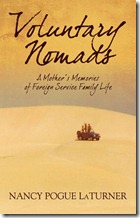
Voluntary Nomads, coverWith the first draft completed, I began a new adventure. On this journey, I learned what it takes to publish a book, and I discovered plenty about myself too. At the beginning of the trip, I couldn't have guessed that I would be able to handle the critical input of an editor, find a publisher, format a manuscript for both print and digital editions, turn color photos into black and white as well as crop and size them for both print and digital reproduction, or carry out the marketing of my final product.

I should have worn a Santa suit to launch my book. On that day, as I signed and distributed my gift of stories, I finally felt like the real thing. I recognized myself as a real writer at last and changed my identity forever.

Nancy Pogue LaTurner plays Santa to three grandsons when they visit her home in Albuquerque where she enjoys retirement with her husband, Fred. Nancy's current writing project is a suspense novel set in New Mexico. Learn more about her on her website and read my review of Voluntary Nomads on Amazon.

Write now: Write a story about your writing journey. If you’ve been writing for years, include some of the blocks you’ve faced and how you overcame them. If you are just beginning, write about your hopes and dreams, and how you will know you are a real writer. Explore elements underlying your belief that you are not yet a real writer. Regardless of your state of maturity as a writer, include your dreams for what you’d like to achieve with your writing.

Writing With All Your Senses — A Learnable Skill

Sunday MorningWhen beginning writers read flowing prose full of dazzling descriptions, they may think, “I’ll never in a thousand years be able to write like that!” They may grow depressed and consider throwing their computer off a bridge. None of us are immune, as I pointed out in a past post, Inner Critic — Guide, Guard, or Enabler

When you hear that voice, rest assured that your Inner Critic is the source, and those words are both true and false. They are true because our writing voices are as personal and unique as our speaking voices. You could study and practice for fifty years and be equal in skill and reader impact, but you’ll never write exactly “like that.”

They are false because writing dazzling descriptions is a learnable skill. It takes practice and dedication and seeps into remote corners of life, but the results are worth the effort. In my experience, a three-pronged approach has worked well to hone description skills to a keen edge. One prong involves reading, another involves awareness of surroundings, and the third is deliberation.

I’m a deliberately slow reader. I savor words as a gourmet savors flavors. I always have a pad of sticky flags at hand when I’m reading a novel or memoir so I can flag words and phrases I admire. Some books may have only a couple; others bristle with them. When I read an innovative description, I roll it around, saying it out loud to practice the sound and feel of it, letting it sink deeply into my mind. I imagine how that author may have come up with it.

After I finish the book, I head for my computer and type the flagged passages into a Word document I’ve set up like a primitive database. I have over three dozen books logged there, perhaps half the number I’ve read since beginning the log. I review the file now and then when I need inspiration.

Turning to awareness of environment, when I see something unusual in my surroundings, I ponder ways to describe it. I consider its color, texture, shape -- anything unusual about it. I think about things it may remind me of as I search for metaphors and similes. I try to think out of the box and stretch to find new ideas, relying on the exercise I just mentioned — thinking about how other authors come up with the phrases I admire.

Finally, as I edit, I deliberate and seek fresh ways of stating things and artful ways of arranging the words I use. Free association and visualization are helpful.

This is art, and it has a musical component. You hear a lot about a writer’s voice. This is something we each develop. I may admire Rosamund Pilcher from daybreak to dusk, but my writing will never sound like hers. It won’t sound like Sue Grafton’s either, and certainly not like Steven King’s, or William Zinsser’s. My writing will sound like Sharon Lippincott’s, as it should. My challenge is to continually strive to stay on pitch and in rhythm to keep my voice as crisp and clear as it can be.

I will be sharing description writing secrets and strategies in an online class, Writing With All Your Senses, offered by Story Circle Network in January and February. Click for class and registration details.

Write now: scan the room around you and find one specific item that catches your eye, then write about it. Describe it in an unusual way, and strive to involve all your senses.

Photo credit: Rochelle