Showing posts with label Darkness. Show all posts

Lessons Learned about Lifestory Writing, Part 2

LS-Lessons-Learned-2

My previous post gave the background for lessons I’ve learned about lifestory writing since The Heart and Craft of Lifestory Writing was published ten years ago. This post continues the list.

5) Stories without shadows are flat — It’s not easy to share stories about embarrassing or hurtful memories. But these are precisely the stories that add heart and connect with readers. Shadows add the third dimension to stories.

6) When you change your perspective on life and the past, life changes – several years ago as I began writing about growing up in Los Alamos, I hesitated. How could I write about my chronic feelings of being outside the group, of not fitting in and being different? I did not want my classmates to know they had hurt me, and I didn’t want to make them feel bad or sound like a victim. Using tools I’ve described in previous posts and will include in my new book, I realized most of those feelings were in my head, based on my assumptions and perceptions. I felt like the door to a  prison cell opened and began discovering legions of others felt the same way.

7) Sharing our stories connects us with others – My term for daring to show emotional vulnerability in writing or daily life is “baring your belly” in the sense of exposing  a vulnerable body part. Baring your belly takes trust and guts. It is true that a few readers may sneer at perceived weakness or feel squeamish. Far more will relate and feel empowered to bare their own bellies in story.

8) Neuro-science based guidelines for connecting with readers – A growing body of research relevant to writers is rendered approachable by authors like Lisa Cron. In her book, Wired for Story she translates the technical into easily understood strategies. She provides clear, convincing strategies for grabbing readers by the eyeballs as mirror cells wake up in their brains. Active mirror cells create an effect much like total immersion in a holographic version of the author’s experience. Learning how this works and how to apply it is a work in progress.

9) Writing is good for your health — After The Heart and Craft of Lifestory Writing was published, I learned of the work of James Pennebaker, whose pioneering research on the healing power of expressive writing has been replicated hundreds of times. These studies uniformly show that writing about traumatic, troubling memories, even for a short period of time, helps resolve those memories and improves physical and mental health in countless ways. My archived blog, Writing for the Health of It, includes dozens of posts on this topic.

10) Lifestory writing can be transformational for writer and readers alike – Wouldn’t it be awful if we had to learn every life lesson first hand? Who wouldn’t prefer to learn lots of the tough stuff by reading about someone else’s experience? Quite possibly the plethora of survivor memoirs today is due in large part to brave pioneers who began the trend of what several have called “writing themselves naked.” If someone else overcame (addiction, abuse, incest, deaths of dear ones, etc.), readers may be inspired to do likewise.

Note that this list does not include additional mastery of topics like writing dialogue or description or piecing stories together along a story arc. I’ve made no mention of creating eBooks, selling books, or other technical skills. Those are craft topics. I’ve stuck to the heart of lifestory writing in this list.

I would not have learned any of these lessons if I hadn’t gotten my fingers moving all those years ago. Writing, especially life writing, is a lifelong journey. If you haven’t begun yet, pick up a pencil or head for your keyboard NOW!

How to Write About a Change of Perspective

Celebrate-not-celibate

The meme you see above has prompted millions of laughs, but can you imagine a more life-changing moment than a priest, monk or nun hearing this revelation after decades of devotion?

Misperceptions like this do happen, and they can shape lives. This meme came to mind recently when a woman told me how she spent her child and early adulthood terrified of burning in hell. She knew in the core of her being that ministers thundered messages of hellfire and brimstone “all the time.”

Eventually she discovered that her particular church believed that yes, the wicked did perish in “The lake of fire,” but they did not burn forever. The perishing was mercifully quick and permanent. The wicked were punished only by being deprived  of the multitude of blessings the righteous are due to receive. She did hear about a lake of fire. That was true. But the burning forever part must have leaked in from outside, according to her informant. “I assure you, that was never part of our teaching.”

By the time she heard this, she had moved away from that church. But learning this still angered her: I didn’t have to spend all those years so scared!

Now she’s wondering how to write about this: “I really did believe that. That is how I heard it. If I was wrong, and I only have that one person’s explanation to go on, I still totally believed it. But now things have changed. And I’d definitely never go back to that church. How do I tell this story?”

“That was your truth back then, and nothing has changed that,” I said. “Not even finding out you were, or might have been, wrong.” My advice to her was simple and four-pronged.

1) Write about what life was like back then. Explain what you heard and how that affected you.

2) Write about the whiplash you experienced when you heard the other point of view. Who told  you? How did you know to believe it? How did that affect you? How did you and do you feel about all this? What has changed?

3) Write with compassion. True, you may feel angry and betrayed. Own that and write it. Then consider the angles. Did any one purposely deceive you? Did you ever ask for help or tell anyone you were scared?

4) Sum it all up. By the time you’ve written through steps one, two and three, you will probably be feeling some closure, if you weren’t already there. Stories demand it, whether they’re still at the stage of self-talk or written down. Readers crave it.

Conflict or tension, especially the internal sort, is the meat of this and any story. Jump into the middle of the mud with both feet and let it all rip. Be brave. Write it real. Polish it to flow smoothly, but leave those emotions in place. They are the lifeblood of your tale. They add the juice and the glue that bonds reader to story and helps them gain their own insight from your message.

Triumph at the End of a Rocky Road


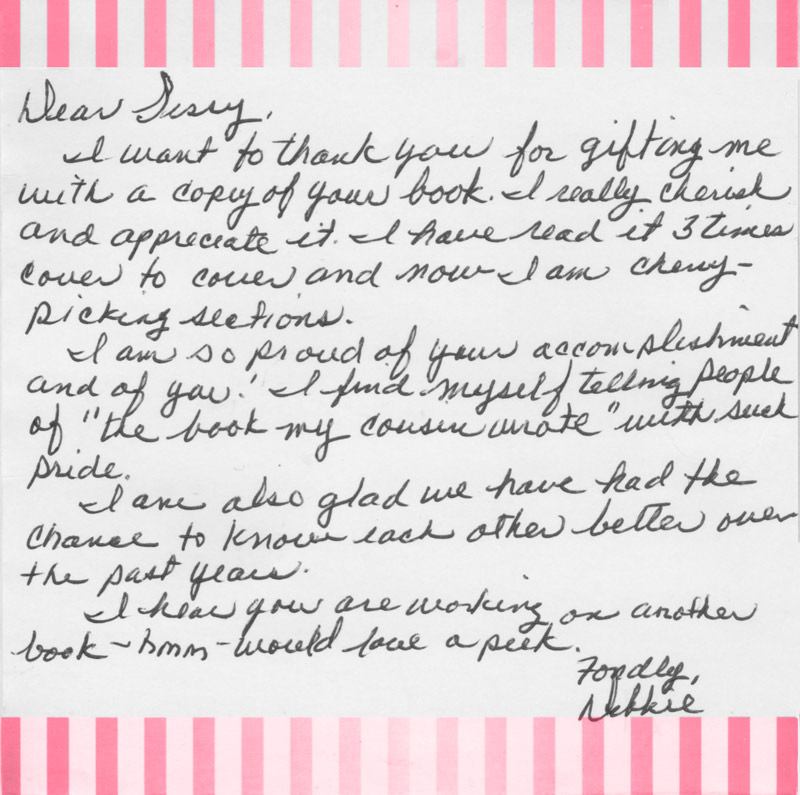
The note above shows one of a rapidly growing list that Carol B has received from family members after privately publishing a volume of family history laced together with relevant aspects of her personal story. She swells with happiness at each one. These notes are more than usually rewarding. The road to this outcome has been rocky. Her stories sizzle with intrigue. That eventually presented a problem.

Carol, her parents, and a family friend (I omit her full name at her request to protect her family’s privacy), spent decades gathering stories and documents from county records and other sources, documenting purchase and sale of property, births, deaths and marriages, police and jail records, newspaper articles and pictures. Piles and piles of pictures. She took careful notes as relatives chewed the fat at family events.  She even sought out help from her local historical society to gather added information.

Eventually she wove memories and facts into stories. Lifestory writing group members pointed out unclear areas, missing material and more. Her strong writing grew polished in both content and structure. Then forces of darkness emerged.

Her family’s history includes mayhem, madness and murder. It’s all a matter of public record, and mostly forgotten, though ripples remain in family attitudes and traits. Still, she was loathe to publish it all without warning the family. She told everyone whose names appeared in the book what she was up to and asked their permission to share stories relevant to their immediate family members. With the exception of one person within her family, she was offered nothing but support and encouragement.  She did not have anyone else read her book, as she was not willing to write a book by committee.  As it turned out, the faith that family members had in her was almost unanimous. Others showed their trust by giving full permission to use their names and their particular family stories.

However, there was one family member who, without even reading the book, objected on principle. “There is no reason to dig all that stuff up again.”  Said Person would not discuss it with Carol and did not respond to numerous requests to be named in the book, then cut off  direct communication.

Carol’s inner critic went nuts. What if I’m sued?  Maybe I’m too critical. Maybe my book is too negative.  Even if I do expose the people in my book to public scrutiny, these are the stories of my family. What should I do?

Her voice had the sound of defeat as she told me, “That person has gobs of money and can afford to sue me on a whim. Maybe that will happen. Maybe I should just drop it. Maybe I should just share the Word file with anyone who wants to read it.”

“You’ve told dozens of people you’re doing this, and they all want to see it finished. What about them? Will you be letting them down? You’ve set aside funds to see it through. How can we work around this?”

Note to readers: don’t try to handle this alone. Get plenty of perspectives. 

“Do you think I’ve been too critical?  Is my book too negative?”

“NO! But I’m not always the best judge of emotional tone. Let’s get one more opinion.” I recommended another writer I know who excels in this area. Her response was supportive. Carol regained her grip.

She decided she would proceed with the project with these caveats:
  • She omitted all references to Said Person beyond a couple of picture captions where she cites the relationship without a name.  She decides to include a vintage photo of Said Person, but includes only a first initial and maiden last name.  To do otherwise would have made her uncomfortable, since she did not want to purposefully leave anyone out of the family history.  She also decided to mail Said Person a copy of the family history book. To date, there has been no acknowledgement of receipt though communication on other subjects has been resumed. 
  • In the Acknowledgments she states: “I have remained faithful to the stories that were passed down through the family and relied on my own memories and those of other family members for additional tales. Throughout the process, I maintained my belief and intention to cause no harm.”
  • The back cover includes a disclaimer of sorts: “… For decades she has collected stories from relatives and public records. She compiles those stories with personal reflections to tell the family’s story with truth and honesty to the best of her understanding.” 

She also firmed up her decision to keep publication as private as possible.

This last step required thinking out of the box. Carol is facing serious health problems and wants to ensure that her extended family will be able to independently order additional copies for years to come.

In line with her decision to keep the book private, she vowed to avoid all promotion and publicity. She is eager, however, for others to know of her experience, even though they won’t be reading the book. Buoyed by the outpouring of gratitude from family members, such as the note above, she has asked me to share that story, hoping to inspire others who battled doubts about sensitive disclosure to persist and find their own way around obstacles.

I’m happy to oblige, emphasizing to readers that publishing privately with limited distribution can be a strong and rewarding option for those who shy away from telling all to the world at large.

As the fan letter notes, Carol is hard at work on a second volume, a personal memoir. Will this one also be kept under wraps? Who knows? If she opts for open publication, you’ll be among the first to know.

Points to Ponder: What tense material might slow down your writing project? What creative workarounds can you come up with? Who can you turn to for support and fresh ideas?

Points to Ponder: What tense material might slow down your writing project? What creative workarounds can you come up with? Who can you turn to for support and fresh ideas?

Ritergal’s Birthday

15-birthday-cakeHeavens to Betsy, today is Ritergal’s birthday, and  I just realized she is a teenager, In fact, she has been a teenager for a couple of years. That could explain a lot of things, but I won’t go into that. In honor of her birthday, she’s my guest today, sharing her flash memoir, previously unread and unedited by me:

That woman, the one whose fingers I’m using, thinks I’m only fifteen, and she thinks she calls the shots. Little does she know. I’m ageless. For several decades I lurked in a hidden closet of her soul, just beyond her awareness, waiting for the right moment to make my debut. In 2000, the time was finally right. The turn of the century signaled the coming of age of both the Internet and my lovely hostess’s relationship with it.

In 2000 She found the ThirdAge.com site and soon discovered that she could build her own website on it, for free. Back in that pre-Facebook era, people were leery of revealing their true identity online, and many adopted web names. She thought she made up the name Ritergal – sometimes she claims her muse Sarabelle gifted her with it. The truth is that I took that opportunity to step out of that closet and onto the Third Age stage she built for me.

The fun part of this story is that she thinks Sarabelle gifted her with an extra name, a costume of sorts. She wrote a post about that ages ago. I know Sarabelle well, and she was in fact in on this ruse. While it’s true that Sarabelle did introduce me, in a whisper as our hostess rightly proclaims, Sarabelle didn’t bestow the name on Her, she introduced me.

Sages that we are, Sarabelle and I have known the secret of Point of View for ages. We know what we know, and we know that it suits us to let Her believe her version of the story. I’m perfectly happy to let Her believe she is me or vice-versa. Let her enjoy this benign case of paramnesia. We all win.

But a teenager I am not, and that fact explains nothing about me. Considering the stage of our relationship, it might explain a lot about Her. But do understand, I am not complaining. She treats me well and we get along great. She’s a great sport when I decide to have fun – I think she’s secretly glad. I do what I can to help and support her. In fact, most of the time I enjoy acting like a responsible, mature (as long as that doesn’t mean stuffy!) human being. It’s a good cover.

She celebrates my birthday. I celebrate Liberation Day and my anniversary with Her. Hey, Sarabelle, party’s on!

Count me in on that party. Oh, wait … did anyone look at the calendar today?

Write now: in honor of April Fool’s Day, write a spoof of some aspect of your life. Make it an open-ended spoof so nobody’s quite sure at the end. Let them wonder. It’s not too late if you read this after April 1. Write it anyway and have fun doing it. Play is strong meat for anyone’s soul, and it’s essential for writers.

How and Why to Write about JOY

Talking-about-problemsThis advice to talk about our joys struck home with me when I saw it the other day. Not surprisingly, I immediately thought how it applies to writing – specifically to life writing – and how happy stories spread joy.

In The Heart and Craft of Lifewriting, I discuss the way many people tend to shy away from discussing success and joy.

“I don’t want to sound like I’m bragging,” some people say. “I don’t people to envy me,” or “I don’t want them to think I think I’m better than they are,” or “I don’t want to make people sad because they missed out.”

These are valid concerns. Compassion for the feelings of others is important. But let’s look at the flip side, at what is lost if you soft-peddle success and happiness:

You are only writing part of your truth. If you are writing for posterity, or for the world at large right now, your success is part of who you are. Surely it’s something you’re proud of. Let them know.

Happiness keeps your story authentic. People who know you’ve achieved something, financial or business success, a happy marriage, or some other positive state will know something’s missing if you downplay the sunshine in your story. It tends to come across as false humility and lack of trust. This is, of course, assuming you were happy. Not all stories are, though we do hope for a glimmer of happiness by the end. Add it where you can.

Reading about how you achieved success, happiness and joy inspires others. We hear and read about gloom, doom and suffering constantly in the media. We need to hear good news. It gives us hope!

People can learn from your example. Explaining in more detail or less how you managed to achieve your fortunate condition may provide a clue for others to follow your example.

Writing about happy things is good for YOU! A quick web search will verify that simple lists in gratitude journals help dispel or fend off depression (in at least some cases) and generally improve your state of mind. They help you stay positive and foster creativity. You don’t even have to share the contents or turn them into story to get these benefits.

Have I convinced you to write some joy? Hopefully into your story? Follow these guidelines:

Include shadows with the sunshine. Everything brilliant emerges from some sort of struggle or stretch. Tell of the tribulations and challenges you encountered along the way. Report feelings of fear, doubt, or dismay. Don’t leave out your concern about not wanting to brag.

Be honest about jubiliation. Who would believe you weren’t popping champagne corks, real or figurative, when you got that big promotion?

Give credit where credit is due. Nobody scales Mt. Everest without a team of Sherpas. Give your Sherpas credit.

Use humor. Poke fun at yourself. This doesn’t mean putting yourself down, but keep both heart and fingers light.

My latest book, Adventures of a  Chilehead, is the story of my life-long love affair with hot chile. It’s full of humor and joy, and I had a ball writing it. The capsaicin in chile releases endorphins. Writing about those happy memories released more. So remember some joy, write yourself happy, and share that good stuff with the world.

Write now: write about a happy experience you shared with at least one other person and write that story in an email or letter. Send it to that person. You’ll both feel happy you did.

New Years Resolutions

2015-Writing-Resolutions

Happy New Year!

I spent considerable time crafting general writing resolutions (in no particular order) that I feel able to keep, but will also push me a bit. I invite you to shamelessly steal any or all that appeal to you.

Some of my underlying thoughts:

PRIMARY INTENTION: I want the concept of lighting a candle in the darkness to underlie everything I write. This is the first year I’ve stated a primary intention. It feels right write.

Write what I want when I am ready. The emphasis here is on when. 2015 promises to be a challenging year of transition, and more than ever, I shall follow whatever schedule works, for writing in general and for writing blog posts. You may see large gaps this year, but no problem. I don’t flatter myself that you can’t face a week without reading a post from me.

Take as long as it takes to write it right. I’ve seen too many people make themselves crazy and produce less than their best work because they set an unrealistic deadline to publish, whether for the public or private distribution. I have that t-shirt in my drawer. Honor your writing and don’t do this to yourself.

Write something every day. No, grocery lists do not count, but a carefully crafted email with more than a paragraph does. Speaking of which, email is a good chance to practice being articulate and organized in presenting your thoughts. While it’s true that urgency may rule at times, take care that you’ve made yourself clear and fix egregious errors, especially those introduced by autocorrect.

Play with words. I’ve written so much about this. Write yourself out of your rut. Constantly think of new and fun ways to express yourself. This resolution links to Write it colorful and considering every angle.

Gorge on rich reading. Let everything you read serve as a self-directed writing workshop. Read once for the story and review to explore structure behind the magic. Make notes to nail those insights, then review the book, for your benefit as well as the author’s.

Share lots of stories informally. Gather a group of people who appreciate your writing and send stories around. Encourage their comments, good, bad and indifferent. You’ll learn a lot and they’ll enjoy the reads. Don’t limit yourself to just writers. All readers count.

Write it real. This thought goes beyond sticking to the facts. I’m reminding myself to include sensory detail, character quirks, self-talk, and those other elements that breathe life into scenes, real or imagined.

Check everything five times. This advice goes beyond checking spelling and grammar. My inbox overflows with emails describing sign bloopers, i.e. “Persons are prevented from picking flowers from any but their own graves.”

 Consider every angle. This advice is especially helpful for lifestory writers. You may be amazed when you consider how others may have viewed a situation or why they may have done what they did. These insights can be life changers.

Sign your name! to cement ownership and intention.

I wish for you a year filled with gratifying results from your writing, whenever, however you do it, with whomever you share.

Write now: make your own list of writing resolutions if you haven’t yet done so. I strongly urge you to do this on paper – pixels are okay if you use a stylus as I did. I’m partial to the Papyrus android app for such projects, partly because my markers have dried up and I like to use lots of color. The idea is to involve brain centers and muscles that add personal value to the writing process.

Author Interview: Kathleen Pooler

Pooler Final CoverToday I’m privileged to have Kathleen Pooler stop by to answer some questions about her newly published memoir, Ever Faithful to His Lead. In any memoir, the author today tells the story of the author back then, and sorting through the jumble of memories and pain to find a meaningful story thread can be a daunting task. Kathy has done a terrific job of finding that thread and turning it into a story that should touch nearly everyone’s life. If you haven’t personally experienced the sort of trauma she did, odds are strong that you know others who have. Let’s hear some back story for this book that lets the wise Kathleen of today put her former confusion into perspective.

Leave a comment below to enter a drawing to receive a free eBook version of Ever Faithful to His Lead.

SL: Why did you write Ever Faithful to His Lead: My Journey Away From Emotional Abuse?

KP: I started out writing a different story about a cancer diagnosis and watching a beloved son spiral downward into substance abuse. I didn’t find this story until I had written three years worth of vignettes while taking a memoir writing workshop. As I kept writing, the story that needed to be told revealed itself to me. When a developmental editor told me I had two memoirs, I realized I could not write the story of my simultaneous battle with a cancer diagnosis and a young son’s descent into substance abuse until I wrote about getting into and out of two abusive marriages. It took on a life of its own and I became connected to its purpose—to share hope with others. It is possible to climb out of the abyss of poor decisions and go on to live life on your own terms.

SL: How do you describe the theme of your memoir?

KP: I was driven by the question: “How does a young woman from a loving Catholic family make so many wise choices about career, yet so many poor choices about love that she ends up escaping in broad daylight with her two children from her second husband for fear of physical abuse?” It was time to answer the question that had been asked of me my entire life by those who loved me.

SL: In the book, you say “a loving family, a solid career and a strong faith cannot rescue her until she decides to rescue herself.” What lies behind that statement?

KP: One of the lessons I learned as I wrote this book is that I already had everything I needed within. I only needed to claim and honor my inner strength. . It sounds so simple, but it took a dozen years for me to realize I had to do this myself. If I can help one person connect with their own inner strength and leave an abusive relationship sooner rather than later — or better yet, not even get involved in one to begin with, then my mission in writing this book will be fulfilled.        

SL: What will readers will learn from Ever Faithful to His Lead?

KP: Three things come to mind:

  1. One does not have to sustain broken bones or bruises to be abused. Emotional abuse is harmful and the impact on the children of mothers who are in abusive relationships is far-reaching and damaging.
  2. Abuse impacts all socioeconomic groups. Despite having earned my master’s in nursing and growing up in a loving family, I was drawn to two emotionally abusive spouses.
  3. Denial and magical thinking can keep one from recognizing abusive behavior and taking action. Emotional abuse can lead to physical abuse. According to the National Coalition for Awareness of Domestic Violence, “One in every four women will experience domestic violence in her lifetime; 1.3 million women are victims of physical assault by an intimate partner each year. Most cases of domestic violence are never reported to police.” These are staggering statistics of epidemic proportion.

Domestic violence results in physical injury, psychological trauma and sometimes death. The consequences of domestic violence can cross generations and truly last a lifetime.

10% of the proceeds of the sale of Ever Faithful to His Lead will go toward the National Coalition for the Awareness of Domestic Violence.

SL: People reading books like yours often struggle with guilt and shame. What's your best advice on how they can deal with that?

KP: First, be awareness and acknowledgement that you are indeed in an abusive situation—denial can play a big role, as it did for me—and need to get out. Then, develop a support system and an escape plan. Have your bags packed. This can only happen when you admit you’ve made a mistake and need to act on your fears. You need to love yourself enough to want something better for yourself. Listen to, honor and embrace your inner voice.

SL: Where can we buy the book?

KP: Print and Kindle versions are on Amazon and print on Barnes & Noble. Digital versions are available on Smashwords for any eBook reader.

SL: Thank you Kathy for an enlightening discussion of your process.

KathyPoolerBrighterKathleen Pooler is an author and a retired Family Nurse Practitioner whose memoir, Ever Faithful to His Lead: My Journey Away From Emotional Abuse, and her work-in-progress sequel, Hope Matters: A Memoir are about how the power of hope through her faith in God helped her to transform, heal and transcend a long string of obstacles and disappointments:  domestic abuse, divorce, single parenting, loving and letting go of an alcoholic son, cancer and heart failure. She emerged to live a life of joy and contentment. She believes that hope matters and that we are all strengthened and enlightened when we share our stories.

She lives with her husband Wayne in eastern New York, and  blogs weekly at her Memoir Writer’s Journey blog: http://krpooler.com

Visit Kathleen online: (click site name for link)
Twitter: @kathypooler
LinkedIn: Kathleen Pooler
Google+: Kathleen Pooler
Goodreads
Facebook
          Personal page: Kathy Pooler
          Author page: Kathleen Pooler/Memoir Writer’s Journey
Pintrest

One of her stories “The Stone on the Shore” is published in the anthology: The Woman I’ve Become: 37 Women Share Their Journeys From Toxic Relationships to Self-Empowerment by Pat LaPointe, 2012.

Another story: “Choices and Chances” is published in the My Gutsy Story Anthology by Sonia Marsh, September, 2013.

Write now: leave a comment to enter the drawing for a free eBook version of Ever Faithful to His Lead. The winner will be notified on August 14.

Busting Buttons

We-Feed-Each-OtherIf there’s anything as satisfying as laying eyes and hands on the first print copy of a book I’ve written, it’s having the same experience with a friend’s book. Especially when I know how hard that friend struggled to make the book happen. Thus I whooped with joy last week when Ellen Dehouske handed me a copy of We Feed Each Other: Nourishment through Friendships, her “memoir of sorts.”

Joyful tears filled my heart as I beheld this substantial volume with the strikingly gorgeous cover and lovely layout. I had witnessed many of the labor pains preceding the birth of this book.

I first met Ellen about three years ago when she took an Osher Life Long Learning class I taught at the University of Pittsburgh on writing description. Subsequently she began attending the Life Writers group that meets at the Monroeville Public Library twice a month.

I’ve known for a couple of years that Ellen had resolved to write this book, but I did not fully comprehend what she had in mind. I only knew it was a tribute to the vast network of loyal friends who have stood by her through trials and triumphs. She brought dozens of component stories to the writing group, seeking and receiving input on how to make them better. I’d seen her writing transform from awkward to amazing in the process.

I’d also known that food was a theme and she was asking each friend to contribute a favorite recipe. To my astonished delight, she asked me for a picture and a recipe.

What I didn’t realized was how those isolated snippets would weave together to give such a comprehensive view of Ellen. This volume is a tightly focused memoir with dual threads of food and friendship highlighting her personal transcendence.

Gratitude for friendship shines through bright and clear, framed within roles friends played in her life. She grew up without a typical family. Her father died before her memory kicked in, and when Ellen was three, her mother began a thirteen year stay in a mental hospital. Ellen and her younger sister were raised by a succession of emotionally distant relatives.

Thanks to a scholarship, she graduated from Duquesne University in Pittsburgh, later earning a PhD in early childhood development. She retired as Professor Emerita from Carlow University. That was not a smooth path. Ellen was hospitalized four times with mental disorders. With the support of friends, she found legal counsel and retained her job when Carlow laid her off after she was hospitalized.

A combination of talk therapy and psychotropic drugs have kept her stable and productive for decades now, and she shares her story as witness that mental illness is just that – illness, much like heart disease or diabetes. It isn’t contagious or scary, nor is it a reason for avoiding contact with the afflicted. Her story is a beacon of hope to mental health patients and their families. Hopefully Ellen’s testimony will build bridges of understanding.

Her story is not a sermon. It’s a carefully crafted journey beginning with a bleak girlhood that nevertheless had rays of happiness penetrating its pallor. It continues through turbulent seas of four melt-downs, ending with profound professional and personal success.

Ellen did not accomplish the miracle of this book on her own. She honed writing skills in classes and groups. She learned to streamline sentences, substituting precision words for rambling phrasing and rearranging awkward sequencing to make them flow. She streamlined stories and used an ingenious menu content to shape her story arc.

She paid for editing and layout help and commissioned an artist to do that brilliant cover. Not only is it gorgeous and eye-grabbing, it’s powerfully symbolic. The significance of the spoon seems obvious at a glance, next to the title of the book: We Feed Each Other. The overlay of tiny icon photos makes sense: this is a book about a friendships. As soon as you begin reading, in the second paragraph of the preface (which you can find in the Amazon preview), she tells of a Jewish allegory of Heaven and Hell, using spoons as the determining element.

One of the most poignant features is that even with all the editors and feedback, Ellen’s unique voice shines through, ringing loud and authentically true.

Write now: click this link to Amazon and read the allegory in the Preface to Ellen’s book. Then ponder myths, legends and tales that might crystalize the essence of an element of your life in a similar way. Free write or journal to get clear on what that element is. Find a writing group, take a class, do something to firm up your resolve to write YOUR story.

Eternal Optimists Piss Me Off

RoseColoredGlassesAt the risk of sounding judgmental (how human would that be?) I’ve got to admit that when I continually hear nothing but rosy accounts from the same person, I grow suspicious, even angry at times.

For example, an elderly woman I knew many years ago never had anything but the kindest, nicest things to say about people, even about people I found monstrously arrogant or rude. She was always smiling and cheerful, even in her nineties when I knew she had aches, pains, and countless physical problems and not everyone treated her well. By her account, people were always delightful, and her cheerfulness never ended.

Get real, Gertie, I thought. Admit it. Some of the cherries in that bowl are rotten.

Another example is an acquaintance who seemed authentically forthright and open. Until serious illness set in. At first, rosy Caring Bridge accounts of awesome friends and caregivers, minimal side effects, and even the blessing of illness seemed brave and spunky. Later, when no post ever mentioned the least affliction of the spirit, I became suspicious. These sound like press releases from the Ministry of Positive Thinking and Eternal Gratitude. What's it really like? What are we not hearing?

Snarky bitch am I not? But those reports increasingly reeked of dishonesty. I became increasingly convinced I was not reading the whole story. I felt disrespected and misled. While happy to hear good reports, I wanted to read about the challenges of remaining positive in spite of the odds, in the face of obstacles. I wanted survival lessons "just in case."

Now, lest you decide I’m totally lacking in compassion, please understand that I realized both these people presumably held back for good reasons. The old lady belonged to an ethnic minority and learned from her first breath not to make waves. My annoyance with her was fleeting. The ill acquaintance was probably hanging on by fingernails, frantically stomping all negative thought, hoping thereby to promote healing for self — and also for the world. This person is like that. Genuinely compassionate and caring, expecting the best of others and determined to set a great example by walking the talk

But it pissed me off. Reports — STORIES, that is — that lack conflict, lack a bit of appropriate, expected pain, suffering and angst don't ring true. Authenticity holds my attention, especially authentic transcendence. You can't transcend what you don't experience and unless you give a fuller picture we don't know but what you had a fortunately light case of whatever, sort of like being passed over by a blizzard after dire forecasts.

I'm not perfect. I obsess, fend off fear, dread and demons of doubt and despair like anyone else. I bite back now and then. So the last thing I want to read or hear about is someone so good, so saintly, that they don't have these carnal thoughts or problems. That makes them unattainably better than me. I must cut them down to size or feel diminished myself. Unfortunately, cutting them down to size makes me feel rotten, not encouraged.

So here's the irony for lifestory and memoir writers:

If we record only the light sides of ourselves, our noble accomplishments — the sides we want to be remembered for and examples we want to provide, we come across as plastic stereotypes who set an unattainable standards. Through perceived insincerity, we run a great risk of pissing off readers.

To claim admiring respect spin around in front of the camera, for at least a quick rotation, and prove that you are/were human. It doesn't have to be much — only what's required to flesh out the story. A few lines of inner reflection may be enough, if they support the story to help readers understand your point and person.

Only vampires and liars lack shadows.

Write now: pull out an overly bright story and add a few lines of shadowed reflection for depth and credibility. Readers will love you for it.

Winter Wonderland–It’s All in How You Look At It

Sunburst in snowy woods SL (Custom)This photo is my favorite of all the snow pictures I’ve ever seen or taken. I was standing on our sun porch the morning of December 10, 2003 (I know the date because it’s embedded in the original digital photo file), rejoicing in the return of sunshine after the first serious snow of the winter. I had my camera in hand, already framing the shot, when a branch in the background suddenly relieved itself of its burden. Diamond mist filled the air just as I snapped the shutter.

I lowered the camera and watched this enchanted scene play out. I was bursting with gratitude that I’d been there to see it. This picture reminds me that even during the dreeriest, darkest, coldest times (like the past several weeks in the northeast), flashes of beauty and gratitude appear to lift our spirits.

It reminds me that beauty is all around us, if we learn to look. I was indeed fortunate to be there that day and see a scene nobody could ignore. But I can find beauty anywhere. I look around the room where I sit and admire the tapestry fabric on a chair. I see Chinese embroidery, fine as spider’s web, preserved on a tiny tray that serves as a coaster for my coffee mug. Even when it’s snowing (again!), the flakes and new fallen blanket are beautiful. Slush? I’m working on that.

These are physical objects I can see with my eyes. Finding the beauty may be harder in situations. How do you find beauty and gratitude in pain, anger, loss and grief?

My method is to write. I scribble on piles of paper, I vent in volumes of journals. I bang out stories, real and imagined. Once I have a draft on paper (sometimes in pixels), I start asking questions to crack open assumptions and beliefs:

  • How else could I see this?
  • How might (whoever) see this?
  • Could (that person) have actually meant (this)?
  • What would (advisor of my choice, real or imagined) tell me about this?
  • What if … (fill in the blank)?

One question, from The Work of Byron Katie is so powerful it’s in a class of its own:

  • Is this true?

Three other questions support that one. You can download more information on Byron Katie’s site: The Work.com. Whatever questions I use, I write the answers. I may write them several times.

I don’t always find answers and beauty right away. It may take years, but I know it’s there, and pictures like the one above help me remember that one day, in a blinding flash of the obvious, I’ll see what was always there, but hidden by the darkness of a storm. I’ll find my old story flipping upside down or turning inside out to form a new one. I’ll feel relieved and enormously grateful.

Write now: look around you and find some beauty that inspires gratitude. Write about this. Then think of a situation that’s harder to parse. Use tools like the ones above to write your way through to what may be a jolting conclusion and new way of looking at life.

Full size image link: http://t.co/JeokuYdSp6

What Is Truth?

TruthEight years ago as I pulled together the material that became The Heart and Craft of Lifestory Writing, I thought I knew the answer to that question: It's what really happened, or what you really think. It's basic honesty, plain and simple. Everybody knows that, right?

That's a good starting point, but based on what I’ve learned and discovered since then, that definition is incomplete and misleading. Some of my increased understanding is old news, things I knew that had not yet integrated into my life writing neuron cluster. Meanwhile, advances in the field of neuroscience continue to deepen understanding of how memory works. These discoveries have profound  relevance for life writers. Here's a list of a few insights worth sharing:

Memory is fallible. Contrary to what you probably heard in psychology class, self-help seminars, and various other places, your subconscious is not packed with every minute detail of every sensation that ever entered your brain. Recent evidence shows that incoming data is filtered, scrubbed, compacted and consolidated. Unless it significantly relates one way or another to something you already know, most new material is filtered out.

Another stumbling block is that our brains often mistake vivid mental images for fact, embedding them as memory. This phenomenon explains many “suppressed” memories that may be planted by certain forms of questioning. Are those “true” memories? Debate rages on.

Memory morphs. Research shows that each time you recall an event or thought, current circumstances and thought become enmeshed in the memory, which may become buried in debris over time.

Perception is personal. If you have not yet done so, read my essay, Mayhem at Camp Ryla for a first person account of sensational and documented differences in personal perception as a simulated crime was committed. Elizabeth Loftus and other researchers have repeatedly verified my ad hoc observations.

Truth is relative. As you take different points of view, you see truth in different lights. What was true without a doubt to you as a child may look quite different after fifty years of life experience. What seems true to a child is something entirely different to a parent. Experts often disagree on the truth of such fundamentals as the meaning of scripture.

Truth is situational. You may already have noticed how you select aspects of thought depending on who you are talking to. Conversation and writing are both shaped by our perceptions of the people we address. Time dictates filtering. Even if we had all the time in the world, shaping our message for best understanding is also important.

So, again, what is truth? Amazon is full of books on this topic. Here’s my current take. Today my best answer is that truth is found at the core of my being. It’s as ephemeral as an atom, lacking substance and location, but forming the essence of being. I recognize truth as a sensation of rightness or “inner knowingness” that washes over me as my beliefs, values, memories and experience converge in a single bright spot.

Truth does not trump fear, nor does speaking or writing it promise a smooth path. Speaking, writing and living in conformance with truth as you believe and understand it does lead to a sense of integrity and personal peace.

Story that springs from the well of truth within you shines the most brightly. You don’t need to blurt it out. You can veil it, scatter it, turn it upside down. But if it isn’t there, your story will ring hollow.

Writing, especially (but not only) journaling, may be the most powerful way to arrive at your truth. William Faulkner is credited with first saying,  “I never know what I think about something until I read what I’ve written about it.”  The longer you work on a story, the more you dig for detail, the more deeply you know the truth of that story, and the truth of yourself.

Write now: even if you’ve done this before, start fresh and write about a cornerstone memory, ideally one with volatile emotional content. As you write, as yourself the question, “Is this  really true?” Keep writing until the answer to that question is “YES!” Then write the true story.

Lessons Learned

Mr-ChileThat curve ball I reported in the previous post about my book title has been tossed all over the field. I appreciate the comments many left there. An update is in order about  principles validated, lessons learned, and conclusions reached.

Principle 1: Do your research.

When controversy arose over the spelling of chile or chilehead, I did do lots of research, and I learned many fascinating facts about chile/chili quite apart from the spelling lessons and history.

Principle 2: Check your references

When I called my father to double check my memory of what he told me, I was in for yet another surprise. Without knowing why I was asking, he turned my memory inside out. In his considered opinion, replacing the “e” at the end of chile with an “I” is an affectation that became fashionable about the time people began naming baby girls Christie rather than Christy. I never did understand how he could be at such odds with local custom, so although chagrinned at this outcome, I’m relieved to find him in character after all.

Lesson 1: Involve lots of others

I was beginning to wish I’d never mentioned this project to the Facebook group, considering in retrospect that asking forgiveness would have been easier. I had no intention of stirring up such a flap. But … I was using what I remembered as my father’s guidance in the first place, and his opinion trumps the rest. Had I not stirred up that Facebook pot, a permanent cloud would have hung over that book when I learned of my flub. This way I can still fix it. Community matters. Crowdsourcing helps.

Lesson 2: Double check your sources.

Memory is a tricky thing. We all know that. My memory error was legitimate and defensible. And I could have asked that question sooner. I just never thought of doing that. So, learn from my example and think about it. Root out and check out your assumptions to keep that egg off your face.

Conclusion 1: I need a new title!

It’s time for creativity. I’m considering options and open to suggestion.

Conclusion 2: It’s chile, not chili.

Case closed on that.

The story of compiling this collection from loose stories to memoir goes far beyond the title. I’ll continue the tale in the next post.

Write now: Think back through your old stories, or perhaps one you are currently writing and look for underlying assumptions. In my case, this was an assumption about spelling and remembered advice. Yours may be quite different. When you find an assumption, check it out. This is especially important when your assumption is based on things other people said or did. Mine was resolvable. Yours may not be. But it’s always worth a try.

Photo credit: Clotee Allochuku

Story Around the World

tanya-preminger-picToday it is my privilege to feature an interview with  Tanya Preminger, a resident of Israel, who created and manages Life-Memo.com, a website jam-packed with slices of life from the four corners of the earth.

Tanya recently contacted me about the possibility of trading web-links. When I visited her site, I was profoundly moved. Wanting to forge a stronger bond with her work, I invited her to tell you more about her site.

I have spent hours reading selected stories there. Each is profoundly touching. Although some are light-hearted, many are heart-breaking, filled with darkness, despair and fear that most in more privileged parts of the world prefer to avoid dwelling on, lest we feel guilty, helpless or depressed. You can’t read these stories and remain unchanged, even if all you can do is send compassionate thoughts and prayers.

The Life-Memo site is powerful testimony to a belief shared by many that Story is the key to helping people across political and cultural boundaries realize that “what happens to one, happens to all.” As growing numbers become attuned to a united beat within the heart of shared Story, the craziness must end!

I urge you to spend time on Life-Memo.com. Read the stories listed below and keep exploring on your own. Leave comments. Contribute stories yourself. Your heart will be bigger and stronger for doing so.

And now, Tanya’s story:

What led you to start Life-Memo.com?

I was always fascinated by people's life stories. What led them to where they are, what led them to be what they are, how they were as children, what life has brought their way. Peoples' paths are different, but we all share the same feelings, troubles and hopes.

The last trigger was when my both grandmothers reached 80 and wrote their memories, and I discovered their inspiring survival stories which I wasn't aware of all my life. Their stories were the first stories in life-memo.

How long have you had the site up, and how has it grown and evolved over time?

I stared planning Life-Memo in 2007, but the site was up only in 2009.
I did the design, the user interface, and the architecture. I even collected and wrote the first 10 stories myself. The site slowly developed naturally. Today there are 351 public and private stories from 27 countries.

What are your hopes and dreams for Life-Memo?

I hope the site will grow and have more stories from different countries. I hope that the stories will be meaningful and will enrich and open the minds of its readers and bring them closer. And, of course, eventually – world peace?

How many countries are represented by Life-Memo writers?

So far, 27 countries. Two biggest major contributors are the US and Pakistan. The US has 133 stories, I guess because it’s the largest speaking English country. Pakistan – I suspect that some 6th grade school teacher in Pakistan discovered the site and gave his students an assignment to write a story in Life-Memo. So the site has 177 stories by 13 years old Pakistani kids.

Tell us about a couple of amazing stories people have submitted.

There are many courageous and inspiring stories, a few which are so horrible I can't decide if they are true or made up.

How can readers get involved?

Users can read stories, or write their own. They are invited to enjoy stories and share them in Facebook or Google Plus posts. It's all completely free at http://life-memo.com. Thank you Tanya, from the bottom of my heart, for your vision and efforts on Life-Memo.

Tanya Preminger is a writer, a web developer and an internet entrepreneur. She was born in Moscow and lived in New York City. She currently lives with her partner and six-year-old son in Israel, where she works in internet marketing.

Write now: think of some aspect of your life that would interest people around the world. You might want to share some of your fears, hopes for the future, or simple childhood memories. Maybe you have stories to inspire dreams and hopes of freedom. No preaching – just heartfelt experience and reflection, please. Write the story and post it on Life-Memo!

Is Memoir a Betrayal?

money“Writers are always selling somebody out,” wrote Joan Didion at the beginning of her first essay collection, 1968’s Slouching Towards Bethlehem.

This sinister quote was included in Boris Katcha’s feature article on the New York Magazine site discussing Didion’s brutally personal new memoir, Blue Nights. Katcha considers Didion’s words “a statement of mercenary purpose in the guise of a confession: not a preemptive apologia but an expression of grandiose, even nihilistic ambition.”

How might this apply to “ordinary people” writing lifestory and memoir? How many memoir writers have grandiose or nihilistic ambitions? My previous post, “Above All, Cause No Harm,” emphasizes that shadows give depth to a character, and that speaking our truth may be inconvenient or painful for others. So, yes, in a sense, even without Didion’s mindset, memoir can be seen by some as a betrayal, in at least a small way.

Most thinking people will agree that this is a matter of degree. Mentioning that Aunt Agatha was portly won’t raise nearly as many eyebrows as sharing the news that Uncle Elmer groped children, specifically you.

So here’s the ethical dilemma. Assuming it is true that Uncle Elmer groped children, even if “only” you, most would consider that Uncle Elmer betrayed family trust, and yours  most of all. Perhaps by opening this wound to light and air you will help yourself and an entire family heal and move on. Perhaps you will inspire others to speak out and help rid society of this evil, or at least give future generations the strength and awareness to teach children to speak up so we can deal with it quickly before permanent damage is done.

In this case the question may be, if Uncle Elmer betrayed trust in general and yours in particular, is disclosing this fact in a published memoir betraying Uncle Elmer? Betraying the family? I leave that for you to decide. There is  no right answer.

Are hurt feelings a betrayal? Who owns reactions? Does Aunt Agatha ever look in the mirror? Does she think nobody knows she is the elephant is in the room? Is she truly unaware that people whisper and snicker behind her back? If you know Aunt Aggie’s feelings will be hurt, perhaps you don’t need to mention her size and eating habits, at least not so bluntly. Perhaps she’s eating herself into an early grave and you can wait her out. If it is an important story element, you’ll have a decision to make.

On balance, published memoirs do tend to include “juicy” material, perhaps because most people who feel motivated to take on a writing project of that scope generally have some sort of traumatic event or series of events to report, in the belief that doing so will have benefit for others. But even these thorny stories have rose petals strewn among them.

Decisions about what to include and what to leave in the closet are always an individual decision. Use these questions to help make your own:

  • What is my purpose for including this event or detail?
  • Does it further the purpose of the story?
  • Am I using it to gain sympathy or a laugh at the expense of the person I’m writing about?
  • What are the long term consequences likely to be?
  • Do the anticipated costs of  expected turmoil outweigh the benefits?
  • What will that person think? Others who know the person?
  • Can I generalize enough to mask the identity of this person?

You may think of other questions to add to this list. I’ll continue writing about this thread in future posts, so please participate in the conversation by posting additional questions and other thoughts in a comment.

Write now: a draft of a story with juicy content that you aren’t sure about sharing with anyone. Write the draft without consideration for propriety or anyone’s feelings. When you finish, look back through the story and underline sensitive passages. Consider each one. How does it contribute to the story? Would your message be clear without that line? Is there another honest way to say the same thing in a less offensive way?

Ditch the Dummy Subjects

Dummy1It was a dark and stormy night. That sentence surely takes the prize as the most clichéd and often cited example of bad writing. Do you know the reason? It lies in the first two words, “it was”. This construction and its variants are ubiquitous in our speech and much of our writing. For example,

It’s snowing hard as I write this post. There are several people sitting near me who look worried. It’ll be hard to get up the slippery driveway when I get home if this continues.

In sentences like the ones above, “it” and “there” are dummy pronouns because they refer to nothing specific, thus functioning as dummy subjects. Simply put, they are a form of passive voice, which generally weakens your sentence and slows the story.

The fix is simple. Reword your sentence to ditch the dummy subject. For example, here’s a possible revision of that initial dark and stormy night intro:

The heavy scent of rain filled my lungs, and my scalp tingled with anxiety as I peered through the window. Nearly constant lightning showed trees bowing like ballerinas before the gale. I imagined the gods bowling up above, and the stakes were high.

Moving on to the next example:

I look up from my keyboard and see snowflakes the size of nickels rapidly coating the ground. Worry etches the faces of people peering out the window at nearby tables. A woman at the next table looks my way. “Wow, I dread the trip home on these roads, and my uphill drive is going to be impossible if this keeps up,” I say. “How far do you have to go?”

These revisions switch from telling to showing. They add sensory detail to pull readers into the scene and create connection.

Don’t worry about simple dummy subjects as you write your initial draft. They are easy to spot and easy to toss, so think of them as  your friends, giving you a springboard for going on to greatness. Use your imagination to flesh out the thoughts and add life to those dummy subject.

As with much writing advice, there is an exception to this rule has an exception for dialogue. Real people use dummy subjects and other grammar shortcuts all the time in casual conversation. Sanitizing these elements out off written conversation will result in stiff, plastic-sounding characters, so let them keep the occasional “there are” or “It is.”

Write now: Read through a story you’ve written, keeping an eye open for dummy subjects, then edit them out. Then read a published story by an acclaimed writer and reverse this process. See how many sentences you can deconstruct, adding dummy subjects. Analyze the effect.

Challenge yourself to write at least twenty pages without using a single dummy subject, other than in dialogue. Then, if you feel their absence has ruined your writer’s voice, of course you can add a few back in, but you’ll do so with the power of purpose and awareness, not because you don’t know better.

Everyday Editing

ThinkerWhat to tell and what to hide is one of the most puzzling questions we all face when writing life stories and memoir. Although few may have realized this, this sort of decision isn’t limited to writing. We make them on a regular basis, perhaps daily, maybe hourly.

My epiphany on this matter came as I wrote a recent email. The email included statements such as “Ordinarily I would not have mentioned this, but …” and “knowing the other side of this story may help you understand … more clearly.”

Rereading that email, I realized that even when I’m not writing, I constantly edit what I say for some or all of these reasons:

To avoid coloring person A’s view of person B.  I realize that my perceptions and beliefs about any given individual reflect my experiences and values which may not pertain to others. Of course that’s most true of less favorable impressions. Favorable ones I share quite freely. When I was young, I often heard the aphorism, “If you can’t say something nice, don’t say anything at all.

To help others avoid a pitfall or make sense of a puzzling situation. As an adult, I realize there are times when exposing the dark side of a situation or person may serve a valuable purpose in helping others avoid similar pain and pitfalls or to help them make sense of an otherwise baffling situation. But my personal code of ethics requires a compelling reason to do so.

To avoid embarrassing others. Children are taught (for better or worse) not to blurt out questions like “Why is that man all hunched over?” or observations like “Aunt Agatha sure is fat!” when that man or Aunt Agatha is within earshot. I could write an entire post about situations like this, but you get the drift.

To present myself in a favorable light. I admit it. I want to be liked and admired. I’m not eager to expose my many Achilles’ heels, though reluctance is crumbling with age and experience.

To express my thoughts in a way that makes sense to others. This requires a certain degree of awareness about the background and thought patterns of others and the ability to adapt to alternate points of view.

To keep others interested. How many times have you silently wished someone would get to the point? Excessive detail bogs down your story and causes glazed eyes and wandering attention in both readers and listeners.

Time limitations. I think at warp speed, about 16/7/365. There will never be enough time to report all my jumbled, overlapping, contradictory thoughts.

Filters and editing are an inherent part of effective communication in any mode. Most of us intuitively recognize the strategic importance of suiting both content and mode of expression to the purpose at hand as we go through our days. It’s no different with writing. Consider your reason for writing, what you hope to achieve, and the reaction you hope for from readers. Pair that with your best understanding of where they are coming from, and make you best call about what information will be most effective and helpful for them.

If you have brazen, inflammatory disclosures to make, you may feel safer doing so from behind the shield of print, but the issues involved in making that decision are almost identical to smaller ones you face each day.

Write and live honestly and boldly, with courage and compassion.

Write now: Think back over the last few days and identify situations where you chose to reveal or hide information. Use free writing to explore these decisions and the beliefs, attitudes and values that led you to make them. Then extend this reasoning to puzzling situations you face about disclosures in stories.

Mother Memoir

MDMLynn Henriksen, aka The Story Woman, is a woman with a mission. As she explains in a blog post on Telltale Souls.com, since her mother’s death over a decade ago, she has been collecting “Mother Memoir” stories. She publishes collections of these stories, and teaches people how to write them. Although I have not yet read it, her newly released how-to book, TellTale Souls Writing the Mother Memoir, is said to be a comprehensive guide to remembering and capturing the essence of your mother’s story – and probably your own in the process.

Memoirs about mothers abound. Since nobody came into this life without a mother, it’s hard to imagine writing a book-length memoir that didn’t mention the author’s mother at least in passing, but some dwell on the mother-child relationship in more depth than others. Flavorwire.com recently posted a list of “10 of the Best Memoirs About Mothers.” Many titles may be new to you, but chances are you’ve read (or at least heard of) The Glass Castle, by Jeannette Walls. The Flavorwire list barely scratches the surface. Carol O’Dell’s memoir, Mothering Mother, is a heart-rending read, and Linda Joy Myer's’ volume, Don’t Call Me Mother (soon to be re-released with additional chapters) is a fine example of writing about a darker type of maternal relationship.

While the volumes I just mentioned are book-length, even single-page memories and stories are a worthy tribute to the woman who brought you into the world and shaped your life. When I say tribute, I don’t necessarily mean accolade. Whether rosy or dark, your stories should reflect the truth of your mother as you knew her.

The fact is, stories without shadows and shape tend to be flat and uninteresting. Ann Lamott explains this in one of her books – I don’t remember which. Her novel Rosie is modeled on her family, with twists. She explained some of them. The mother in Rosie has one nostril larger than the other. She did this to give her more interest and character. Ann did similar things with behavioral and emotional quirks. Your mother may not have unbalanced nostrils, but she will have distinctive traits and quirks. Use these to add interest and color to your story. Don’t just tell how loving she was. Include a little conflict and tension, thus showing her as real and human.

And definitely include snippets of daily life. That which you took for granted back then has already changed dramatically and will continue to do so. Let future generations know what ordinary life was like “back then.”

Whether your mother sported a halo or horns, hopefully you’ll show her foibles with compassion and understanding, as Jonna Ivin does in Will Love For Crumbs and Linda Joy Myers does in Don’t Call Me Mother.

If you have accolades, what better time to record them than this Mother’s Day season? If your memories are more tender and sore, writing about them may help you shift your perspective and find the understanding and compassion that can sooth many of those raw memories. Whatever the case, your story or stories will make an important contribution to your legacy of personal and family history for future generations.

Write now: make a list of key memories involving you and your mother. Select one and write about it. Include details of the scene where it takes place. Include some dialogue and show what your mother looked like. Give a sense of her emotional state – and yours as you interacted in this scene.

Photo: Marjorie Melton. Happy Mother’s Day Mom, your memory lives on.

Memoir: Breaking Through to the Next Level

Breaktrhough3Over the last few days I’ve read two memoirs back-to-back, Margaret Overton’s Good in a Crisis and Jonna Ivin’s Will Love For Crumbs. Both stories revolve around disastrous relationships with men. I was struck by the fact that although these two women had very different backgrounds and their stories are quite different, each had to piece together the puzzle of her mother’s life to break free and follow a different path. I was reminded of computer games where you must find all the hidden tools to advance to the next level. 

As I thought about this similarity, I realized how universal this theme is. I did study Freud once, along with a tower of other psychology books, and dimly recall some psychobabble about “differentiation.” Obviously there is nothing new under the sun here, other than airing this process in public. That public sharing angle is the aspect that most fascinates me.

Thinking beyond the stories themselves, I realized that as I read each one, it stimulated me to think more deeply about my own life and relationships. I realized once again that although I’ve certainly faced my share of puzzling and tense times,  for the most part I’ve led a charmed life, spared most of the traumas they disclose. In spite of the odds against it, I’ve remained happily married for nearly fifty years, and my mother’s shortcomings are hardly worth mentioning. Still, although comparing my life challenges to theirs may be like placing the Blue Ridge mountains next to the Himalayas, reading how these women “broke through to the next level” and became more peaceful and comfortable in their skin settled me more securely in my own. 

As I pondered the powerful effect these books had on me, a light went on. Each woman explained at the end of her book that she initially began journaling or writing random notes in an attempt to make sense of her experience. Transforming those notes into a coherent narrative was a profoundly healing experience. That healing process rippled out to me as a reader, and presumably to a multitude. Perhaps, just maybe, those of us who are “called” to write and share our stories are gifted with the opportunity to help others find hidden clues and find their own next levels of peace and freedom. As we heal ourselves, the effect spreads through our words into the world at large. 

I’m reminded of thoughts I’ve heard, perhaps from Christina Baldwin, and probably also from others, about “restorying” the world. I’ve written a pile of blog posts scattered around the web about my own experience with revis(ion)ing my memories and discovering far more light in them than I ever imagined. I know the process works, and some memory visualization tools I’ve found are magic cursors pointing to hidden tools and maps.

Not everyone wants or needs to write and fewer still want to share their work. For many or most, it’s enough to read or privately journal. To whatever extent you are called to write for peace and healing, whether it be a letter of reconciliation and forgiveness, a single short story, or several volumes of memoir, write with boldly honest passion and flood the world with light. I’m beginning to find tangible evidence that as we heal the past, we also heal the future. Let’s get on with that!
As an aside, there is still time to register for my 3-week NAMW short course, Soaring High and Digging Deep: Tools for Refining Your Memoir. It begins this week. Find more details and sign up for the class and this month’s related free Roundtable here

Write now: start a collection of random notes about a person or situation that puzzles you. Add to this collection over time as further thoughts occur to you. When you run out of new thoughts, read through what you’ve written and transform that to narrative. As you work on that story, your understanding is almost guaranteed to shift.

A Picture Can Spark a Thousand Words

Oh_wow Nothing can get words and memories flowing for a life writer quite like a picture. Whether you’re journaling, writing a simple story or crafting a memoir, pictures can bring back memories as fresh as wet paint, and having the picture as a focal point may enable you to revisit the memory from many angles.

The general wisdom is that looking through your own  photo stash will spur memories. I gave an example of how that can work in Photographic Memory Jolts, in October 2007.

Before the days of digital cameras, most people only took photos on special occasions, so reminders of everyday life are rare. Fortunately, there is an alternative: browse through magazines and picture books, or do keyword searches on sites like Flickr.com to find thought-provoking photos.

When you find a picture that resonates with you, tear it out, or copy digital ones into a writing prompt folder. Write about it right away, or stick it in a collection to use when you feel stuck or want to do some freewriting. I pulled the picture above from a pile of illustrations I tore out of magazines a few years ago to use as writing prompts for myself and writing groups. I love the look of astonishment and maybe a few other things on that fresh young face. The pile has served well, and writing from it is a popular group activity.

Whether you find pictures from your own photos or enticing new sources, here are tips for using them to best advantage:

  • Let your mind wander as you look at the picture. Run your eyes over various aspects of it. For example, in the one above, notice the expression on the girl’s face, her wide eyes and gaping mouth, the time of day, the expanse of table. Look at her hair, perfectly combed into cute pony tails.
  • If this is a familiar picture, try to look at it as if you have never seen it before and set aside as many memories as you are able.
  • Assess your feelings about the picture. Do you feel happy? Sad? Anxious? Indifferent?  Excited?
  • Ask yourself what the picture reminds you of.  Make a few notes about any memories that come to mind.
  • If the picture is of someone else, try putting yourself into the other person’s situation. For example, pretend you are the girl in the picture above. What might you be seeing that has your eyes popping? Were you ever in a situation where you reacted like that? Do you think others know she’s there?

After dwelling on the picture and thinking briefly about your reactions and memories or imaginations, begin to freewrite about whatever comes to mind, keeping the picture in sight as you write. You may be surprised at what comes out.

If a picture evokes especially powerful emotions, try writing about it another time or two taking different perspectives each time. Your creativity will get a boost, you may have material for a great new story, and you may have some fascinating and helpful new insight for unclogging a memoir or your life.

Write now: find a pile of old magazines and start a collection of meaningful pictures to use as writing prompts. Keep them loose to reuse, or paste to the page you’re writing one. Alternatively, copy and paste a significant picture into a new document and write about it on your computer.