Showing posts sorted by date for query writing prompts. Sort by relevance Show all posts

Preserve a Record of Life As It Was

News-collageBelieve it or not, this post is not about politics. It’s about change. Regardless of your political position or beliefs, you’d have to be living in a deep jungle to be  unaware how fast things are changing. It’s too soon to say if life will be better for Americans in general or if some form of Armageddon is at hand as current headlines seem to suggest. Heavens above, collecting those headlines today for the collage you see above was an anxiety-laden task!

For better or worse, I’m betting on the end of life as we’ve known it. It’s already drastically changed from what I knew as a child.

In any case, it’s time to preserve memories of the past. WRITE ABOUT LIFE AS YOU HAVE KNOWN IT. You can’t count on history books to tell it like it was for you. History is always written through filters, and those filters change over time, subject to prevailing culture. If lifestyles in the future are an improvement, let your progeny know how much better it is.

On the other hand, if, as some fear, tyranny is at hand, preserve a picture of freedom. Keep its memory alive.

I am convinced that it’s important for families to create personal archives, and to keep print copies as well as backups in pdf format on DVD disks or thumb drives. What if the internet came tumbling down? What if libraries full of books were burned? What if …?

No, I do not anticipate a Doomsday scenario, but … what if?

In addition to preserving your memories of the past and what life was like, share your reflections about it. I’m not writing about politics and my personal beliefs here, but I am writing piles of journal entries and essays that aren’t public, but will be available for family. I want my grandchildren to know what I believe, what I feel, what actions I’m taking.

Writing prompts for preserving a picture of life in the past

  • How much freedom did you have as a child? Did you freely roam the neighborhood? Ride your bike across town when you were 10 or 12? Play hide-and-seek with the neighborhood gang after dark in the summer?
  • What did you do to pass the time before computers and electronic games? Did your family play cards or other games together? Do crafts?
  • What was it like to cook real food from scratch without frozen entrees?
  • Did you go to church? What were/are your beliefs?
  • What political party did your parents support (if any)?
  • Were you ever involved in any protests or demonstrations? Which ones? How and what did you do?
  • Did you or your dad ever change the oil in the family car or fix a flat tire on t he road, or do other maintenance?
  • What was medical care like? Were you ever in the hospital? How much did it cost when your children were born?
  • How have your views changed over the years?
  • What are your views on the corner our country seems to be turning right now? What was your position on the 2016 election? Keep a log of your thoughts as things unfold.

This mini-list should get your wheels turning.

Don’t put this off another minutes. Write fast. Write off the top of your head. You may edit it later, but get it on paper, write now!

The Book I Wish I’d Written (and May Yet)

memoir-project-coverWhat greater praise can an author give a book than to say “This is the book I wish I’d written!”? That’s the praise I heap onto Marion Roach Smith’s book, The Memoir Project: A Thoroughly Non-standardized Text for Writing & Life. How can I count the ways I admire this book? I’ll list a few:

1) She had me laughing the whole way through. Her rainbow of material covers the tragi-comic spectrum, but even the tragic has an amusing twist. I adore her off-the-wall humor and perspective. She nudges me to look at life from even more corners.

2) She walks her talk. She constantly illustrates her key point of writing with intention (that being focus at the closest range) by using short annotated clips of her own material. Many of these are items that have never fit anywhere else and finally found a home in this volume. Quite amazingly, she sticks to the point so tightly that she covers her material a mere 112 power-packed pages.

She also holds to a a primary tenet of memoir by closely framing her material and not attempting to cover the full gamut of all aspects of the writing process. She sticks to finding your story and framing it sparely, making every word count.

3) She brings fresh perspective to key points I hold dear. We both urge people to use small cards to collect story ideas. We both urge all writers to carry writer’s notebooks to record those ephemeral observations, thoughts and other gifts of the muse that are fragile and fleeting as soap bubbles. We both firmly hold the belief that there is no right way to write, although she’s a bit firmer on urging people to stay in one place and I tend to wander.

4) She has cleverly disguised a memoir. In my opinion, this book is at least as much memoir as instruction. It’s an ideal combination of using snips of life experience to illustrate writing principles. Her entire approach simply oozes with creativity.

5) She eschews writing prompts. I always read and admire them in other books, but use them only when they ring my bell to write something real. But wait. I do benefit from briefly considering whether they work for me. So I’ll stick with Write now: prompts on at the end of each post on this blog. I’m quite sure most readers use them as thought ticklers and suggestions and seldom actually write.

6) “What’s this about?” I can’t cite a page or copy in a quote, but this key question seems to permeate the material and is a key take-away focus for me. It’s not a new idea. I’ve included some version of this concept in a pile of previous posts. But the fresh emphasis is timely and the key to the tight focus she propounds.

I initially waited months after requesting a copy of this book from the county library system. When it finally arrived, I read a couple of chapters, then returned it and ordered my own print copy. This is a book I want to refer back to. It’s a book I want to wave in front of groups and quote from. It’s soft and feels good in my hands.

In the final analysis, I realize our two books complement one another well. We take rather different perspectives and cover different ranges of material. On balance, hers has more heart focus, mine more craft. So I suggest that if you already have a copy of The Heart and Craft of Lifestory Writing, you absolutely want to place The Memoir Project on the shelf right next to it. If you don’t have either one, order both!

Meanwhile, visit her website and subscribe to her excellent weekly blog.

Write now: leave a comment if you’ve read this book and tell us what you especially like about it. Or write a comment about how you use scraps and snippets of memory that don’t fit longer stories. Write a vignette about such a memory.

Writing Prompts Aren’t Just for Beginners

Little-ShaverNo matter how long we’ve been writing, free writing, writing practice, and writing prompts remain a powerful source of inspiration. Some prompts come from books, some from websites, some from writing groups or friends, but some of the most important come from our thoughts. I was reminded of this when I found the following email snippet from my writing buddy, JS:

I was thinking last night about shaving and decided I’d write a little bit about it. I thought maybe I’d write about ten sentences. As soon as I started writing, I remembered all sorts of things I hadn’t thought about for years. I remembered how my father used to use his shaving brush to stir up some lather in his mug of shaving soap. He’d lather me and let me pretend to shave with a bladeless razor. I remembered starting to shave for real, lots of different kinds of razors, blades and electric, and barbers I’ve gone to, and how they nearly shaved my head in the Army, and all that stuff. I wrote for nearly and hour and really had fun with it. There’ some great story starts in that mess. 

This email snippet also reminded me that listening to those tiny whispers when we start thinking about “the olden days” can yield fascinating stories. It’s also great sport, like having a family reunion with memories and you get to tell al the stories. It can also lead to fame, if not fortune. JS lives in a retirement community that publishes an occasional anthology of poems, pictures and pieces of work written by residents. He submitted an essay based on the ramblings in that memory dump. He’s become a local celebrity there and heard lots of shaving jokes and stories for some time after his essay appeared.

Snippets like his are rewarding for several reasons:

  • Without his essay, his great-grandchildren may never know about shaving mugs and brushes and blades that were sharpened for reuse.
  • Writing about memories like these helps focus on them and renews a sense of connection with the past.
  • Collecting a number of related memories can help you see patterns and connections you never noticed, sometimes solving several minor mysteries of life.
  • Sharing memory stories builds community.
  • It’s fun!

We all have little daily things that bring back memories. My kitchen is haunted with memories. Two of my three cast iron skillets were wedding gifts from my grandmother. I’ve used them nearly every day for over fifty years now and thought of her nearly every time I pull one out. I have pie plates, tea strainers and other gizmos of my mothers. Peeling potatoes or carrots, making meatloaf or enchiladas, even filling the sink with soapy water brings back memories. Some of them go back to childhood, some are more recent.

I’ve written about some. After reading that email from JS, I’m motivated to write more about daily life, probably contrasting then and now.

In fact, I just stopped and filled a long Evernote with prompts that sprang to mind that I can use some morning soon when I sit down to journal and inspiration has run dry. That happens.

Write now: Call up a recent memory of times past and things you used to do. Jot down a few key concepts, then spend ten minutes (more if you get into the swing of things and don’t want to stop) and write about one of them. Start paying attention to those mental riffs and capture some writing prompts. Go back over your free-writing material and find some juicy material to develop into an essay or story.  

Photo adapted from work published by Phyllis Buchanan under a Creative Commons license.

How Do I Start Writing My Lifestory?

q's.pptx

“I want to tell my grandchildren about my life, but when I sit down to write, my hand freezes and no words come  out. I don’t know where to start or how to do it. What can I do?”

“Do you use email?”

“Yes.”

“Try this: Open a new email message and write a long email to your grandchildren. Start at the beginning. Tell them when and where you were born and who your parents were. Then start telling them about things you remember from early in your life. Tell them what things looked like and what you thought and felt about them, why they mattered. Write about friends you had and important people in your life. Just keep writing, talking from your heart in email, just like they were sitting there with you. You can send the email, or copy it and paste it into Word. Or both. Can you do that?”

“Yes, I think I can do that. That sounds easier than writing stories!”

When people hear that I teach and write about life story writing, confusion often tumbles out. Many people have tried this email approach with good results. A few write by hand, sometimes on stationery – remember that lovely old letter paper? That works too.

Something about writing letters seems less intimidating than writing a story. You can keep using paper to write more stories, or switch to Word.

I included dozens more tips for getting started in The Heart and Craft of Lifestory Writing, like  setting up a folder in My Documents (or wherever you keep your Word documents) named “Life Story” or something similar. Save drafts of your stories in that folder so you can find them later.

For now, don’t think about editing. Keep writing and adding to the pile. This is one time that quantity trumps quality. Rest assured that you are always going to start with rough drafts. Even professionals with decades of writing experience write messy first drafts, so you are in good company.

The reason for quantity is to capture as much as you can while you are able. My mother began writing her life story around the time she turned 70. Her health soon declined ending her writing. After she died, I found piles of notes and drafts. I had to piece them together, but we have a complete record that stops just when she met my father. We can fill in the rest, but the early stuff was totally new. If she’d stopped to polish early drafts to a shine, those fascinating stories would be lost.

If you need help remembering or knowing what to write about, Google “lifestory writing prompts.” You’ll find a million.

Now, get those fingers moving!

Write Now: whether you are just starting or you’ve been writing your lifestory or memoir for years, open a blank email window and write about your birth and first year. Everything you write will be from records like your birth certificate and from hearsay. That’s okay. Write it the way you heard it, and include any thoughts it brings to mind. You may be surprised what comes out in this informal setting.

Guest Post – Cheering for Life

Stepping-into-the-WildernessI’ve been following Susan Payne’s Blog The Water Witch’s Daughter (written under the pseudonym SuziCate) for at least a couple of years and each time I read it, I’m enchanted with the combination of breathtaking photos and heartwarming insights, touching stories and snippets of life.

Susan recently published her first book, Stepping into the Wilderness, an anthology of sixty encouraging posts from her blog. Each contains five thought provoking questions to promote inner growth through reflection or journal writing. In addition, each piece contains five writing exercises for enriching the writing experience. Each contains five thought provoking questions to promote inner growth through reflection or journal writing. In addition, each piece contains five writing exercises for enriching the writing experience, and in this post she shares a touching story with prompts for you to write about parallel experiences.

Susan_Stephanie 2“Is my letter crooked?” I adjusted the large “N” stretching across her sweater and pinned it in place.

“How about my hair? My bangs ok? My pony tail too high?”

“You’re perfect. Now, get out there and get us going!” She was beautiful, popular, and my best friend.

Her skirt flung to and fro as she swung her hips to the beat. Green and gold pompoms danced through the air as all the girls followed her lead in waving their arms above their heads. The bleachers smelled of sweat and mixed perfumes as we clapped, yelled, and stomped. She jumped from the human pyramid, long, muscular legs spread, back arched as her arms almost touched midway, and landed on her feet. She ran across the gym clapping and cheering, “Go green. Go gold!” She encouraged the football players. She encouraged us to get into the team spirit. By the end of the pep rally I was so caught up in school pride goose bumps tickled my skin and sent a chill over me.

Her damp bangs formed a ridge around her dark eyes. Her ponytail hung limp, but she bounced. She asked, “How was the new routine?”

“You performed flawlessly!” And that she did. Oh, how I wished I was wearing the short swirly skirt and toting pompoms. She tossed the pompoms to me…”Hold ‘em for a minute. Will ya’?”

“Sure.” She had no idea how I loved the times I helped carry her stuff. I thrust my arms skyward mocking her earlier movements. Problem was I jerked back and forth. I didn’t have her grace. Honestly, I didn’t have a rhythmic bone in my body. I tripped over my own feet, and my voice was definitely not the sing-song type.

Still, somehow she talked me into going to cheerleader practice camp. I flopped. She encouraged me to keep trying, telling me I’d eventually get it. I didn’t get it. I dropped out before tryouts. Though we walked our days together, she was swamped with cheerleading duties, and I was busy with my own fortes of being literary magazine editor and newspaper reporter. Still, we supported one another with our gifts. I helped her write her school papers, and she helped me develop confidence.

About fifteen years later, I told her on the phone it was going to be ok. I told her she could beat the cancer. I encouraged her to do the chemo, the radiation, go to Mexico, swim the Atlantic, to do whatever she needed to live.

She suffered, but her faith and courage proved to be as strong as her grace. I called her every week and traveled four hours to visit when I could. On the last visit, she was so weak she could barely eat or speak. “Don’t pray for me anymore. I think God is tired of hearing my name and wants you to pray for someone else. I need you to do something else for me. Will you?”

“I’ll do anything you want,” I said as I squinted my eyes to hold back the tears.

“I need you to tell my story, to encourage others to keep faith no matter what. And I want you to write my obituary.”

“There’s no need for an obituary. You’re going to be fine.” I knew I was lying but I just couldn’t bring myself to have this conversation.

“Promise me you’ll write it.” Her fingers pulled at mine.

“I promise.” I squeezed her fingers for confirmation.

A few days later I awoke about five a.m. to a cool wind sweeping across my soul. I knew before I got the call. I wrote the obituary and delivered the eulogy. As she requested, I encouraged all in attendance to keep the faith.

I never learned to dance, nor did I develop a singing voice. Still, I am a cheerleader. A cheerleader of life, that is. Through reflection of these many years I am learning my friend’s story, though it seems she knew mine all along.

As a genealogy enthusiast I write memoir. As a person who feels emotion deeply, I wrote poetry. As a hiker and canoeist, I write prose about my connection with nature. As a creative, I write fiction. From my soul, I write inspiring words to encourage others. I say this to you: Embrace this beautiful life of yours, and live your time here with passion and love.

Walking Along the Edge of the Woods:

How do you deal with loss? Do you close up and shut down? Do you face it head on? Do you rely on faith?

Have you ever been asked to something difficult but felt obligated to do it? How did you deal with it emotionally?

When have you felt your prayers or needs were not being heard? Did you remain encouraged things would get better?

Have you ever known with certainly in your soul something has occurred before receiving confirmation?

Do you have a best friend? Why is this person important in your life?

Stepping into the Wilderness:

Write a death scene. Have your character make a bizarre request of a loved one.

Write a memoir about how a non-achievement in your life became a gain in the long run.

Write a narrative about the best friends of your life. Tell us how they have changed or remained through the seasons of your life.

Write a dialogue between two people where one wishes to emulate the other.

Write a short story about someone keeping hope alive in a bleak situation. Use your setting to convey the bleakness of story’s situation.

The above questions and exercises are not in my book but are an example of those contained in my book.

Susan’s book, Stepping into the Wilderness, is available on Amazon in both Kindle and print, and you can visit her on the web at The Water Witch’s Daughter.

Give the Gift of Story

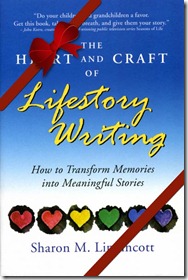
book-giftIf you, like Santa, are making a list and checking it twice, here’s a gift idea for adult relatives: stick a copy of The Heart and Craft of Lifestory Writing in their stocking.

This gift is a way of urging them to record their stories for you and the future. While you’re at it, order a copy for yourself. While you may not be able to crank out the story of your entire life in the next six weeks, you can begin now with a single story or two. If you write two pages a week, you’ll have six hundred pages in two years.

Amazon has dozens of books explaining how to write lifestories, and all have merit. In fact, I encourage anyone who is serious about writing lifestory, autobiography or memoir to read several.  I also encourage them to begin with mine, which is the most comprehensive I’ve found.

In addition to the usual guidelines for writing stories, here’s a list of features that set The Heart and Craft of Lifestory Writing apart:

  • Start-to-finish instructions on planning writing projects, whether you want to write a simple story about a single incident or a complete history of your life.
  • Guidelines for finding your personal writing style, whether you are a spontaneous binge writer, or someone who likes an orderly, little-bit-at-a-time process.
  • Simple explanations of elements that bring stories to life like description, strong beginnings and endings, including personal reflection, and more.
  • Concise overview of grammar and punctuation. Everything the average writer needs is covered in a one place.
  • Layout guidelines with step-by-step instructions for using your computer to prepare attractive printed pages.
  • Self-publishing overview explains the basics of preparing finished volumes of stories or memoir for uploading to free Print-on-Demand (POD) publishing sites like Amazon’s CreateSpace.
  • Extensive list of writing prompts to trigger memories about any stage of life.

Please understand: this book is not intended to be read cover-to-cover, non-stop. It’s a user manual for the writing process. Read some, then write. Then read more. Repeat until your project is finished. Then read again and start another volume. It’s addictive!

Write now: click here and enter ordering information for several copies of  The Heart and Craft of Lifestory Writing! Then write notes for each recipient explaining that you’ll never be able to remember or tell their stories the way they do, and you hope they’ll write them down as a legacy of family history. Explain that it’s okay if they write these stories as a series of letters. The book will show them how to get started.

How I Realized that Poetry Alone Was Not Enough to Convey the Story in My Memoir

Guest Post by Madelyn Sharples

dust-jacket-cmyk.epsMadeline Sharples’ memoir began as a collection of poems, that she thought would suffice to record her memories of living with her son’s bipolar disorder and subsequent suicide. In this invited post she explains how she realized poetry alone would not suffice.

My memoir, Leaving the Hall Light On: a Mother’s Memoir of Living with Her Son’s Bipolar Disorder and Surviving His Suicide consists of a mix of prose, poetry, and photos. And if I could have put music into it I would have.

I originally dreamed about publishing a memoir in poems. I had a finished poetry manuscript early on and since poetry came out almost miraculously from my pen soon after my son died, I thought telling his and my story in poems would be most appropriate.

But I was soon convinced the poems could not stand-alone. My book would lack the details, characterization depth, and the thoughts and feelings of my husband Bob and surviving son Ben that were necessary in the telling of our whole family’s story. The poems provided the chapter themes and emotional impact, the prose provided the details and descriptions, and the photos helped to make the story seem more real.

Early on my son Ben introduced me to a former literary agent who asked to read the poetry manuscript. After her reading she suggested I use the order of the poems as a way to organize my book’s chapters. And that organization stayed mostly intact in the final book manuscript. This young woman also generously gave me writing prompts that helped me flesh out my story in prose. I worked with her in developing the first draft of my memoir for about a year.

As I began to introduce more prose into the manuscript, using my huge supply of journal entries, pieces I wrote in various writing classes, and my advisor’s wonderful writing prompts, I formed chapters each starting with a poem. Then I began to worry that interested agents would reject my book because of the poetry. That concern was not unfounded. As I looked for appropriate agents I found more and more who did not want to be involved in poetry books in any way. I even work-shopped the book and was advised by my instructor to take the poems out.

I also remembered the words of a good friend. She told me no one had the right to tell me that I had to take something out of my book if I, the author, felt it belonged in it. So, I kept the poems in although I didn’t mention their existence in my query letters. I thought I’d discuss the poetry later if it ever came up. Even then I was still waffling about leaving them in or taking them out.

Although I never found an agent to represent my book, I happily contracted with a small traditional press. My publisher asked me to revise my book in many ways, but her only suggestion about the poetry in the book was that I should add more. She resonated with my final decision to include poetry in my memoir.

Madeline-SharplesMadeline Sharples studied journalism in high school and college and wrote for the high school newspaper, but only started to fulfill her dream to work as a creative writer and journalist late in life. Her memoir, Leaving the Hall Light On: A Mother’s Memoir of Living with Her Son’s Bipolar Disorder and Surviving His Suicide, tells the steps she took in living with the loss of her oldest son, first and foremost that she chose to live and take care of herself as a woman, wife, mother, and writer. She hopes that her story will inspire others to find ways to survive their own tragic experiences.

Madeline’s mission since the death of her son is to raise awareness, educate, and erase the stigma of mental illness and suicide in hopes of saving lives. She and her husband of forty plus years live in Manhattan Beach, California, a small beach community south of Los Angeles. Her younger son Ben lives in Santa Monica, California with his wife Marissa. Click to visit Madeline’s blog, Choices, and on Red Room.com.

Read my Amazon.com review of Leaving the Hall Light On.

Write now: if you write poetry, find a poem or few and write a narrative version of the story they tell. Those like me, who lack the poetry gene or muse, can find a photo and do the same exercise.

Finding Starts in Personal Essay Writing, Part 2

writing-essaysIn the previous post, noted essay expert Sheila Bender introduced the concept of essay writing as an adventure of personal discovery. In this second of three parts, she continues with two more freewrite prompts.

A Second Freewrite

After writing from where you are, imagine yourself inside a place you can’t really write from, the pantry in your kitchen, a drawer, or perhaps a window box:

If I were sitting in the window box under the leaves of the trailing geraniums, I would look down at the impossible height and draw in my legs under my chin.  Would I feel cramped under scalloped leaves, next to the segmented stems?  Would a pink petal form a little rug at my feet or blanket my knees?  Nothing could protect me from the onrush of the watering hose, the torrents, the floods.  Would I sink into the spongy earth to arise like a swamp monster or get washed overboard to a new destiny, landing perhaps upon the heavenly bamboo or the thorny bougainvillea?

A Third Freewrite

Now open something in print and let your eye fall somewhere on the page. Use the words your eye falls upon as an opening for your writing. When I did this exercise last, I randomly opened William Kittredge’s collection of essays, Who Owns the West? to page 67 and pointed to these words:

Tess had worn a little path around the grave. She went down there and talked to him, she said. "I tell him the news," she said.  "Like all of us, Ray was given to a love of gossip and scandal.”

Knowing this passage was about mourning short story writer Raymond Carver, whose stories I had recently taught to an intro to fiction class, I wrote:

Like all of us, author Raymond Carver was given to a love of gossip and scandal. Although I never knew him, I’ve read and enjoyed his short stories, even taught one in particular, “The Cathedral.”  In this story, a narrator tells about the overnight visit of his wife’s former boss, a blind man from Seattle.  The narrator is a narrow-minded man with little real connection to others, and in the course of the evening, he does enjoy a moment of pure human (and therefore cosmic) connection with the blind man as they draw a cathedral together.  And gossip does seem to be a way of thinking in this story—the narrator uses all he has heard from his wife about this man to build notions about blindness that keep him from entering the moment.  I can certainly identify since I keep myself from living in the moment by leaning on structures in my mind.  One of those is the to-do list I seem to carry perpetually:

There are clothes at the cleaners waiting to be picked up, food to be found at the market, a resume to update and send out, and evening plans that require I bring a dish for the meal.  I have a set of papers to grade and more email than I want to answer at the moment waiting on the spool.  The cats are out of food and I have forgotten to cut their nails this month so they are sharp and leave scratches when they launch from my lap after a moth or a fly.  The outdoor plants need watering, on all three levels of my home.  The jasmine is in bloom.  I should fertilize.  Measure, mix, fill the jug, lift the heavy thing and hear the water rush into the pots.  Too much overflow in the dishes beneath the plants. Must empty that. They don’t like to get their feet wet, my horticultural friend reminded me.  No blooms on the bougainvillea, perhaps over watering.  Container gardening—there are rewards but the plants suffer if I am not attentive—cold roots, wet roots, underfed, overfed.  White fly, aphids. Bites out of leaves from something else I haven’t seen.  Somehow, the plants survive.  Like me!

Next post: In “Mining the Three Freewrites”, Sheila will conclude with instructions on how to tap the power of these freewrites to find a “new way of knowing” on the page.

Sheila Bender is the author of over a dozen books, including her newest Behind Us the Way Grows Wider: New and Collected Poems, A New Theology: Turning to Poetry in a Time of Grief, Creative Writing Demystified and Writing and Publishing Personal Essays. To learn more about her books and her online classes and instruction, visit http://www.writingitreal.com.

.

Finding Starts in Personal Essay Writing, Part 1

SheilaBenderToday’s post is the first of a three-part series by noted author Sheila Bender. Sheila has become one of the leading national experts on writing personal essays. Her book, Writing and Publishing Personal Essays, is in its second edition. With her books, her online classes, coaching, and myriad of other services, she has helped thousands benefit from the humble art of personal essay.

Although it might not be obvious, those of us who write personal essays can benefit greatly from not knowing what we have to write about.  That is surprising to people who think of the essay as researched knowledge with a professorial, didactic tone.  But to write an essay is really to “assay” or test out a hypothesis about something.  If writers walk around with a head full of ideas and think they have to commit to writing them, they miss the hypothesis part of the process, the part about finding something of interest to test.  In other words, the essay is an exploration, not an initial knowing.  Because of this, I like to utilize exercises for finding topics that model not knowing as a way of beginning essays.

After the following directions for a series of three freewrites, I will show you how to mine the collection of material you create to discover your hidden essay topic.

First Freewrite

Go to a place you have not previously come to write.  It can be the corner of a room or a chair facing a different window than you usually face; you might sit at a café or park bench new to you, or even your car will work if you do park somewhere other than your habitual spot.  In fact, just getting out of the driver’s seat and sitting in a passenger seat could make any parking spot new for the purposes of this freewrite.

Begin your freewriting by describing where you are and what you see where you are.  You can add in what you think you will be able to see in the near future.  Then involve your other senses to stay “in scene” and really deliver the experience of the place you are describing. A sound or sight, smell or texture, or even the taste of something you are eating or have waiting for you for lunch will offer new experience and associations.  So stay specific. Don’t be cursory.  Don’t write, “Here I am again writing before I go into work and there are cars as usual and I am tired as usual.” Instead stay in the moment and record details from where you are:

Here I am again writing in my journal before I go into work and I am parked dangerously close to the white line that separates my space from the next car’s slot.  That spot is empty now but within minutes someone will drive in and our cars shall remain close, shoulder-to-shoulder, for the eight hours of the workday.  I hear the fibers of my wool scarf like Velcro releasing as I pull the scarf from off my coat collar and I smell the boiled egg I’ve packed in my lunch today and think of the animals that have scent glands and release smells as warning or to mark territory like this sandwich might if I let it out on my desk. When I open the car door, pulling the hard plastic handle will be like a handshake I don’t quite want to make with a person I must depart from though I don’t feel our business is done.  I will leave my scarf in the car so I don’t later forget to replace it around my neck.  What secrets does it keep wrapped up here on the seat till I return?  I will enter the cement-chilled air of the basement garage heading toward the chrome-lined elevator.  I will go up and up, hoping the crowd of my thoughts will stay warm and hatching until I return.

Next post: Instructions and prompts for two more freewrites.

Sheila Bender is the author of over a dozen books, including her newest Behind Us the Way Grows Wider: New and Collected Poems, A New Theology: Turning to Poetry in a Time of Grief, Creative Writing Demystified and Writing and Publishing Personal Essays. To learn more about her books and her online classes and instruction, visit  http://www.writingitreal.com.

What’s the Difference Between an Essay and a Story?

EssayStory

Basically, story and essay are labels defining two ends of a spectrum of focus ranging from thinking to acting. Both are components of Story, an umbrella category that essentially comprises the operating system of the human brain. We use Story to make sense of life and the world we live in. Story explains how things fit together. It explains what happened and helps us predict what might happen next. It defines our place in the cosmic order. Story provides identity on all levels from “child of …” to “best friends forever” to “writer” to “This Is MY Country …”

As common usage has evolved over the last few decades, the term essay, specifically personal essay, has come to refer to relatively short compositions expressing the writer’s beliefs, values, and opinions about events, experiences and meaningful topics. Writing an essay is generally an adventure in self-understanding, as these beliefs and opinions may change as they are clearly articulated and organized on the page.

Story, specifically life story, generally focuses more on experiences and events as such.

Traditionally essays were confined to strict reason. Stories on the other hand had plots, action, drama, dialogue, all the elements that keep a person’s heart pumping and eyes locked on the page.

These differences began to disappear in the 1980s as the new genre of creative nonfiction began to emerge. Creative non-fiction has paved the way for the essayist to include personal opinions and experience. Today personal essay is as likely as story to have dialogue, description and action, perhaps even plot, so differences blur and become a bit meaningless. But the terms still exist in the general vocabulary and still serve some purpose.

Circling back to the earlier concept of a continuous spectrum, I see essay as a useful term for describing writing that focuses primarily on values, attitudes, beliefs, stories about what and how we think. At the other end, those compositions we generally think of as stories tend to focus more on action and experience — what happened.

The spectrum illustrates the fact that essays need to include at least a little bit of action or experience to provide context for thoughts. Readers want to know what happened to lead you to your current beliefs. They want to know the “story” of that belief. Likewise, stories that don’t include a certain amount of reflection and interpretation seem shallow and leave readers wondering how you felt and thought about the situation.

In general, personal essays are well-suited for the overall purpose of Story in making sense of experiences and perceptions. The essay writing process helps arrange reflective fragments into insights and coherent story. Once this basic understanding is in place, it can be embellished and polished into a work of art by employing description, dialogue, plot, and other tools that add impact for readers.

Stories that connect with readers will have it all: action and reflection artfully blended with all the elements that add impact. They’ll sit somewhere along the center of that spectrum.

You could start at either end to write these stories. Perhaps a journal entry about a puzzling situation inspires a story. Perhaps writing the story of an exciting situation prompts you to begin digging deeper into your feelings about it. There is no formula for concocting these powerful stories, but there are lots of inspiring ideas.

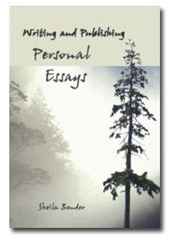
You can easily find mountains of books with guidelines for writing stories, but I have found only three that focus on writing non-academic personal essays. Sheila Bender’s Writing and Publishing Personal Essays is a classic, now in its second edition. Sheila has graciously agreed to share some starter ideas for writing personal essays in the next three posts here. Stay tuned!

Write now: read back through a few stories or scenes from your memoir and notice how much content addresses your thoughts about events and experiences in the stories.

Your Journal: a Treasure Chest of Memories

WeekByWeek cov

Amber Starfire is a valued colleague who shares my passion for life writing and photography. Her recently published book, Week by Week is a treasure trove of tips and prompts to supercharge your journaling. (Read my review here.) In this guest post Amber gives tips on how to get even more value from past entries as you work on lifestories and memoir.

Journal writing is good for so many things: sorting out problems, recording life events, healing, self-reflection, and personal growth. Often, we process events and emotions in writing and then stack them on a shelf or in a box and forget about them. We rarely make use of our previous entries.

So, what would you say if I were to tell you that your journals are full of precious memoir-writing gems just waiting to be discovered? Journals are wonderful places where images, metaphor, sensory details, as well as stories about events, people, and places are mixed in with the emotional ups and downs of daily life.

Try this: Browse journal entries from a previous year or month with an eye to noticing images you've included. Do any specific, seemingly inconsequential details strike you now? Something that stays in memory? Perhaps you wrote about seeing the cat cross the hallway during the time of the event, or the way the sunlight slanted across the living room floor, or the teapot on the table. Perhaps a particular detail carries emotional resonance: the lift of your mother's eyebrow, the pain in your son's eyes, the sparkle in a little girl's eyes. All of these images have significance—or you wouldn't have recorded them. The trick may be to understand why they were important enough to write down.

Once you find one of these gems, here are a few journaling prompts and ideas to help you dig more deeply into its meaning.

  • What sensory details (smell, sound, sight) are included in what you wrote? What emotions and/or associations with other memories arise as you read that passage?
  • If the image or scene involves action, write more now about that action, adding as much detail as you can remember. What part of the action carries the greatest emotional charge—is most fulfilling, dangerous, scary or exciting?
  • What does the image/memory represent? For example, you might associate the image of a red skirt with defiance. The metaphor then is, defiance is a red skirt. You can then play in your journal with ways to extend that metaphor. For example, When worn short and daring, it may reveal more than you intend, or it shouts to be noticed.
  • Is there a person in your memory to whom you assign that image—someone who wore a red skirt? Make a list of that person's physical and psychological characteristics. How many of these characteristics relate to that image, and why?
  • Do a word association exercise with a word that stands for the image. For example, if you wrote about the force of the wind on a particular day, you might use either the word "force" or the word "wind." Write the word at the top of your journal page. Then quickly write down the first word that pops into your head. Write the next word, and the next. Keep writing words, without censoring (it's okay to repeat), until no more words come into your mind and you feel quiet. Then look over the list of words. What do you notice about the list as a whole? Does it have a mood? A color? A shape? Does it make you think about something else that happened in your life?

Ways to mine your journal entries for memoir writing, and ways to use your journaling to reflect upon significance of those entries are infinite—limited only by your willingness to engage your mind and imagination. Try a few of the ideas listed above, or create your own. And please leave a comment about what you discovered.

Visit Amber’s website to subscribe to weekly blog updates and sign up for her free 4-week email Journaling 101 class. She will be the featured guest on the May 18 NAMW Member Roundtable: Journaling for Memoir Writers—A Short Course in Writing Deeply. Read more on the NAMW website.

A Picture Can Spark a Thousand Words

Oh_wow Nothing can get words and memories flowing for a life writer quite like a picture. Whether you’re journaling, writing a simple story or crafting a memoir, pictures can bring back memories as fresh as wet paint, and having the picture as a focal point may enable you to revisit the memory from many angles.

The general wisdom is that looking through your own  photo stash will spur memories. I gave an example of how that can work in Photographic Memory Jolts, in October 2007.

Before the days of digital cameras, most people only took photos on special occasions, so reminders of everyday life are rare. Fortunately, there is an alternative: browse through magazines and picture books, or do keyword searches on sites like Flickr.com to find thought-provoking photos.

When you find a picture that resonates with you, tear it out, or copy digital ones into a writing prompt folder. Write about it right away, or stick it in a collection to use when you feel stuck or want to do some freewriting. I pulled the picture above from a pile of illustrations I tore out of magazines a few years ago to use as writing prompts for myself and writing groups. I love the look of astonishment and maybe a few other things on that fresh young face. The pile has served well, and writing from it is a popular group activity.

Whether you find pictures from your own photos or enticing new sources, here are tips for using them to best advantage:

  • Let your mind wander as you look at the picture. Run your eyes over various aspects of it. For example, in the one above, notice the expression on the girl’s face, her wide eyes and gaping mouth, the time of day, the expanse of table. Look at her hair, perfectly combed into cute pony tails.
  • If this is a familiar picture, try to look at it as if you have never seen it before and set aside as many memories as you are able.
  • Assess your feelings about the picture. Do you feel happy? Sad? Anxious? Indifferent?  Excited?
  • Ask yourself what the picture reminds you of.  Make a few notes about any memories that come to mind.
  • If the picture is of someone else, try putting yourself into the other person’s situation. For example, pretend you are the girl in the picture above. What might you be seeing that has your eyes popping? Were you ever in a situation where you reacted like that? Do you think others know she’s there?

After dwelling on the picture and thinking briefly about your reactions and memories or imaginations, begin to freewrite about whatever comes to mind, keeping the picture in sight as you write. You may be surprised at what comes out.

If a picture evokes especially powerful emotions, try writing about it another time or two taking different perspectives each time. Your creativity will get a boost, you may have material for a great new story, and you may have some fascinating and helpful new insight for unclogging a memoir or your life.

Write now: find a pile of old magazines and start a collection of meaningful pictures to use as writing prompts. Keep them loose to reuse, or paste to the page you’re writing one. Alternatively, copy and paste a significant picture into a new document and write about it on your computer.

Metaphor for a New Year

Sidewalk

Pictures make powerful story prompts, and this picture of a  crumbling sidewalk is no exception. It strikes me as a metaphor for our path thorough life and fits with the general theme of the new year and story.

Each New Year’s Day I’m reminded that life is a cyclical process. Each year exists within the “container” of twelve oscillating months that fit on a series of rectangular sheets roughly the shape of a sidewalk slab progressing through the year.

Though some may be similar, no two years are quite the same. Even on a newly poured sidewalk, you’ll find variations from one slab to the next, and by the time a sidewalk reaches the age and condition of this one, the differences among the sections are huge.

Each year in our lives has a story to tell. Although it’s anyone’s guess what it might be, it appears likely that each section of this sidewalk experienced some individually unique stresses, leading to its individual array of cracks, chunks and deformities.

This sidewalk is a visible record of the effects of a year – probably in reality a series of years. Our life writing, whether public or private is a visible record of the effects of years on our lives.

A freshly poured sidewalk traversing a lovely landscape is relatively uninteresting in its apparent uniformity and smoothness. It’s good for roller skating, pushing strollers, and playing hopscotch, but otherwise little more than a convenience for walking from place to place. A life with no challenges would be a dull life indeed.

This sidewalk is full of stories. It has repairs and subsidence and other areas that appear to be intact. Some spots are damp. How did this all happen? Is this the result of natural aging or damage? Has it experienced floods? Did a careless crane drop a wrecking ball? What might that have felt like, and how does the sidewalk see itself now? Various years evoke similar questions.

Looking toward the future, this sidewalk will need further repair to remain safe and useful. Lives sometimes need repair, and writing can be a powerful way to effect it.

Taken as a whole, this sidewalk is traveled by people on their way to a destination. Whatever the condition of the rest of the path, this section presents challenges to keep your balance and avoid stumbling. Some years are like that.

At this point my mind wanders to another task for today or tomorrow: updating my personal timeline – the rough equivalent of adding a new block to the sidewalk of my life. I see the similarity between my timeline and this sidewalk. Each year on my timeline is different. Some years were smooth, some were rough and challenging.

Like this sidewalk, the challenging years are the most intriguing, the most likely to provide insight, and the most likely to intrigue readers if I write about them.

I find a certain sort of dignified beauty in this sidewalk, and also in years of challenge.

Write now: Update your personal timeline. Start one if you don’t have one. Pick a year that was especially challenging and write about it. Describe each of the fragments, and how it came to be. What did it mean to you then, and what lessons have you learned? Use this sidewalk graphic as a prompt if it fits.

Photo credit: Bart Everson

The Tree of Me

Tree-of-MeOn a whim inspired by matroyshka dolls and Growing Old: A Journey of Self-Discovery by Danielle Quinodoz, I decided to make a sketch of my “layers.” I found a tabloid-sized sheet of blank newsprint, picked up a pencil, and within about five minutes this graphic emerged showing my life from beginning to now. For the purposes of sharing and further embellishing, I redrew it with color for the boundaries. It’s still rough, as you can see by the orange blotch in the core that didn’t work out quite as hoped. But that’s okay. This is a source of inspiration and insight, not destined for the living room wall.

I was surprised as could be to see it. I’ve thought for ages about a chronological map of stages of my life. I like this one ever so much better. It’s organic and representative. As Quinodoz points out, I hold all those previous layers within me, but redefine them and cover them with new growth as I go.

When I began, I had no sense of direction. I thought I might be making a graph of roles I play. This emerged on its own. I will still work with the role idea later, as creativity further instructs.

I especially value this form, because within the layers I have space to write thoughts about that era. Here I’ve included rudimentary memories of threads of activity and my emotions and state of mind at the time. The layer boundaries are especially bold and jagged for times of great turmoil and upheaval. My world shifted on its axis at these points. The colors aren’t significant. Note that the boundaries are uneven – like the rings in an actual tree. They serve to organize memory clusters to clarify my sense of them and provide inspiration when I write.

Perhaps I’ll develop this further, but for now it’s a super-rich source of writing prompts, and it basically comprises a life-long memoir-at-a-glance, at least for me. Those cryptic notes won’t mean a lot to anyone else. 

It does show chronology, because the rings expand year-by-year. I didn’t put dates on the ring boundaries, but I could. I could do a lot of things. So can you, if you give this a try. I suggest using even larger paper so you have more room to take your time and make more notes.  I predict that you’ll be pleasantly surprised at the patterns and insights.

Write now: Find a huge sheet of paper or piece of posterboard and make your own cross-section. You  might sketch it roughly in pencil first, then move to the full-size sheet. Add detail and make it rich. Then write about each layer.

Gift from the Heart

StorybookGiftAre you among the growing number of people searching for ideas for more personal, low-budget gift ideas for people on your Christmas or Hannukah  list this year? Many are motivated by the sagging economy, others by a desire to cut down on frivolous consumption and a general shift toward sustainability.

One gift you can give, in place of or in addition to others, is the gift of story. If you already have a pile of life stories and you’ve been thinking about pulling them together into a volume, you have plenty of time to pull it together and place your order by Thanksgiving or shortly after to ensure delivery before Christmas.

If you don’t yet have a pile of stories, you still have time to write several. You could write a personal story for each recipient, recalling a favorite memory of that person and why they are special to you. You might write humorous or poignant stories about your own life or perhaps shared ancestors.You can include essays about your beliefs and values. The list is endless.

Many years ago Thelly Rheam, the original Story Lady from California’s Cardiff on the Sea, began writing short vignette stories documenting her life and lessons she learned, planning to distribute stories she’d written through the year to family members each Christmas. The year she began, she gave each child and grandchild a binder with labeled dividers for each decade in her life and an assortment of stories already filed. In subsequent years, they received envelopes with additional stories and instructions on where to file them in the binder. She has set aside funds and made arrangements for the collection to be printed in bound volumes upon her demise.

Writing a memoir, a rewarding though complex undertaking, is one way to organize your stories, and but it’s far from the only way, and no single memoir can encompass all the stories that come to mind.

In The Heart and Craft of Lifestory Writing you’ll find oodles of ideas for organizing collections I refer to as story albums. These can range from a random assemblage of miscellaneous memories to an compilation of family recipes including the story of each, or a composite of photos and the stories surrounding them. This khelpful book covers all the basics from inception of the idea to writing tips and prompts and layout tips for self-publishing.

Publishing options abound. High-end photobook publishers produce gorgeous full-color volumes, but options for accomanying text are limited, and price soars as page count rises. No-setup fee Print-On-Demand services like CreateSpace or Lulu,  are economical alternatives for commercially printed and bound volumes if black-and-white print is adequate. They can also handle color printing, though at a much higher cost. For special projects, you can print pages at home or a copy shop and put them in binders or similar alternatives.

Thinking outside the box, they don’t have to be printed at all. You could make your own eBook in pdf format, using one of  the free pdf “printers” such as PDF24. Smashwords is a free service that coverts print documents to Kindle and other eBook reader formats.  Or you could use the free Audacity software to digitally recording  yourself reading your stories for an audiobook. Going one step further, you could use the free Windows Live Movie Maker to  combine those recordings with photos and turn them into a movie. Similar applications are available for Macs.

Due to limited space in this post, I can’t expand on individual options. If you have questions about specific ones, please leave a comment and I’ll cover them in a future posts.

However you go about it, give your family the gift of story, for  their reading pleasure and to preserve a legacy of your life.

Write Now:  write a story to share with  at least one person as a gift this holiday season.

A Picture Is Worth a Thousand Stories

tumblerWhat story does this picture tell? I was intrigued when I noticed it on A Writer’s Right to Keep Writing and followed the trail to bingobongo’s source image. I challenge each viewer to add a comment with a couple of sentences answering that question, and to do it before reading any of the other comments. I guarantee you that no two stories will be quite the same. Themes may emerge, but each story will have a unique twist. This illustrates that no two people see or understand the same way, and pictures require clear verbal communication to ensure that everybody is on the same page.

Now and then when we have a little extra time in a writing group, I pull out my folio of a few hundred pictures I’ve clipped to use as prompts for a freewriting exercise. Some are as simple as a single flower blossom. Others are complex scenes. Many feature people doing things or interacting with other people. The instructions are simple:

“Look through the pictures and select one that calls to you. Take a couple if you wish. Look at the picture for a minute or two, then start writing whatever story comes to mind.”

If we have lots of time, we may write for fifteen or twenty minutes, but more likely it will be five or six. No two people write about the same picture, so no two stories are the same. It wouldn’t matter if everyone wrote about the same picture. (No two stories would be the same.) People are always amazed at the depth and quality of the stories that emerge from this exercise. They tend to be rich in detail and highly personal. They always go home with dozens of new entries on their story idea lists.

Sometimes I use these pictures to start a story myself. They are great for smashing through a crusty case of Writer’s Block and they always result in stories I would not have thought to write on my own. Family photos are also a great source of story prompts.

If you want to start a collection of writing prompt pictures to use on your own or share with a group, assemble a selection of magazines, ideally with a wide variety of content and heavily illustrated. The pictures may be photos or any other art. I trim all the words. Other people leave words and sometimes incorporate them into the stories. I’ve used pictures from travel magazines and brochures, sports , history/culture (i.e. Smithsonian, Nat’l Geographic), home décor, cooking, parenting, news, and general interest magazines. Any size will do – half a page is ideal.

Another approach is to hit the web and search for pictures on sites like Flickr, Picasa, or Webshots. Select a topic and use Google’s Images tab to find pictures about it. Unless you plan to publish the picture, copyright doesn’t matter.

Write now:  just for fun or two overcome writer’s block, find one or more pictures and write about them. Begin a collection to share with a writing group, or invite a group f friends and neighbors to join you for an evening of writing fun.

Picture credit: bongobingo

The Other Side of the Story


Matilda Butler runs a column of writing prompts on the Women's Memoirs site. The current one is about point of view and includes some gorgeous photos of Mt. Shasta that visually illustrate her points. She suggests writing about an experience from your own original point of view, and then again from your current one. As an additional twist, you can write again from someone else's point of view.

I was not thinking of this exercise when I wrote the following mini-essay in an e-mail to a friend. As I read over it before sending, it came to mind. I realized that in a very few words, I covered all three of those angles. Can you find them? They are somewhat interwoven, which is a good way to make your writing sound organic.

Back in the '60s when we were newly weds and living in an $85-per-month ground-floor apartment in Boston, Frau Levy, a sturdily built German-Jewish woman, lived above us. Though she was barely five feet tall in her stocking feet, she sounded like an elephant thumping around overhead. A jingle kept running through my mind, to the tune of “Flow Gently, Sweet Afton” (aka “Away in a Manger”): “Tread lightly Frau Levy, we live down below.” Fortunately she did not keep us awake at night. I have no idea if Jack Paar (later Johnny Carson) kept her awake ‘til midnight — we did try to be good neighbors by keeping the volume as low as possible.
I never spoke with Frau Levy. I knew her name only from the label on her mailbox. I don't even know if she spoke English, though she must have known some. Everyone else in the building—several women and a couple of men—was old, and I didn't know a single one. I assumed they were refugees from Hitler. What a shame. If I'd gotten acquainted I could have become fluent in German (or were those Yiddish fragments I heard?) instead of being unable to say Guten Morgen understandably after two years of classes, and I could have learned enough to fill volumes about their refugee experience before and after they fled. But I was afraid of my shadow back then, and they seemed as strange and arcane as visitors from outer space. I had no idea what to say to them. I'm sure this went both ways. From their point of view, even if they did speak English, what could they possibly have had in common with a ditsy shiksa who was young enough to be their granddaughter and barely nodded their way in the hall?
Those two paragraphs flowed forth in about three minutes. Looking back over them reminded me that I didn’t always look at things from the other person’s point of view, and it doesn’t always fit smoothly into the flow of a story when I do. Perhaps the fact that I was writing to convey a specific message wove things together naturally here. For those times when it doesn't come naturally, exercises like Matilda’s are especially valuable.

Write now: take five minutes (I spent even less on the two paragraphs I wrote) and write a mini story like the one above with all three points of view — then, now and other. Let them flow naturally and add a dash of description while you are at it. Make it a mini-essay.

What's the Lesson Here?


 Light Chaos by Kevin Dooley
I don’t know if it’s the magnetic forces building as we slide into the core of the Milky Way, or maybe I'm wearing a sign on my virtual back that says “Trash My ’Puter” or something like that. My desktop machine (Hotshot) has lost the ability to record sound (think “Podcast Impossible”). Jack, my middle-aged ’Puter Wizard, is in the midst of finals week, and doesn’t want to hear my whining, or even take my money. He does his best to keep me self-empowered anyway. He assures me the sound card does work, so it's a Windows thing, and I “just” need to do a clean install and rebuild the system.

“NO!” I yell into the phone. “NOT THAT!” I have, oh, maybe 120 programs installed — true, half can be dumped — but it takes days to rebuild my system.

“Deal with it,” he tells me, in much kinder words.

Adding insult to injury, last night I discovered my laptop no longer recognizes our home network. The CMU wireless network I connected to Tuesday afternoon fried this function, and I can’t connect to the hard drive on Hotshot where I store all my files. This has happened before, and I’ve always relied on System Restore to make things right. System Restore has let me down. It looks as if a fresh installation of Vista is in the cards for the laptop. This system is less complicated and will only take one day. It's been acting wiggy anyway.

How’s a person supposed to find time to write?

After a quick test for compatibility and further consultation with Wizard Jack, I've resolved to replace Hotshot’s aging XP brain with Windows 7. I have to reformat and rebuild her anyway, and this should extend her life another couple of years. So add learning a new operating system to this mix I just described.

In case life weren't already exciting enough, my hubby just ordered parts for Jack to build him a new system (and I know who is going to end up holding whose hand while he installs his favorite apps), and the ophthalmologist who was scheduled to perform cataract surgery on my eyes in less than two  weeks just decided to hand me off to “someone better qualified” which will result in an additional delay of around two months. My head is spinning.

I seriously consider zipping up my down-lined red parka (red will fend off the deer hunters slipping through the woods just now) and going out to sit on a stump under our tri-centenarian oak, sucking my thumb, chanting, and rocking until I turn numb from the cold and . . . 

Wait! Sarabelle is saving me from myself. She just started a banner scrolling through my mind: What’s the message here? What are you supposed to learn? What’s the story? Ah, yes! The message. The story. Am I living my beliefs to the hilt? What sort of messages am I showering myself with? What would I like to have happen as a result of this craziness? These questions sent me scampering for my journal.

This is the true value of life writing: to write my heart out in times like this, to get these thoughts on the page where I can see them and work with them, and defuse their ability to sting and cause chaos. And in the process I’m certain to discover amazing ideas and answers.

Write now:
make a list of questions you’d like to have answered about an area of chaos in your life — past, present or future. Use those questions as journaling prompts, then write a short essay about what you hope and expect to see happen.

Hitting the Bullseye


For most of my life I’ve thought of my father as a background person in my life. He was always around, eating dinner with the family every night, taking us on picnic and camping trips, and occasionally directing my sister and me to clean up the kitchen on nights my mother may not have bothered. He was handy to have around for help on math homework in high school.

But he was not much of a conversationalist, and much of our interaction took place through the filter of my mother. For example, she would tell me, “Your father doesn’t like thus and such,” or “Your father thinks you should do this or that.”

As I wrote The Albuquerque Years, I recalled all sort of things I did with my daddy as a very young girl. I “helped” him irrigate and tend the garden. I watched as he killed chickens for Sunday dinner. I rode in the basket of his bicycle to get fruit from the stand up the road. I rode on his shoulders. I learned how to take pictures. I tricked him with a fake yoyo on April Fool’s Day. I regretted that these memories of direct involvement seemed to taper off as I grew older.

A few minutes ago I began skimming a free pdf version of Paulo Coelho’s book The Way of the Bow that I downloaded from his website. As I read the description on page nine of Tetsuya stringing his bow, I recalled the long-forgotten yellow bows and arrows my father gave my sister and me when I was nine or ten. I don’t remember the occasion, but I do remember spending hours and hours over a period of years trying to perfect my aim.

With that memory dozens more came pouring forth, and suddenly I’m suffused with the most delightful realization that although he may not have shown it openly, he always loved me more than I would have imagined. I never doubted that — I was just not fully aware of the extent of it. This memory hit a bullseye in my heart! I’m simply aglow with gratitude and joy.

I doubt I ever would have stumbled across this discovery if I hadn’t spent so much time writing and thinking deeply about various memories. Individual stories were a good way to start this process, and I’m finding that going on to the next step of integrating those vignettes into a more comprehensive overview is deepening the results and insights.

When I first began what I now recognize as the practice of life writing, I had no idea that it would be come a lifelong pursuit. I thought I could just write a few stories — maybe even one hundred
and be done with it. I can no longer count the number of stories I've written, but the last time I did, the total exceeded seven hundred, and I've just begun to write. Now I realize that the longer I stick with it, the deeper I write and see, and the happier and more peaceful I feel. The positive effects reach every corner of my life, and I can’t imagine not spending time at least several days a week on this ongoing exploration.

Write now: make a list of memories of happy times spent with a special person in your life. Use this to write a paragraph or two or longer story about each memory, or as journal prompts.